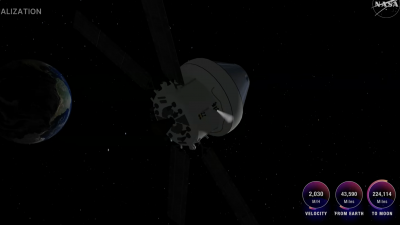
The telescope Two-meter Twin Telescope (TTT) at the Observatorio del Teide has captured images this Friday images this Friday of the Orion spacecraft of the Artemis II mission of NASA during its transit through cislunar space, just hours after the translunar injection maneuver.
The images have been captured between 04:27 and 04:29 hours by the aforementioned robotic telescope, which operates Light Bridges at the Teide Observatory of the Canary Islands Astrophysics Institute, as reported by the scientific entity in a note.
At the time of observation, the spacecraft was approximately 65,000 kilometers from Earth and was moving at a speed of 10,800 kilometers per hour, approximately 3 kilometers per second, with a visual magnitude of V = 11.5, which placed it within reach of small and medium-sized telescopes, although its rapid angular movement required the high-precision tracking system of the two-meter robotic telescope TTT3.
Artemis II is the first crewed mission of NASA's Artemis program, with a crew of four astronauts aboard the Orion capsule, which performs a free lunar flyby trajectory at a maximum distance from the Moon of about 10,000 kilometers, as a preliminary step to the moon landing planned in subsequent missions of the program.
The observation was performed with the FERVOR-M instrument —a high-sensitivity and high-cadence sCMOS scientific camera— installed in one of the Nasmyth foci of the TTT3, with a sequence of 200 exposures of 0.4 seconds each.
The TTT3 is a 2-meter aperture Ritchey-Chrétien telescope that operates in a completely robotic and autonomous way, managed by the intelligent system ROBOTQOP (Robotic Telescope Observation Queue Optimization, from the English ROBOtic Telescope Queue OPtimization), developed by Light Bridges.
This observation demonstrates the unique ability of TTT telescopes to detect and track artificial objects in cislunar space —the region between Earth and the Moon—, a spatial domain of growing strategic, scientific, and economic relevance.
The TTT system combines high pointing speed, sub-arcsecond astrometric precision, and stable millimagnitude-level photometry, which makes it a top-tier infrastructure for tracking artificial objects, including satellites, spacecraft, and space debris, cislunar domain surveillance, and planetary defense, adds Light Bridges.



Add La Voz de Lanzarote as a preferred Google source.
Stay informed with the latest current news.