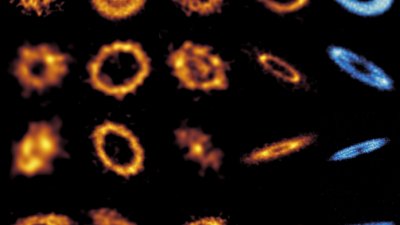
An international team of astronomers, with the participation of the University of La Laguna (ULL) and the Canary Islands Institute of Astrophysics (IAC), has captured for the first time the details of the "adolescence" of planetary systems, a period that has long been shrouded in mystery.
The study, named the Atacama Large Millimeter/submillimeter Array (ALMA) survey to Resolve exoKuiper belt Substructures (ARKS), is based on a series of ten articles published simultaneously in the journal Astronomy and Astrophysics and was carried out with the Atacama Large Millimeter/submillimeter Array (ALMA).
Thanks to this work, the sharpest images to date of 24 debris disks, the dust belts left over from planet formation, have been obtained, the IAC reports in a statement.
These disks are the cosmic equivalent of planetary system adolescence: somewhat more developed than planet-forming disks, but not yet mature.
According to the IAC, these findings from the ARKS project are very valuable for the search for young planets and the understanding of how they form and reorganize into families, like the planets in the Solar System.In this regard, Carlos del Burgo, a researcher at the ULL and IAC and a member of the ARKS project, highlights ALMA's potential for revealing structures in disks, as it allows for increasingly sharp observations that can be combined with radial velocity curves and light curves to improve the characterization of these emerging worlds
Meredith Hughes, associate professor of astronomy at Wesleyan University (USA) and co-leader of this study, highlights the importance of the project because, while photos of planets in formation have often been seen, adolescence had until now been "a missing link".
The scientist points out that this project offers a new perspective for interpreting the craters of the Moon, the dynamics of the Kuiper Belt, and the growth of large and small planets.
The counterpart to this evolutionary phase in the Solar System is the Kuiper Belt, a ring of icy debris beyond Neptune that preserves a record of **massive collisions and planetary migrations** that occurred billions of years ago.
This new study of 24 exoplanetary debris belts allows for a better understanding of what the Solar System experienced as the Moon formed and the planets made their way to their final positions.
“Teenage” Albums
The IAC explains that debris disks are faint, hundreds or even thousands of times fainter than the bright, gas-rich disks where planets form.
The ARKS team overcame the challenge of producing unprecedentedly detailed images of these disks, as these faint disks have managed to hide from astronomers for years, but thanks to ALMA, it is now possible to observe their complex structures
These are formed by belts with multiple rings, wide and smooth halos, sharp edges, and even unexpected arcs and structures.
"We are observing great diversity: not only simple rings, but belts with multiple rings, halos, and strong asymmetries, which reveal a dynamic and complex chapter in planetary history," adds Sebastián Marino, leader of the ARKS program and associate professor at the University of Exeter (United Kingdom).
The research has confirmed that a third of the observed disks show clear substructures (multiple rings or distinctive gaps) that could have formed in earlier stages of planetary formation or were sculpted by planets over much longer timescales.
While some disks inherit intricate structures, others smooth out and extend into broad belts, similar to how the Solar System is expected to have developed
Furthermore, many disks show evidence of calm and chaotic zones, with vertically "puffed up" regions, similar to the mix of classical Kuiper Belt objects in the solar system and those scattered by Neptune's past migration.
It has also been observed that several disks retain gas for much longer than expected, and in some systems, the residual gas can influence the chemical composition of growing planets or even displace dust into wide halos.
The IAC indicates that ARKS's results show that this adolescent stage is a period of transition and turmoil.
The ARKS project is the work of an international team of approximately 60 scientists, led by the University of Exeter, Trinity College Dublin, and Wesleyan University, with participation from the ULL and the IAC.



Add La Voz de Lanzarote as a preferred Google source.
Stay informed with the latest current news.