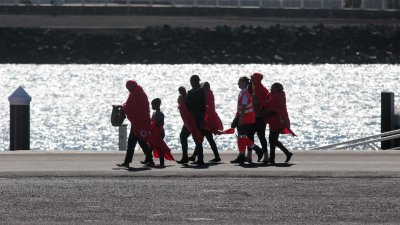
This 2025 will go down in history for many as the year Spain brought a solution for unaccompanied migrant children and adolescents to the Official State Gazette (BOE), but its implementation has been marred by political battles and the standoff between the autonomous communities and the Government.
A year in which immigration management has occupied a large part of the political debate, with Vox once again making its anti-immigration discourse its banner and a PP that has significantly toughened its messages and proposals on the matter.It is the year in which the Supreme Court reprimanded the Government to assume the guardianship of minor asylum seekers, but also the year of the racist riots in Torre Pacheco (Murcia) and the one that ends with the eviction without alternative solution of 400 people who occupied a building in Badalona (Barcelona)
Relocations by decree due to regional refusal
After months of negotiations, on March 18, the Council of Ministers approved the royal decree-law that modified the foreign law to establish, for the first time in Spain, a mandatory distribution of the reception of migrant minors among all the communities.
The objective was to alleviate those with more migratory pressure - especially the Canary Islands, which housed 5,566 minors at the beginning of the year - with a mechanism to relocate some 3,000 children and adolescents from this archipelago, Ceuta, and Melilla to other territories based on criteria such as population or per capita income.
This model encountered the outright opposition of most communities (almost all of them from the PP, but also from Castilla-La Mancha), which consider it a unilaterally imposed system that does not take into account the reality of their systems, which they also say are collapsing, and for which funding is lacking.
Nine autonomous communities have appealed the regulation before the Constitutional Court, and some, like Aragon, the Valencian Community, the Balearic Islands, or Andalusia, have challenged several executive decisions on the matter before the Supreme Court.
Tension reached its peak on July 17, when PP communities snubbed the Ministry of Childhood at a Sectoral Conference that was supposed to address this issue.
Despite the attempted blockade, the Executive launched the system, which began operating at the end of August and has served to transfer at least 342 young people: 166 from Ceuta, 155 from the Canary Islands, and 21 from Melilla.
Supreme Court scolds government over refugee children
Also in March, the Supreme Court ordered the central Executive to house all unaccompanied migrant minor asylum seekers that the Canary Islands were attending, using its own resources, a precautionary measure that the archipelago had requested.
The high court gave the government 10 days to fulfill this mission, but it wasn't until November 21st and after two more warnings that the Executive declared the requirement complete after taking in around 700 children and adolescents, mostly from Mali, who had fled armed conflicts, hunger, and the climate crisis alone.
To this scenario, another Supreme Court requirement in the same vein has been added in the last month, this time in relation to the children and young people of the Community of Madrid.To comply with this latest order, the Executive has stated that it will make spaces available at its refugee center in Pozuelo de Alarcón (Madrid), which has been under scrutiny since September, when the City Council decreed its closure due to a lack of license, a decision that the Ministry of Inclusion, Social Security, and Migrations has appealed in court.
Arrivals in the Canary Islands drop by 60%
Irregular arrivals represent a very small part of the country's migration - 94% of foreigners enter Spain through regular channels - but they occupy a significant part of the migration debate and management.
After a record 2024 for arrivals by sea, 35,935 people have entered the country irregularly in 2025, according to the latest report from the Ministry of the Interior, with data up to December 15th, representing an overall decrease of 40.4%, with a 59.9% drop in the case of the Canary Islands.
17,555 migrants have arrived in the archipelago. According to UNHCR data, as of November 30, 416 people have disappeared or died trying to reach the Canary Islands in 2025. The NGO Caminando Fronteras raises this figure to 1,482 victims by May alone in its latest count.
Lower pressure on this route, the first transfers of minors to other communities through the royal decree-law, and the diversion of asylum seekers by Supreme Court order have contributed to the emptying of the islands' minors' centers, although they remain saturated: the Canary Islands have gone from caring for 5,566 at the beginning of the year to 4,506 at the end of 2025.
Arrivals by small boat to the Balearic Islands increase by 27.3%
The case of the Balearic Islands has been different: 7,295 people have arrived by dinghy as of December 15, 27.3% more than in 2024. Furthermore, 57 lifeless bodies have been recovered this 2025 in waters near the Balearic archipelago.
This has had its effect on their reception system for migrant children and minors, and the Balearic government has denounced the saturation of its system on several occasions.
The islands cannot transfer any of their young people to other territories because they do not meet the overcrowding requirements, nor have they received any young people from other communities, as they have filed up to three legal appeals against transfers agreed from the Canary Islands.
In Ceuta, 3,396 people have arrived by land this year (including those who swam ashore), 42.3% more than in 2024, and 44 deceased individuals have been found on its coasts, double the previous year.
The relocation mechanism for minors has eased pressure on the autonomous city with the transfer of 166 children to other territories, but its system remains strained – it currently houses 402 minors – due to arrivals by swimming of children and adolescents: 764 this 2025, 16% less than in 2024.
In the case of Melilla, arrivals by land have increased by 255.4%, from 92 registered by December 15, 2024, to 327 this year.
Violence against migrants 'spills over' from social media: the case of Torre Pacheco
In the realm of social media, hate speech has been inflamed and radicalized this 2025, with a worrying escalation in social polarization and the legitimization of aggressive behaviors that has even had its effect outside the platforms
This trend reached its peak last July in Torre Pacheco (Murcia), when far-right groups mobilized on social media to go to the municipality to hunt migrants after a 68-year-old resident suffered a beating for which three young Moroccans were arrested.
Lights and shadows of the new immigration regulation
2025 has also been the year of the Government's major reform of the immigration regulations, with measures favorable to migrants such as the easing of the "arraigo" (roots) provision but also adverse effects for asylum seekers, a much-criticized aspect that has led some NGOs to appeal the ruling before the Supreme Court.
For 2026, it remains pending for the Government to approve the Intercultural Coexistence and Integration Plan, which the Prime Minister, Pedro Sánchez, announced in October 2024.
The Executive will also have to complete the implementation of the European Pact on Migration and Asylum, which will bring significant changes to our legislation, especially regarding asylum, and has already aroused the suspicions of many social organizations due to the risk of a possible regression in the rights of migrants



Add La Voz de Lanzarote as a preferred Google source.
Stay informed with the latest current news.