
We have recently witnessed how the volcano transforms the territory and changes people's lifestyles, something similar must have happened in the eruptions from 1730 to 1736 in these fertile spots of Mácher.
According to the geological maps of Carracedo, Alex Hansen and Claudio Moreno, the lava flow must have descended taking advantage of the slope and slipped between the mountains of La Asomada and Conil, forming a filament using the ravine bed with some overflows. It crossed Mácher towards the sea through the place where the populous hamlet of El Volcán would later be built.
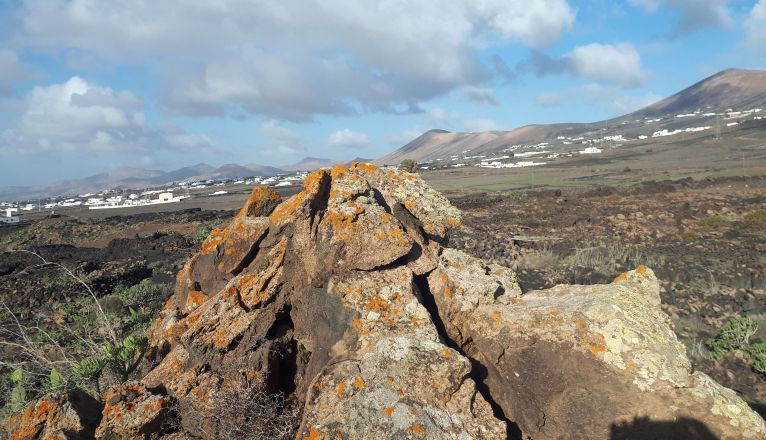
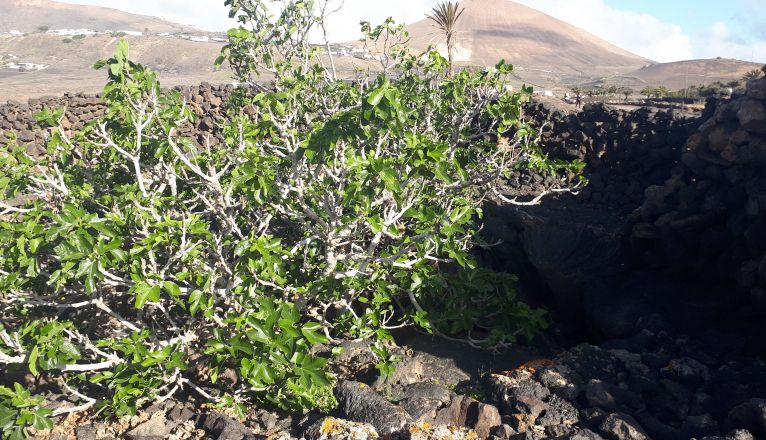
In one of these overflows, the lava spread over a badland of a previous volcano, a place known as Peñas Blancas. Colonization began to develop with the distribution of all the land south of the mountains since the fertile lands of Tras montaña became unusable due to volcanic eruptions. Peñas Blancas is an area where human action on the lava was fundamental to find the bottom of the puddles and find topsoil to plant fig trees, mulberry trees, guava trees, vines, peach trees, prickly pear trees, etc., and in a short period of time the area becomes “the pantry of the municipality of Tías”. Hence the popular saying: “owning a fig tree in Peñas Blancas was like having a treasure and having a vineyard of muscatel grapes was capital”. Large fruit drying areas for fig trees and prickly figs were located in this area to turn them into porretos, which were stored in barrels and constituted a fundamental food for the population in times of drought and, together with chickpea gofio, had great added value. The method of making porreto consisted of sweeping the figs, then peeling them one by one with a knife, a task that was always carried out by women, and then taking them to the drying area. The drying areas had a wall on the volcanic lajial, rubble and a gate were added to prevent animals from entering.
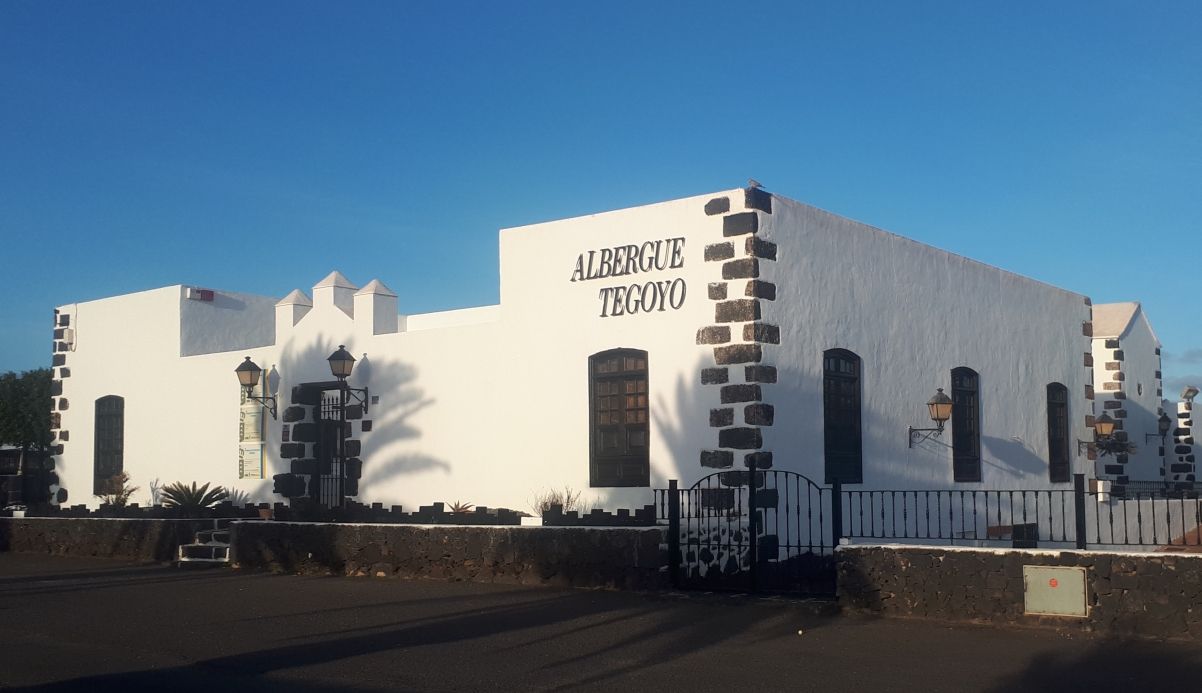
The Tegoyo Municipal Shelter
In this unique setting stands La Casona de Tegoyo, built on the edge of the volcano, and the puddles were used to build cisterns and the lava itself to make the water intakes and other outbuildings, large central patios, orchards above cisterns, its pantries embedded in its wide walls are striking.
The house has a spectacular facade with views of the spacious farmyard of almost three fanegas, which extends to the west. We do not have the exact date of its construction, but it must have been commissioned by its first owners, the Cabrera family, wealthy merchants of grocery stores that appeared since the capital moved to Puerto del Arrecife, and they also had houses in many locations in Lanzarote.
The house and the farmyard are acquired by auction, and pass into the hands of the unique neighbor of Tías, Nemesio Rodríguez Borges. (Tías 1862-Arrecife 1926). Nemesio was the son of José Agustín Rodríguez Rodríguez, the town hall's tax collector and agent, positions he guaranteed with his farms. Agustín was a native of La Oliva and married a Borges lady from Tías. His sons, known as “Los majoreros” Nemesio, Santiago and Rafael, were prominent ranchers and linked to Canarian wrestling, as is the case of Santiago, a good wrestler and stylist. The saga of the majoreros continues in the 20th century in the third generation of “los majoreros” with the sons of Santiago; Mamerto and Ulpiano Rodríguez Pérez, the latter also a prominent wrestler, which is why the wrestling ground in the town of Tías bears his name.
Nemesio emigrated to Argentina where he learned the profession of cook at the Hotel Madrid in Buenos Aires and made a fortune. Upon returning, he bought a house in the square of Arrecife in 1891 and set up the “Pensión Nemesio” or “Hotel del Inglés”. In Francisco González Díaz's book “Thirsty Lands” it is written about Nemesio “that he became rich thanks to sauces, stews, salads and casseroles”. He acquires countless houses in Arrecife and the aforementioned Mácher farmyard. Nemesio married a young woman from San Bartolomé, Genara Perdomo Martín. Later, upon his death in 1926, this house and farmyard passed into the hands of his wife's family.
Since then, it has become known as the farmyard of Don Eloy Perdomo Martín, the farm produces good harvests of tomatoes and chickpeas, according to one of its last sharecroppers, Agapito Reyes.
The house and the farmyard had been abandoned for several years in the sixties and were acquired by the American citizen Malcolm Brooks Davis in 1971. The American would make some small interventions in its forges and lintels.
The Tías town hall acquired it in 1988 and in 1994 several phases of restoration began through “Escuela Taller” programs in masonry, carpentry, forging and others, until it became the “Tegoyo Municipal Shelter” at the end of the nineties.


Add La Voz de Lanzarote as a preferred Google source.
Stay informed with the latest current news.