
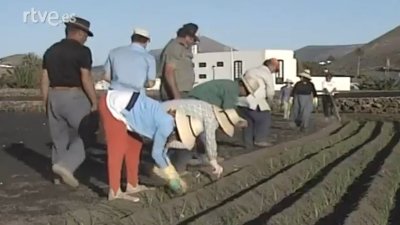
A date that was recorded on tape.
On Saturday, September 9, 1995, TVE broadcast the episode of Atlantes dedicated to Lanzarote. RTVE today preserves the complete recording and accurately records the date, duration—57 minutes and 10 seconds—and the direction of Carlos Pablos Melero. The official file summarizes that Lanzarote as a "volcanic paradise" of ochres, blues, and whites associated with the work of César Manrique.
The existence of the recording makes this event exceptional: we are not only talking about an event noted in a newspaper archive, but an audiovisual document that can still be seen. The island of that day is preserved in motion: landscapes, buildings, people, and ways of life were recorded by a camera that, without knowing it, was constructing memory.
A series that wanted to explain the Canary Islands
Atlantes was a production of the TVE center in the Canary Islands. It consisted of eight episodes: one dedicated to the archipelago as a whole and seven to each of the islands. RTVE itself points out that the series addressed the historical, anthropological, social, cultural, and landscape aspects that defined the Canary Islands. The scripts were written by eight Canarian authors and the series was directed and narrated by Carlos Pablos Melero.
Among the names linked to the project is Dolores Campos-Herrero, a Canarian journalist and screenwriter who developed a large part of her career at TVE in the Canary Islands and who participated as a screenwriter for Atlantes. Her career is particularly significant because she had also lived in Lanzarote and knew part of the island's reality from the inside.
That is why it is more appropriate to understand Atlantes as a cultural look at the islands than as a simple travel program. The Lanzarote that appears on screen is not only that of the visitor: it is also that of memory, territory, popular culture, and those who inhabited the island.
An entire island within 57 minutes
The documentation preserved by Memoria de Lanzarote allows us to reconstruct the extensive journey of the episode. The camera passes through the coast, the Fire Mountains and Timanfaya, Alegranza, La Geria, Papagayo, the Castillo de Las Coloradas, Rubicón, Teguise, Puerto del Carmen, Órzola, the salt flats of Río, Jameos del Agua, Los Valles, Arrecife, Zonzamas, Haría, Arrieta, the Pechiguera lighthouse, and other places.
In Arrecife, spaces appear that we recognize today, but that also allow us to observe the city from the distance of time: the Yellow House, the Bridge of the Balls, the Charco de San Ginés, the church of San Ginés, the Castle of San Gabriel, Real Street, and the Arrecife Gran Hotel. They are not simple names on a list: together they form a kind of audiovisual map of the capital of Lanzarote in the mid-nineties.
The Gran Hotel: an image with a story behind it
There is a detail that takes on special significance when the context is known. The episode includes the Arrecife Gran Hotel and was broadcast in September 1995, less than a year after the fire that had devastated the building on November 21, 1994. The property, inaugurated in 1970 as Lanzarote's first five-star establishment, had closed in 1990 and was abandoned when the fire occurred.
The reference is revealing because it shows the extent to which a historical documentary can capture moments of transition. The camera was not only recording what Lanzarote preserved; it was also filming, perhaps unintentionally, the traces of an island that was undergoing transformation.
The protagonists who are now memory
One of the greatest riches of the episode is that the camera is not limited to landscapes. Memoria de Lanzarote identifies the presence of Juan Brito and Doña Dorotea de Armas, in addition to the traditional Mojón sweethearts.
Dorotea's presence takes on extraordinary value when viewed from the present. Born in 1899, she would die in 1997, just two years after the broadcast. The images from 1995 therefore preserve a woman belonging to a generation that had kept alive traditional forms of craftsmanship and popular culture.
The case of Juan Brito leads to another dimension of Lanzarote's identity: the transmission of memory. The fact that both appear in a television production with national reach makes the documentary more than just a description of the landscape. It is also a small archive of those who helped explain Lanzarote from Lanzarote.
La Graciosa appears when the documentary has already covered almost the entire island
There is another detail that today takes on a special reading: La Graciosa appears approximately in the 50th minute of the documentary. In that journey, it was part of the narrative of Lanzarote as a territory still presented on a much more contained scale.
Returning to those images in 2026 allows for a direct bridge to one of the island's current major debates: how to preserve the appeal of a territory precisely when that appeal increases pressure upon it. The image of La Graciosa in 1995 does not need to be idealized to become a document; it is enough to compare it with the current reality.
1995 was not just any year for Lanzarote
The broadcast of Atlantes must be placed in a very specific context. Lanzarote had been declared a Biosphere Reserve by UNESCO in 1993. Two years later, in April 1995, the island hosted the World Conference on Sustainable Tourism, held at Los Jameos del Agua and supported by international organizations. From that meeting, the first World Charter for Sustainable Tourism was born.
The Charter proposed an idea that is surprisingly relevant today: tourism should reconcile economic development with environmental conservation, respect for cultural identity, and a balanced distribution of its benefits and costs. That is, while TVE was showing that Lanzarote to the rest of Spain, the island itself was participating in an international discussion on how to prevent tourism success from compromising what made the destination attractive.
Thirty years later, the anniversary of that Charter once again placed Lanzarote at the center of the debate. In 2025, new initiatives were promoted to update its principles in the face of issues such as climate change, the circular economy, governance, digitalization, and regenerative tourism.
A comparison that needs no nostalgia
The temptation when revisiting a document from 1995 is to claim that any time in the past was better. This article does not aim to do that. The Lanzarote of that time also had its problems, its contradictions, and its aspirations for growth.
What is interesting is something else: the images allow us to see how much an island has changed in a single generation. Some buildings have changed function or appearance; some protagonists have disappeared; some traditional activities have lost prominence; some places today receive tourist pressure that was much lower then. And, at the same time, many of the keys that made Lanzarote unique continue to be present.
According to data released by Turismo Lanzarote, the island received 3,455,200 tourists in 2025 and surpassed two million visitors between January and July 2026. The figures do not explain the transformation on their own, but they help to understand the magnitude of the tourist phenomenon compared to the Lanzarote that TVE filmed in 1995.
The Lanzarote that was trapped in 57 minutes
Perhaps the true value of Atlantes: Lanzarote is not only in what it intended to tell in 1995, but in what it now allows us to discover. The series wanted to explain an island. Thirty-one years later, we can use it to ask ourselves what island we have built.
Because the camera recorded something that no screenwriter could have foreseen: the passage of time. It recorded people who are no longer here, spaces that have been transformed, customs that have become less visible, and landscapes that we now look at from a different tourist reality.
And therein lies the strength of this anniversary. On September 9, 1995, no major inauguration, battle, or political decision that changed its history occurred in Lanzarote. Something apparently simpler happened: a public television station broadcast a documentary about the island.
But that documentary was saved. And today we can press the play button again.
For 57 minutes and 10 seconds, we can return to the Lanzarote of 1995. Afterwards, we can turn off the screen, go outside, and look at the island of 2026. Each reader will make the comparison.
Documentary Sources
RTVE Play · Atlantes: Lanzarote, broadcast September 9, 1995, duration 57:10, directed by Carlos Pablos Melero. RTVE · Atlantes Series and general production description.
Memoria de Lanzarote · Atlantes Series File. Lanzarote.
Academia Canaria de la Lengua · Biography of Dolores Campos-Herrero.
Memoria de Lanzarote · Documentation on sustainable tourism from 1995 and other audiovisual records. Government of the Canary Islands · Documentation on the 30th anniversary of the World Charter for Sustainable Tourism. Turismo Lanzarote · Visitor data 2025 and 2026.

Add La Voz de Lanzarote as a preferred Google source.
Stay informed with the latest current news.