
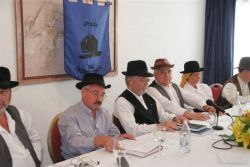
The 1st National Assembly of the Order of the Puppy took place in Lanzarote this weekend. "Lanzarote was chosen because it is a wonderful, fortunate and dignified island", explained Jaime Guinares, president of the Order. "Having held this Assembly in Lanzarote has been a tremendous success," said Marcial Morales, president of the Order in Lanzarote, shortly after. "This will help us relaunch it, as it has been a bit stalled until now." Currently, the Order of the Canarian Puppy has 47 members in Lanzarote, after four years of existence.
During the event, the new members of the Order were baptized and the Puppy of Honor was presented to the El Patio Agricultural Museum. Finally, this 1st National Assembly concluded with the interpretation of the Canarian anthem.
History of the Order of the Canarian Puppy
The history of the Order dates back fourteen years, when it was founded as a "parranda" in Gran Canaria. "Later it was created as an Association where all the activities of rescuing, transmitting, disseminating and living the Canarian customs entered", explained Morales. Little by little, the association has been extending to several islands, until it is located in five of them currently: Tenerife, Gran Canaria, Lanzarote, Fuerteventura and La Gomera. "We intend to collaborate so that the Canarian identity cultural heritage is not only not lost but is promoted, nurtured, cared for and loved," said Jaime Guinares. "That we are a people with roots and sure of ourselves, in order to be able to interdepend on other peoples of the earth who visit us with immigration; it is important that in these circumstances the Canarian people are a united people, where neither political parties, nor religions nor other elements divide us".
Activities to promote Canarian culture
To spread these values and traditions, the Order of the Canarian Puppy promotes some activities on each of the islands. "One of the things we are doing in Fuerteventura and Gran Canaria is to organize school visits to our house, our headquarters, so that our children receive classes in geography, Canarian language, so that they learn traditions such as Canarian wrestling, how gofio is kneaded in the saddlebag or what Canarian ceramics are like.


