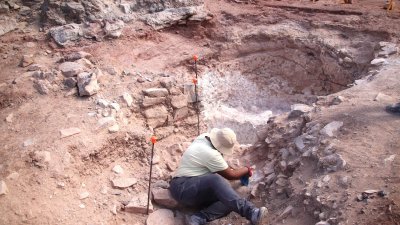
Last Friday, October 25, the excavations of the fifth campaign of archaeological research at the San Marcial de Rubicón site, located in the Los Ajaches Natural Monument, concluded. Since 2019, the two public universities of the Canary Islands, the Yaiza City Council, and the Government of the Canary Islands have been developing it under the scientific direction of Doctors Esther Chávez Álvarez and María del Cristo González Marrero, researchers and professors at the University of La Laguna and the University of Las Palmas de Gran Canaria, respectively, with excavation work in this campaign that has just concluded being directed by Miguel Ángel Hervás Herrera, Nona Perera Betancor, and Luis Alejandro García García.
During the five weeks of arduous and productive fieldwork, alongside these women and men, the visible heads of the research, was a large group of graduates and students from both public universities, as well as five members of the company ML Reyes Servicios SLU.
The mayor of Yaiza, Óscar Noda, points out that "just as it is important to disseminate the results of the research, as we, the entities signing the agreement, have been doing, we also want to publicly exalt the work of the scientific direction and the entire exploration team, also highlighting the performance of the team of professionals, assistants, and municipal workers who were at the site from sunrise to sunset for five weeks."
Mission accomplished
The objectives of this campaign included the excavation of the cemetery found last year and the continuation of work in previously opened areas. Previously, during the months of July and August, surveys were carried out in the surroundings of this historical enclave, the first European settlement in the Canary Islands from the 15th century.
The remains of three individuals, two adults and one child, were exhumed, and it can be confirmed that the southern sector of the necropolis no longer houses any more burials. As happened with the human skeletons found in the previous campaign, these will be subjected to various studies. Obtaining radiocarbon dates will allow us to know when they died, and genetic analyses, which are already being carried out on the previous bone remains, will provide relevant data, such as their possible kinship relationships.
The discovery of a lime kiln is the main novelty of this fifth campaign. The first conclusions of the archaeological work suggest that the kiln was abandoned with the last load inside. The remains of lime and the determination of the charcoals and their subsequent analyses to obtain radiocarbon dates will allow us to know when this last load occurred, and the remains of charcoal will tell us what fuel was used for the fire.
Finally, on one of the rocky ridges of the site, where the remains of a large house were found last year, the excavation confirms that it is a prominent place, with lime floors and stone slabs of considerable size, characteristics that were not part of the domestic habitat located in the sectors of the site excavated in other campaigns.


Add La Voz de Lanzarote as a preferred Google source.
Stay informed with the latest current news.