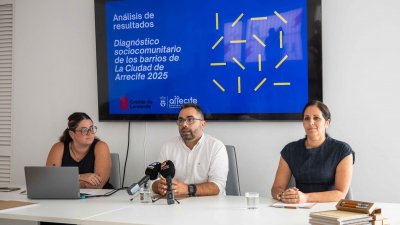
The Deputy Mayor of the Arrecife City Council, Echedey Eugenio, and the Councilor for Citizen Participation, Cathaysa Suárez, presented this Tuesday at the El Zaguán Citizen Participation Center the results of the Socio-Community Diagnosis of the neighborhoods, a study promoted to learn about the social reality of the capital through the voice of its residents and strengthen citizen involvement in public life.
This diagnosis, prepared by researcher Eliana Parrilla, was developed between October 2024 and May 2025, through surveys of more than 550 people and neighborhood meetings in eleven districts of Arrecife. The report reflects a comprehensive view of the quality of life, coexistence, security, and citizen participation, identifying both the strengths and the main challenges of the municipality.
According to the study, 63% of participants consider neighborhood involvement insufficient, and the most frequently cited problems are insecurity, lack of urban maintenance, and a limited supply of meeting or recreational spaces. More than 80% of respondents support the creation of a community center and demand improved communication with the local administration. The conclusions also point to the need to strengthen social cohesion and develop housing, coexistence, and community well-being policies.
During the presentation, the Deputy Mayor, Echedey Eugenio, emphasized that "this diagnosis will not remain a report; it will become a roadmap to guide our public policies based on the real participation of the residents." Eugenio also highlighted that "understanding what citizens feel and think is essential to building a fairer, more inclusive, and cohesive city."
For her part, the Councilor for Citizen Participation, Cathaysa Suárez, highlighted that "for the first time, Arrecife has such a complete study on the life of its neighborhoods, prepared with the direct involvement of citizens." She added that "this diagnosis is a living tool that will guide concrete actions to revitalize sociocultural centers, promote the participation of neighborhood groups, and improve communication between residents and institutions."
The author of the study, Eliana Parrilla, pointed out that "listening to the citizens has been key to building an honest portrait of the challenges and opportunities that Arrecife has. We have found that there is a great desire to get involved, but also the need to create spaces and make it possible." Parrilla insisted that the results "offer a solid basis for designing local urban and community regeneration strategies."
The report proposes measures ranging from urban renewal and improved mobility to revitalizing socio-cultural centers and launching participatory budgets. Its recommendations include the creation of neighborhood coordination tables, support programs for neighborhood associations, and actions to strengthen security and coexistence in the different neighborhoods.
The Department of Citizen Participation conceives this work as a starting point to move towards a more participatory Arrecife, where residents, social entities, and administration share responsibilities and common objectives in the construction of a cohesive city, habitable and committed to its people.


Add La Voz de Lanzarote as a preferred Google source.
Stay informed with the latest current news.