The third day of Routes 2030 was held this Saturday in Tinajo with the aim of endorsing two pioneering projects in the Canary Islands that are being developed in this municipality of Lanzarote and that exemplify the benefits of betting on sustainability in the 46 municipalities of the archipelago affected by the demographic challenge.
The first of these initiatives consists of a tourist mobility plan using electric buses that facilitate access to Tinajo for visitors. The second foresees the execution of a novel irrigation system in this area of the island using a desalination plant and renewable energy.
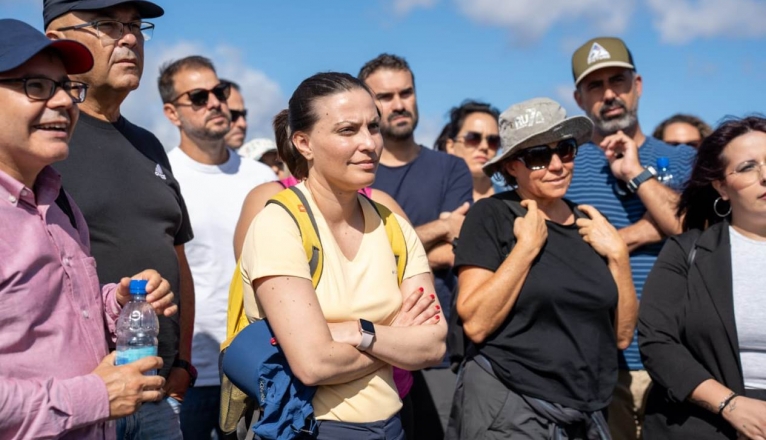
Both projects were presented to a delegation headed by the Minister of Universities, Science, Innovation and Culture, Migdalia Machín, and composed of more than 40 representatives of public administrations and universities, as well as researchers and entrepreneurs in the fields of science, innovation and technological development. Routes 2030 develops a program of activities in the least populated municipalities of the islands to connect them with innovation agents, facilitating the transfer of information and initiatives.
This is the case of the tourist mobility project promoted by the Government of the Canary Islands, the Cabildo of Lanzarote and the City Council of Tinajo, which aims to eliminate areas saturated with private vehicles by launching a circular line of electric buses that will travel through the main places of interest in the municipality. To achieve this, the construction of parking areas is planned where tourists can leave their cars and access the buses.
According to Minister Migdalia Machín, the results of this pilot project in Tinajo will be key to addressing the problems that the excessive use of private cars is generating in areas of high tourist interest in the Canary Islands. "There are areas that our visitors want to see where buses do not stop, making the private vehicle the only means to get there," with the consequent saturation of traffic and harmful effects on the environment, she said.
The Government representative also stressed that this project demonstrates the importance of collaboration between city councils, cabildos and the autonomous Executive to "design innovative initiatives for tourism and sustainable mobility that respects our unique natural environment." "We are clear that the revision of the development model of the Canary Islands must advance in that direction and that we must all do it together," said the head of Universities.
Innovation and primary sector
This third day of Routes 2030 has also featured a project for the modernization and improvement of irrigation of about 300 hectares of crops in the northeast area of Lanzarote. It consists of implementing a seawater desalination plant in La Santa with renewable energy, through the use of wind turbines, for its subsequent elevation to higher elevations where the water resource can be accumulated and supplied by gravity to the farms where there is demand.
The mayor of Tinajo, Jesús Machín, referred to the importance of developing sustainable projects in the municipality that combine the use of new technologies with tourism and agriculture, "as evidence of Tinajo's commitment to innovation and sustainability, fundamental pillars for the future of the municipality."
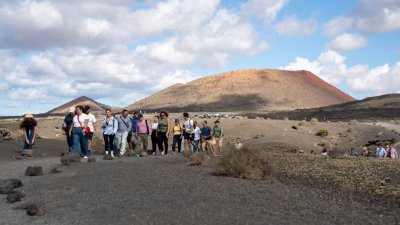
After learning about the two pioneering projects, representatives of public administrations, universities, entrepreneurs and technological startups, and professionals and experts in the field of science and technology have taken a tour of the Caldera de Los Cuervos trail, the place where the volcanic eruptions of the early eighteenth century in Lanzarote began and ended.
In addition to the Minister of Universities, the Deputy Minister of Territorial Planning, Elena Zarate, the Director of the Canarian Institute of Agri-Food Quality, Luis Arráez, and the CEO of the Technological Institute of the Canary Islands (ITC), Guayarmina Peña, participated in this third day of Routes 2030 along with other public representatives. The director of EMERGE, Moisés Santana, also attended, accompanied by more than 25 representatives of knowledge centers and innovative companies in the archipelago.
First edition
La Frontera, Gáldar and Tinajo have been the first three rural municipalities in the archipelago to host this project of the Government of the Canary Islands that seeks to promote equitable development in the islands of the Canary Islands Agenda 2030 and, in particular, bring the R&D&I generated in the archipelago closer to the least populated areas. Under the title Routes 2030, various activities are organized in areas of high environmental and ethnographic value in each of these municipalities to learn about innovative projects and exchange ideas and proposals with local actors.
The initiative, which will continue to be developed in the coming months, has the joint participation of the Ministry of Universities, Science, Innovation and Culture and the Ministry of Agriculture, Livestock, Fisheries and Food Sovereignty of the Government of the Canary Islands. The Canarian Association of Startups, Technology-Based Companies and Angel Investors (EMERGE), in collaboration with the city councils, public universities and other scientific-technological centers of the islands, coordinates and identifies the projects presented, in addition to organizing the participation of the people and entities that attend these activities. It is also responsible for monitoring the results achieved in the form of the creation of consortia or external collaborations with companies or knowledge centers.


Add La Voz de Lanzarote as a preferred Google source.
Stay informed with the latest current news.