
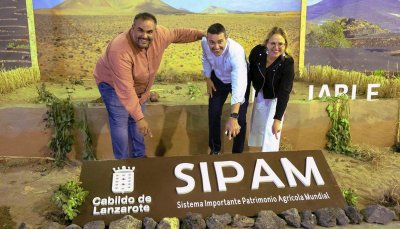
Lanzarote will be recognized next Friday, October 31, as a Globally Important Agricultural Heritage System (GIAHS) by the Food and Agriculture Organization of the United Nations (FAO), in a ceremony to be held in Rome.
The president of the Cabildo of Lanzarote, Oswaldo Betancort, and the Councilor for Landscape and Food Sovereignty, Samuel Martín, who will attend the event representing the island, have expressed their deep satisfaction with this recognition. Both emphasize that "Lanzarote's traditional agricultural model, with its unique crops in 'jable' and volcanic sands, such as La Geria, will be shown to the world as an example of agricultural sustainability and adaptation to climate change."
In this regard, Oswaldo Betancort has pointed out that "this international recognition of our agricultural landscape honors the wisdom of generations of Lanzarote residents who have known how to coexist with nature and create life from the volcano. It is a reason for pride and also a call to continue protecting and transmitting that legacy, which is part of our identity and our way of understanding sustainability."
In the words of councilor Samuel Martín, "Lanzarote's traditional agricultural system is an example of balance between human beings and the territory. Being recognized as a SIPAM by the FAO demonstrates that island agriculture not only has a past, but also a future. It is an inspiring model of adaptation to climate change, land use and rural resilience."
Lanzarote, an example of agricultural adaptation in an extreme environment
Lanzarote's traditional agricultural system represents an exceptional example of adaptation to extreme environmental conditions. In a territory with less than 150 millimeters of annual rainfall, Lanzarote's farmers have developed an ingenious cultivation system based on capturing and retaining soil moisture, taking advantage of volcanic lapilli (rofe) as a natural resource to conserve moisture and protect crops from wind and salinity.
This technique, along with the zocos, the characteristic semi-circular stone walls, has allowed the cultivation of essential products such as vines, fruit, legumes, or cereals, guaranteeing food security and the continuity of traditional agricultural practices, as highlighted by the FAO.
The GIAHS designation, Globally Important Agricultural Heritage System, strengthens Lanzarote's commitment to the protection of the landscape, environmental sustainability, and the transmission of traditional knowledge, pillars that also underpin its recognition as a Biosphere Reserve and UNESCO Global Geopark.
A ceremony broadcast live
The award ceremony for the Globally Important Agricultural Heritage Systems recognition, held every two years at FAO headquarters, is an extraordinary occasion to present certificates to newly designated sites between July 2023 and July 2025, as is the case of Lanzarote.
This event will bring together the international community to promote the conservation of agricultural heritage, share good practices, and celebrate the uniqueness of the recently incorporated systems. In addition, this event will include a digital exhibition and cultural presentations linked to the Museum and Network of Food and Agriculture (MuNe), recently launched on the occasion of World Food Day.
The ceremony can be followed live, on Friday, October 31, from 09:00 Canary Islands time, through the website of the Cabildo de Lanzarote https://www.cabildodelanzarote.com/.
Add La Voz de Lanzarote as a preferred Google source.
Stay informed with the latest current news.


