
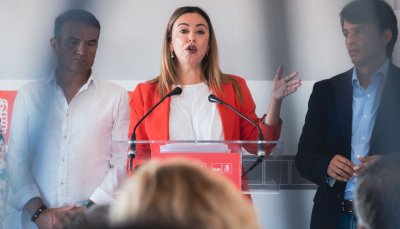
The PSOE of Lanzarote has presented its allegations to the new Island Land Management Plan (PIOLC), demanding "a clear model, with real limits and oriented towards guaranteeing the future of the island." The island secretary and deputy in Congress, María Dolores Corujo, has stressed that "it is not about suffering the consequences of tourism, but about governing it with intelligence, planning and responsibility."
Corujo recalled that "the PSOE was the first party to declare Lanzarote as a touristically saturated island in 2019." "We did it rigorously and with data, because we understood that the territory has limits and that our obligation was to act seriously. Today that reality is undeniable and demands a courageous plan," she said.
The socialists defend "an alternative model that establishes a moratorium in saturated areas, regulates vacation rentals on an island-wide scale, prioritizes rehabilitation over the expansion of new supply, sets more rigorous quality standards, links mobility and airport growth to the island's limits, and establishes a quota of tourist co-responsibility with a specific destination for sustainability, housing, and land protection."
"When tourism is not governed, it ends up governing the island. And that is exactly what we cannot allow," Corujo warned, in contrast to the CC-PP model, which "assumes growth without planning or control, as if resources were infinite."
Furthermore, the PSOE of Lanzarote criticizes that the current PIOLC document "does not address urgent issues such as the housing emergency, the water crisis, or island mobility. Faced with this deficiency, the socialists propose a water shock plan, the reservation of land for a new environmental complex, a competitive public transportation system, and a housing policy that prioritizes social rentals and rehabilitation."
"Lanzarote needs a useful and courageous plan that guarantees the right to housing, protects basic resources, and seriously addresses water management. The PSOE proposes a serious, executable model with a vision for the future. Growing without assuming the costs is not development, it is out of control," Corujo concluded.


