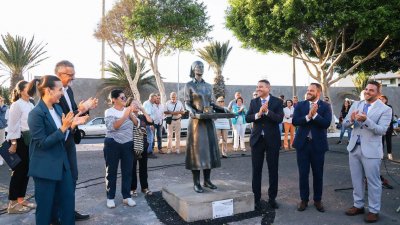
The president of the Cabildo of Lanzarote, Oswaldo Betancort, inaugurated on Friday afternoon the sculpture made in honor of the women who worked hard in the canning industry of the island in the decades of the 60s and 70s, which pays tribute to the strength and resilience of those women who joined the labor market around extractive fishing and its industrial transformation in an era of great economic explosion.
The unveiling ceremony of the sculpture designed by the Lanzarote artist Cintia Machín took place within the framework of the commemoration of the International Day of Rural Women, which is celebrated every October 15. In addition to the creator of the sculpture and women who worked from a very young age in the factories of Arrecife, the vice president of the Cabildo, Jacobo Medina, the councilor for Equality, Marci Acuña, and the mayor of Arrecife, Yonathan de León, among other public representatives, attended the event.
After unveiling the figure in homage to the canning woman in the area of the old Garavilla factory, on the Vía Medular of Arrecife, President Oswaldo Betancort highlighted the leading role played by the women of Lanzarote and La Graciosa in the fishing industry in an era in which female employment depended 80% on this sector. It should be remembered that the canning industry of Lanzarote reached its maximum economic weight between 1950 and 1980, concentrating even 90% of the Spanish sardine fleet during those years. In addition, in the early 80s, the fishing business accounted for 70% of the island's economy.
“Today is a special day because we are gathered here to pay tribute to women who have been pillars of our community and silent guardians of an emblematic tradition in our land: the canning women of Lanzarote,” said Betancort.
“We know very well that the working women of our islands are strong, resilient and that, throughout the 20th century and in the current times, they have faced new challenges always beyond their workplaces, because they have dealt with the adversities of the climate, combining motherhood with intense working days, receiving lower salaries than their male colleagues and even having to endure, in many cases (more than necessary when it should be none), macho attitudes and behaviors. Even so, they have continued forward without allowing their spirit to be broken,” Betancort considered.
“These women, with their work, have made our traditions, our culture, last, and are an example of dignity and the struggle for equality and recognition of their work in a world that is often hostile and always very hard, especially for them, for women,” he added. “And for all this, I would like that, from now on, when looking at this statue that pays tribute to them, we see the symbol of our gratitude for their strength, determination, contribution to family and collective development, and love for our past and for the importance of keeping the entire community united,” concluded the president, with total admiration for what they represented in a very hard time: “They have been able to be there and lend a hand, even in those times of explosion of the Lanzarote fishing industry, and those values are to be admired, remembered and transmitted to the new generations.”
For his part, the vice president of the Cabildo, Jacobo Medina, assured that it is a sculpture “that stages where we come from”. “The canning industry was the source of food for numerous families on the island, and we must always remember our identity,” he said.
Likewise, the Minister of Social Welfare, Equality and Inclusion, Marci Acuña, highlighted that the figure of the canning woman reflects the most essential of her work in the factories: industrialized work and sacrifice, in addition to capturing the feminine aesthetic of her time to perform said work, for which she congratulated the young Lanzarote artist Cintia Machín Morín, who has a recognized prestige and experience. In fact, she is the author of the sculpture referring to the Canarian wrestling 'La Cantera', located in Yaiza; of the statue of Víctor Fernández Gopar 'El Salinero', located in the same municipality, and of that of Cristóbal Colón in the Plaza de las Américas, in La Gomera, among other works.
The history of canning women in Lanzarote
In the 60s there were up to five canning factories in Lanzarote: Lloret y LLinares, Afersa (later Garavilla), Conservera Canarias, Hijos de Ángel Ojeda and Rocar, and later, the fish freezing train and ice factory Frigorsa and Atunera Canarias. Each of them had a staff of between 250 and 400 women.
They, the canning women, were indispensable to guarantee the survival of families, not only supported a large part of the island's economy, but also favored the coexistence of women and men in the workplace, which meant a great advance in the inclusion of women in productive work, with an important impact on the feminist struggle: visibility, economic independence, recognition and prestige of women as professionals.
They started working very young, between 13 and 14 years old, and were forced to assume the factory as the only possible life alternative. As a result of this, they had a feminine ideal to fulfill, relegating themselves to the private sphere, to the care of their families and the home. Often the traditional feminine values clashed with the learning obtained from the factories.
All working women suffered the obligation to assume the role of ''the ideal woman''. However, many accepted it and others continued working. Many women complained about the difficult situation they had to deal with, where the harshness of the loading and unloading work was added to the terrible hygienic and sanitary conditions, with very little ventilation and a shortage of air and light, so that it would not alter the product.


Add La Voz de Lanzarote as a preferred Google source.
Stay informed with the latest current news.