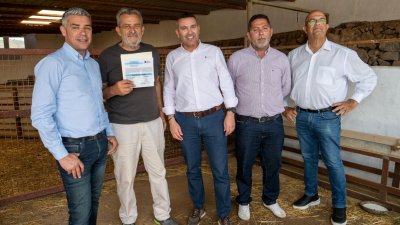
The Minister of Agriculture, Livestock, Fisheries and Food Sovereignty of the Government of the Canary Islands, Narvay Quintero, and the president of the Cabildo of Lanzarote, Oswaldo Betancort, visited this Tuesday the Pleamar Lanzarote livestock farms, in Haría, and Quesería El Faro, in Teguise, where the plaques accrediting the territorial and environmental legalization of these facilities in 2025 and 2026 respectively were presented, after their approval in the Governing Council.
During the visit, in which the Director General of Livestock, Andrés Díaz Matoso, also participated, the minister pointed out that for the Canary Executive, the regularization of livestock farms constitutes a priority in this legislature, "because it is about responding to a historical demand from the sector and accompanying farms in the adaptation of their facilities to current regulations". "There are several facilities that could not be modernized due to an inconsistency between different regional, national, or European legislations that must be complied with, which prevented them from obtaining a municipal license or enjoying public aid to improve their activity, which is why one of our commitments in this legislature is to try to regularize all those that are in this aleatory situation," he stressed.
In this regard, he recalled that 38 farms have already been legalized during the current term, "a fact that contributes to giving stability to this activity, allowing it to continue growing, reinforcing legal certainty and protecting the strategic role of livestock farming in the Canary Islands." "These are facilities in operation that, after completing a rigorous and coordinated process with island councils, town councils and other departments of the Canary Executive, will be able to continue their activity with all guarantees," he added.
For his part, Oswaldo Betancort indicated that this responds "to a demand from the livestock sector of Lanzarote and shows the empathy and commitment of the administrations, both from the Government of the Canary Islands and the island council, to legalize the work of these farms". "Of 16, 8 are already legalized, while with others we have problems with our own regulations because they prevent legalization, so we have to be self-critical and redouble our efforts to approve the island plan and streamline administrative work to avoid a potential risk that affects these farms," he added.
These authorizations are framed within the process of reactivation of regularizations promoted by the Dirección General de Ganadería, aimed at livestock farms executed prior to the entry into force of the Ley 9/1999, de 13 de mayo, de Ordenación del Territorio de Canarias, and processed in accordance with the procedure provided for in the Ley 6/2009, de 6 de mayo.
Likewise, among the measures developed by the Canary Executive to boost livestock and agricultural activity is the work being done for the approval of the Guidelines for the Planning of Agricultural Land and the Regulations governing Agricultural Uses and Complementary Uses, in the processing phase and whose approval is expected in the coming months. This regulation aims to unify the criteria for the identification, delimitation, and categorization of agricultural land, mitigate legal uncertainty, and promote the development of the primary sector in the Canary Islands.

On the one hand, the farm Pleamar Lanzarote began its journey in 1999 with a production focused on sheep and goat elaborations. Since then, it has undertaken two expansion processes to carry out zootechnical improvements as a consequence of adaptation to sectoral regulations. Currently, the facilities cover an occupied area of 8,546 square meters and have 400 head of livestock (200 sheep and 200 goats). After an adaptation process, it has focused on vine cultivation, mainly, and on home agriculture, working with products such as potatoes and other vegetables or fruit trees.
For its part, Quesería El Faro has been working artisanally for more than 45 years in Lanzarote. Since 2017, the Viña Melián family took over the family legacy created by master cheesemaker Dolores Camacho Saavedra and her husband Santiago Hernández Machín. Currently, they have 1,997 head of livestock, mainly dedicated to goat and sheep production, and an occupied area of 21,273 square meters. Since 2014, it has accumulated six awards in the Official Agrocanarias Cheese Competitions, an event organized by the Canary Institute of Agri-food Quality, a public company attached to the Ministry of Agriculture, Livestock, Fisheries and Food Sovereignty, including a Grand Gold Medal for its smoked tender cheese El Farito in the 2020-2021 edition. This is added to a record that combines 20 awards from different competitions such as World Cheese or the Tabefe Awards, which demonstrates the commitment and good work of a producer that has become a benchmark in the primary sector of the Archipelago.
Ecocomedores Program Distinctions
Within the framework of the visit to Lanzarote, the counselor also participated in the unveiling of two distinctive plaques of the Ecocomedores program of the Government of the Canary Islands at CEIP La Destila, in Arrecife, and at the El Majuelo farm, in Teguise. These distinctions recognize the commitment of the educational centers and of the producers who are part of this initiative with healthy eating based on local, fresh, and nearby organic products.
The event also included the presence of the director of the Canary Institute of Agri-food Quality, Luis Arráez Guadalupe, an entity that coordinates this initiative, which currently reaches 197 dining halls, most of them in educational centers, and more than 36,000 diners in the Canary Islands, and has the participation of a hundred organic farmers.
Quintero pointed out that “through these plaques we make visible the participation of educational centers, producers and female producers in a network that allows bringing local organic produce closer to school canteens and promoting healthy habits”. “Ecocomedores is much more than a school feeding program, it connects educational centers with the primary sector, promotes healthy habits from an early age and opens new opportunities for organic farmers and ranchers of the islands,” he added.
In Lanzarote, the program has experienced relevant growth in recent years. Currently, twelve schools and fourteen one-teacher schools, with 2,389 diners, are part of the initiative. In addition, it has twelve male and female producers who supply their products, ten of whom are associated with SAT El Jable, an entity that carries out the logistics of collection and distribution of products on this island and in Fuerteventura.
The CEIP La Destila joined the program last academic year and acts as a mother kitchen for eleven single-teacher schools, which allows this food model to be brought to rural areas and guarantees access to menus made with local organic products.
The farm El Majuelo, managed by farmer Juan Peña, is mainly dedicated to the cultivation of sweet potato, vine, potato, tomatoes, and grain, productions that it habitually supplies to schools within the framework of this project. The farm has about five hectares of cultivation and also hosts school visits during the academic year.
The counselor highlighted that “these distinctions reflect the joint work of management and teaching staff, eco-farmers, kitchen and dining room teams, families, and administrations to build a model that brings local produce to classrooms, improves the nutrition of boys and girls, and reinforces the viability of our organic production farms”.
Ecocomedores has been recognized nationally with the Special Recognition from the Spanish Agency for Food Safety and Nutrition within the framework of the NAOS Strategy Awards, which confirms that the Canary Islands have a benchmark initiative in healthy eating, sustainability, and support for local produce. Likewise, it has inspired the development of the Royal Decree on Healthy and Sustainable School Canteens.



Add La Voz de Lanzarote as a preferred Google source.
Stay informed with the latest current news.