
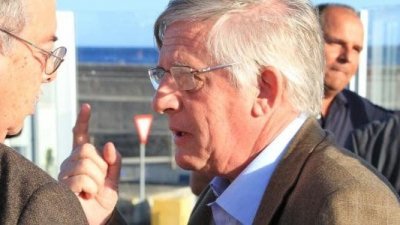
Judge Rafael Lis, who was investigating the alleged theft or loss of cars in the Unión case, allowed people who could be directly "benefited" by these alleged thefts to appear as private prosecutors. They would even be "the main suspects" in the events being investigated in that procedure. This is according to the Sixth Section of the Provincial Court, in a ruling that annuls the appearance in that case of three defendants in the Unión case.
Currently, Judge Lis is no longer investigating that procedure, as he was recused due to doubts about his impartiality. Last March, the Court accepted the recusal (requested by Pamparacuatro and supported by the Prosecutor's Office), as it understood that there was an "indirect interest" and a "reasonable doubt about the prejudices or preventions" that the judge might have "in relation to one of the parties". Specifically, Lis's wife was hired by Juan Francisco Rosa to represent him in the Stratvs case, shortly after this judge took charge of the case for the theft of cars. Rosa is also accused in the Unión case and had appeared in that procedure being investigated by Lis.
Now, the Court has annulled the magistrate's decision to accept three appearances: that of the lawyer Felipe Fernández Camero, the businessman Luis Lleó and the director of Urbaser Francisco José Martínez Llerandi. "They are precisely the ones who would benefit from the alleged theft or loss of the resolutions, because any eventual nullities could render their accusations ineffective", argues the Court, which adds that "it is not surprising that they can be attributed the status of main suspects in such thefts or losses".
Therefore, it argues that Judge Lis should not have allowed their appearance as prosecution in the case and that he "should have waited for the investigation to advance until their participation in the events was ruled out". Furthermore, as requested by the Prosecutor's Office, the Court also orders that "all the proceedings requested" by those private prosecutions be "annulled". In this regard, the Court's ruling emphasizes that the defendants in Unión who appeared in that case for the theft of cars were aware of "the course of the investigation", attended witness statements and raised the "issues they deemed appropriate", including the request for the practice of proceedings and the presentation of appeals.
Lis continued to investigate another separate case despite his recusal
After Lis's recusal, the case passed into the hands of a new judge, who finally decided to dismiss the proceedings (currently, that resolution is pending the appeals that were presented by the different parties in the procedure). However, despite being removed from that case, Judge Lis continued to investigate another procedure that he himself separated from the main case. Specifically, an extension of the complaint presented by one of the main defendants in Unión, Luis Lleó, in which he raised alleged facts that have already been rejected by both the Court investigating Unión and the Provincial Court.
After becoming aware of that separate case, the Prosecutor's Office requested the recusal of the judge also in that procedure, in which only Lleó himself actively participated for months. In fact, it argues that it was carried out "behind the backs" of the Public Prosecutor's Office and the defendants, who are the secretary of Court Number 5 and two members of the UCO of the Civil Guard. In addition to that complaint, Lleó has filed others against the judge and prosecutor who initiated the Unión case, although all have been rejected by the Superior Court of Justice of the Canary Islands, which is the only one with powers to investigate judges and prosecutors.
Thus, the only one that has remained open is the one he filed in Rafael Lis's Court. "We would be facing the violation of a legal precept to instruct a parallel procedure behind the backs of the parties and for the benefit and clear taking of a position by one of the complainants", stated the chief prosecutor of Arrecife, Yolanda López, in her recusal letter.
"Only a hypothesis", by "misfortune for the defendants of Unión"
In its new ruling, dated November 30, the Court also emphasizes that what César Romero Pamparacuatro denounced was not that false resolutions had been introduced into the procedure, but that some originals that did have his signature had disappeared, unlike what happened with the copies that remained in the proceedings. "He does not doubt that the resolutions he signed are the same", the Court emphasizes.
Regarding the appearance of defendants in Unión as private prosecution, it insists that in no case do they have the status of injured parties. In this regard, it insists that they could "use" this "in their defense" in the Unión case, so they would not be "harmed, but benefited", if there really was any cause of nullity, which has been ruled out so far.
"Let's suppose for a moment the hypothesis", the Court points out, "that the resolutions that the instructor did not sign and that refer to those who are appearing are all null, for whatever reason. It seems evident that in such a case, that nullity would benefit them and in such a case, we ask ourselves if they would direct the accusation against the cause of the nullity, that is, against the one who has freed them from being subjected to trial in the other procedure, the answer being obviously negative". In any case, the Provincial Court also adds that this scenario, "unfortunately for the defendants in the Unión case", is "only a hypothesis".


Add La Voz de Lanzarote as a preferred Google source.
Stay informed with the latest current news.