
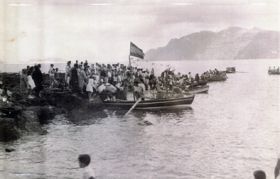
Once upon a time there was a vast and beautiful beach that rested under an imposing cliff. Fishermen worked there, building their shelters and warehouses with planks and metal sheets to protect their tools. These sea workers, increasingly aware of the tranquility and possibilities offered by La Caleta, moved their families there in the summer, and the primitive barracks became, back in the 30s, cozy white houses with doors and windows as intensely blue as the sea. This is the story of Famara, a holiday center that started from a small fishing settlement that has been delegating this privileged place to several generations.
Famara has changed. Those who now watch their children from the small cove of the town remember what summers were like there several decades ago: a group of houses on the beachfront and a town with fine sand floors. A paradise for some kids who did without their shoes for two months. "I remember that when September arrived we tried to put our feet in the shoes of the previous year and they no longer fit, we always went barefoot", recalls Soraya. The construction of the pier caught them by surprise back in the seventies, and some still complain today that it prevents the sand from reaching the cove. Until that moment they only had the so-called "trampoline", a fond memory of what heroism and overcoming early childhood meant at the age of ten. "The trampoline was our initiation to head shots into the water, when you went up there it was a tremendous achievement", recalls Soraya. "In addition, one of the steps had Manrique's footprint since he stepped there when it was being made".
No roads, no electricity, no water. There are those who remember going to the wells to get it, and even seeing the camels coming loaded with jugs from Teguise. Demetrio was born in Famara 76 years ago. Among his memories is the coexistence of fishermen and vacationers on the beach, although "this is not what it used to be" says the fisherman: "They told us that they were going to clean the puddle, that they were going to build shelters for the fishermen, and even a brotherhood... Have you seen it? Well, I haven't, they always promise and then they don't fulfill anything". For Demetrio, everything has changed. "Before here in winter you couldn't hear anything", he explains. "Then, in June, the vacationers started arriving".
La Caleta maintains the familiarity of always. Any vacationer "of always" identifies each of those who enjoy the sun and water there, and knows by heart the history of each house. "That one there is the Casa del Cura", explains Miguel Ángel. "It belonged to a private individual but he gave it to the parish priest of Teguise, and now it is closed". It is one of the properties that the Famara Neighborhood Association requested to include in the catalog of protected real estate, within the Master Plan for Use and Management. "The owner was a very distinguished gentleman from Teguise", explains Juana. "He had a lot of money but he lived alone, and since my father knew him, he would send us to take him stew", recalls César Manrique's sister.
Stories and anecdotes that fight against oblivion through those who can bring them to us again. "When we were little there was no pier, nor half of the houses that are now", explains Carlos. "Now I don't even know half of the people who are around here, there are too many cars, boats and even apartments". It is the vision of those who knew the Famara of before. Those who bathed in a kilometer-long beach free of surfers and cars, those who danced barefoot at ease and those who did not see how the garbage accumulated in the town. "The change has been radical, and more so in summer", explains Gonzalo. "But I understand that people come to Famara because this is a beautiful town, as long as they respect the things of before and have consideration for the people of the town, nothing happens". However, there are those who attribute the situation in which the town is today to this saturation. "Everything is very neglected, there is no cleaning, cars enter the cove dragging the boats... This did not happen before", complains José Miguel. For this vacationer "of a lifetime", as he himself says, the problem is that the town is not being adapted to the amount of people who come. "I have spent my childhood here and it makes me very sad to see how it is becoming more and more uncomfortable".
August is a particularly intense month. To the Lanzarote residents with a second residence in Famara is added the large number of visitors who come to this haven of peace from other islands, the peninsula, and even abroad. But winters in Famara have also changed. "It has gone from being a deserted and lifeless town to being a town where many young people come to live between September and June", says Soraya.
Neighborhood Movement
Famara has built a strong neighborhood movement around an Association. "The Teguise City Council has abandoned us", says Miguel Ángel Ferrer, a member of the group. "We address all the concerns that worry the people of Famara, especially those who live here all year round". Poaching, quads, jet skis, cell phone antennas, lighting and cleaning are some of the issues that concern them the most. "In winter there is only one person to clean the town, the San Juan area, and a five-kilometer beach", explains Miguel Ángel. "The beach, being in the North, receives a lot of garbage, and the excuse that the City Council gives is its location, but I think that precisely because of that, because it is more sensitive, there should be a greater cleaning service". Miguel Ángel describes Famara as a "lawless city". "People cross the town with vehicles at full speed and there is hardly any security, only occasionally a local police patrol passes by, but they leave immediately".
The Famara of César Manrique
The memory of Famara holds memories of a very special vacationer. Since childhood, César Manrique came, summer after summer, to the house that his family still keeps on the beachfront. "For a couple of summers my father took us to other beaches, and we always told him that we wanted to go back to La Caleta", explains his sister Juana. "This place was fantastic for children, we always went barefoot and we could go out at night, even if there was no light or anything". The sand of Famara beach was the first working material for Manrique, who used it to make the first sculptures. "My brother was delighted here, he modeled figures of naked women on the beach, and the girls, as we were smaller, were scandalized and said 'it seems incredible that César does that!". Juana remembers her brother on the beach, transgressive, provocative. "He would put on shorts and there were ladies who said: 'there is no right for César to be bathing like that, with just a pair of shorts", explains Juana between laughs.
The Manrique family's house began to be built in 1935. Since then, four generations have spent their summers there. Juana speaks nostalgically of those days when the sand peeked out at the door of the house. Now she talks about overcrowding, but despite everything, Famara is still a special place. "Life here is very healthy, it's like it used to be, much more informal, and we even dress more crazy!", exclaims Juana before heading towards the water and plunging into it, as she did seven decades ago.


