
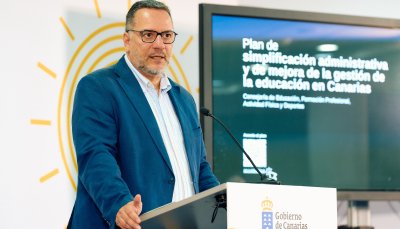
The Ministry of Education, Vocational Training, Physical Activity and Sports of the Government of the Canary Islands has reinforced the teaching staff of the public centers of the archipelago with 700 additional teachers for the 2025/2026 school year.
According to Education in a press release, these contracts guarantee "that the Canarian educational system has the functional staff necessary to respond to the needs of the academic year that will begin on September 9 throughout the archipelago".
In contrast, the 5% Platform for Education has denounced the lack of teaching staff for the next year.
Meanwhile, the Ministry of Education has defended that "the measure is part of the strategy of the Ministry and the Minister himself, Poli Suárez, to continue reducing the ratio of students per classroom, one of the priority commitments of this department for the current legislature".
In this sense, Suárez has stressed that "the reinforcement of staff not only guarantees better learning conditions, but also strengthens equity and educational inclusion, improves coexistence and addresses the demands made by families." These incorporations, the counselor stressed, "respond to the joint work between the administration and unions to achieve the common goal and mission of improving the educational system of our land" and, once again, he concluded, "it is clear that this path involves dialogue to reach agreements such as the historic one signed last April."
Education has concentrated the "most significant" reinforcement in the staff for attention to diversity, after criticism from past courses for the lack of teachers, present in the Canarian classrooms, with the incorporation of 168 specialists in Therapeutic Pedagogy (PT), of which 63 will serve in Primary Education and another 105 in the first and second level of Compulsory Secondary Education (ESO), and the expansion of 140 educational counselors in both stages.
For their part, in basic education, the stages of Early Childhood and Primary Education have been reinforced, with the incorporation, in the first of these, of 65 teachers and, in the second, of another 121 professionals. These increases allow for better schooling in the first levels, contributing to the reduction of ratios in the classrooms, which translates into the creation of 114 new groups in both stages, distributed as follows: 35 in the first cycle of Early Childhood Education, 9 in the second cycle of this same stage, 61 in Primary and, finally, another nine in ESO.
With regard to Vocational Training, a key teaching for the academic and personal development of students who have completed compulsory education, 290 new teachers join the staff, whose incorporation will enable the creation of 81 new groups - 53 of them in the first year - including the creation of 35 of Intermediate Grade and another 27 of Higher Grade, as well as another eight of Adapted Vocational Training.
This reinforcement of the staff is part of the agreement reached by the Ministry of Education last April with a broad representation of the trade union organizations of the archipelago for the development of the multi-year plan to reduce ratios until 2027, which sets maximum limits of 16, 18 and 20 students in Infant, 22 in Primary and 25 in Secondary, which allow the Canary Islands to be among the communities with the best indicators in this chapter.
With this action, the Government of the Canary Islands has defended "its will to place education at the center of the public agenda, allocating more human resources to ensure that each student receives a training tailored to their needs and the challenges of the current educational system." In contrast, the 5% Platform for Education assured that the teaching staff only grew by 0.6% in the Canary Islands, below the state average (1.1%).


