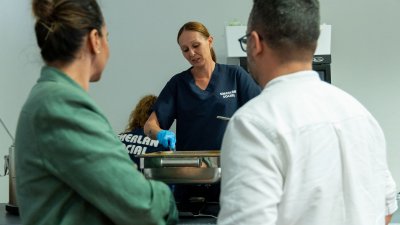
Maite Corujo, councilor for Social Welfare, has valued "very positively" the changes implemented in the municipal soup kitchen after the entry into force of the new management contract. The improvements introduced have led to a significant increase in the number of users, greater participation in activities, and a substantial expansion of the hours and services offered.
The soup kitchen has experienced a very favorable evolution in recent weeks, consolidating itself as a comprehensive resource for attention, accompaniment, and social activation, which goes beyond meeting basic food needs.
One of the most relevant changes has been the extension of the opening hours of operation. If previously the facility did not remain open in the morning, it now provides service for six hours daily, allowing users to remain accompanied for a large part of the day. This measure has been excellently received, favoring regular attendance and reducing situations of loneliness and social isolation, by offering a safe, stable, and reference space.
Currently, the dining hall serves an approximate average of 80 people daily, of which around 20 receive the home delivery service, mainly aimed at elderly people with mobility problems or other personal circumstances that prevent them from traveling to the center.
During opening hours, various individual and group activities are continuously developed, including memory exercises, cognitive stimulation dynamics, social skills workshops, conversation and emotional support spaces, as well as recreational and participatory activities. In addition, new proposals are being incorporated that arise from the interests and demands of the users themselves, thus fostering their active involvement in the programming. The objective is clear: to promote autonomy, participation, and emotional well-being.
Likewise, daily attention has been reinforced with the incorporation of breakfast service in the morning, the maintenance of the lunch service, and the inclusion of an afternoon snack for those who remain at the center. This improvement, driven within the framework of the new contract, favors continued assistance and guarantees more complete attention adapted to the real needs of the population served.
The Councilor for Social Welfare, Maite Corujo, has underlined that “these changes demonstrate that when we commit to improving social resources, results arrive. We have managed to make the soup kitchen much more than a place to receive food: today it is a space for support, participation, and dignity.”
Corujo adds that “the extension of hours, opening in the morning, and the incorporation of new dynamics have had an extraordinary reception. We are seeing more attendance, more involvement, and, above all, more well-being among users. That is the true objective of social policies: to be close, to listen, and to offer real answers.”



Add La Voz de Lanzarote as a preferred Google source.
Stay informed with the latest current news.