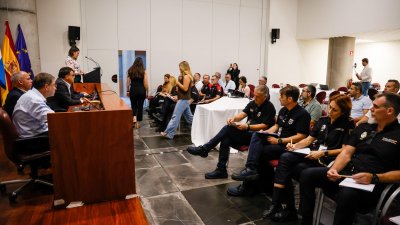
The Canary Islands Government has initiated the participatory process for the drafting of the future Law of the Civil Protection and Emergency System of the Canary Islands, a regulation intended to strengthen the regional emergency system and adapt it to the specific needs of the islands. The initiative seeks to provide the archipelago with a coherent, modern, and coordinated system, capable of effectively anticipating, preventing, and managing natural, anthropogenic, and technological risks, which are increasingly frequent and complex due to climate change.
The process, which will cover all the islands, is coordinated by the public company Gesplan, whose experience in previous participatory projects – such as the update of the Land Law or the Demographic Challenge Strategy – has shown excellent results. The methodology allows for the integration of contributions from institutions, technical experts, social groups, and citizens, ensuring that the law reflects the reality and needs of the Canary Islands' emergency system.
The Minister of Territorial Policy, Territorial Cohesion and Water, Manuel Miranda, highlighted at the opening of the conference that this process not only seeks to draft a regulatory text, but to establish a lasting and effective law. "It is about building a modern, coordinated emergency system that is fully adapted to the reality of the Canary Islands. The participation of institutions, technicians, experts, and citizens will be key. Just as we saw with the update of the Land Law and the Demographic Challenge Strategy, the most solid initiatives are built from shared experience and dialogue. In this regard, I thank Gesplan, a public company that coordinates this process, for their work; their collaboration will be fundamental for this law to be practical and consensual."
Miranda also added that the Government's commitment is comprehensive and, therefore, a **budget of 500,000 euros** has been included in the Autonomous Community's budget project to promote the creation of the Canary Islands Emergency Agency, which will allow for a faster, more professional, and effective response throughout the archipelago.This law also champions **technological innovation**, recognizes citizens as active agents of civil protection, and promotes training, dissemination, and participation. "Today we take the first step in a process of collective construction that will strengthen our emergency system against current and future challenges," explained Miranda.
The future law will adapt state and European legislation to the particularities of the islands, incorporating new planning instruments, unified communication and alert protocols, and mechanisms to optimize the use of material and human resources, including advanced technologies such as drones and digital management systems.
With this initiative, the Canary Islands Executive advances its objective of having a robust, coordinated civil protection system adapted to the challenges of the 21st century, capable of guaranteeing the safety of the population, protecting the territory, and strengthening the resilience of the islands in the face of any type of emergency.
A process that combines legislative analysis and citizen participation
Óscar Rebelo, director of Territorial Planning and Demographic Challenge at Gesplan, highlighted that the work methodology they will carry out "combines the analysis of current legislation, a preliminary consultation through forms, the holding of technical workshops on each island, and the systematic collection of contributions. The objective is to integrate the experience and knowledge of those who, day by day, apply and manage the emergency system in the Canary Islands".
Rebelo detailed that the participatory workshops "are structured in small working groups, of between 10 and 12 participants, to encourage technical exchange and consensus." These groups will address the main pillars of the future legal text: "the first, dedicated to the regulatory framework, planning, and governance; the second, focused on the comprehensive response and management of means and resources in the face of natural, anthropic, and technological risks; and the third, on population care and post-emergency recovery."
The head of Gesplan emphasized that "in this process, administrations and entities from all levels - national, regional, island, and local - linked to civil protection and emergencies, including universities, have been convened with the aim of ensuring a comprehensive and collaborative vision."
In this first session, held in Gran Canaria, "around 40 representatives from organizations such as Puertos del Estado, the National Police, the Civil Guard, the Canary Islands Police, fire services, CECOES-112, and AEMET participated."
Finally, Rebelo pointed out that "all this work **will culminate in the drafting of a proposal** that gathers the main conclusions of the process. It will be a document that guarantees transparency, consensus, and continuous improvement of the civil protection and emergency system in the Canary Islands."


Add La Voz de Lanzarote as a preferred Google source.
Stay informed with the latest current news.