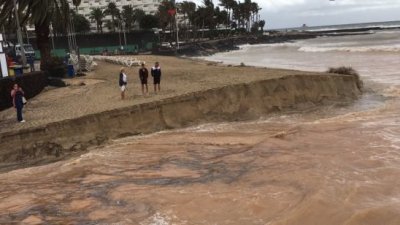
The Government Council of the Canary Islands has approved this Friday, September 5, a budget increase of one million euros to cover the improvement of the rainwater collection network in Argana Alta, Arrecife, and the drafting of a project to increase capacity at the head of the El Hurón ravine and prevent flooding in the urban center of Costa Teguise, both on the island of Lanzarote. The Minister of Territorial Policy, Territorial Cohesion and Water, Manuel Miranda, explained that these are interventions that will be carried out by the Insular Water Council and that aim to mitigate the consequences when there is heavy rainfall in both areas.
This budget modification will cover a grant to the Lanzarote Insular Water Council, which will be responsible for processing and executing both projects. It responds to the objective of avoiding damage that usually occurs in both areas when there is heavy rainfall, such as that which occurred on April 12, which generated more than 200 incidents.
The project to be executed in the Argana Alta neighborhood, in Arrecife, includes intervention in eleven points usually affected by these floods. Gutters connected to the network will be placed on Tanganillo Street, and at the intersections with Jorge Luis Borges and Alejo Carpentier streets. On Trillo Street, these same elements will be placed in several of its points (Buero Vallejo Street, Las Vírgenes and Camino de Los Invernaderos), and others that currently block the outflow of rainwater will be removed.
Intervention will also take place on Los Geráneos Avenue, on Iguazú, Tenderete, Hermanos Álvarez Quintero, Ranchos de Pascua, Saltona and Taro streets. In the latter, the capacity of the LZ-3 pedestrian underpass will also be improved. All work must be completed within eight months, from the moment the works begin.
The second of the measures agreed by the Government of the Canary Islands with the Island Council is the drafting of a project to implement a water lamination system at the head of the Hurón Ravine. This system will increase the defense against flooding in Costa Teguise, reducing the flow of rainwater that ends up in the ravine and generating spaces for the storage of rainwater for its use, for example, in agricultural irrigation or public gardens.
Both areas have been classified in the current Lanzarote Flood Risk Management Plan as areas of potentially significant flood risk (ARPSI).
Add La Voz de Lanzarote as a preferred Google source.
Stay informed with the latest current news.