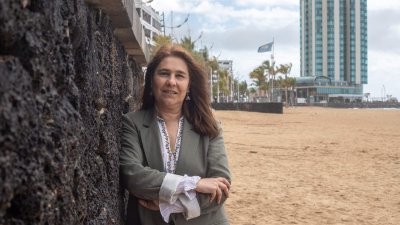
The first doctoral thesis on the work of César Manrique (1919-1992) was conceived when the multidisciplinary artist was still alive, which is rare in this type of research, as they are usually carried out after the authors have passed away. Its author, Violeta Izquierdo, PhD in Art History and tenured professor (accredited to Full Professor) at the Faculty of Information Sciences of the Complutense University of Madrid, decided to do her work on the artist from Lanzarote after encountering his work while studying her specialty in Tenerife.
During the 80s, a visit to Lago Martiánez, one of Manrique's works in Tenerife, opened the way to the artist's universe. "I was surprised by the space, the connection it had with nature, the art that was experienced in such an unconventional space with respect to this type of recreational or leisure places," emphasizes Izquierdo, who is a tenured professor at the Faculty of Information Sciences of the public university in Madrid, who attends to La Voz, on the occasion of her visit to the island to give a lecture at the Torrelavega Society.
After discovering this maritime park in the north of the island, the expert in Manrique's art confesses that she investigated all the author's work. "I realized that I was facing a very exceptional, complete artist, who worked on all the creative aspects of art and that I had a gift to investigate," she confesses. It was then that she decided to do a thesis that covered all the artistic facets of Manrique, from painting, through sculpture, to his intervention with nature. "There are few artists who can be studied in such a complete way with all those elements," she confesses during a conversation in the newsroom.
"It seemed to me that it was a good opportunity to work with someone who could give me his vision, without needing to work only with additional sources," highlights the professor, who emphasizes that the author already had "enough work to be able to address him completely." Unfortunately, Manrique died in September 1992 in a traffic accident in Lanzarote and was never able to meet with him. Four years after his death, the thesis The artistic work of Manrique saw the light and then in 2019 it was reissued by the Cabildo in homage to the artist.
Manrique and his fight for the environment
"He was a complete visionary," begins the pioneering researcher in Manrique's work on the artist's discourse, who advocated for landscape protection and fought against land speculation and mass tourism since the first development of the sector on the island in the 60s.
"He was able to see things long before they happened in Lanzarote," adds the researcher. "He had references in the neighboring islands, where he already knew what had happened and he looked for a way to protect this island from that tourism hecatomb, seeking sustainable tourism," she recalls.
Already in life, Manrique managed to unite support among the political class and the population of Lanzarote to fight for a more sustainable and respectful island model with the environment. "César lived a splendid moment and had great knowledge, he has left his mark on his contemporaries and today many people who knew him continue to embrace his message. He achieved that great impact at the time, but today that message takes on a lot of value, because we realize that he was right," she reflects.
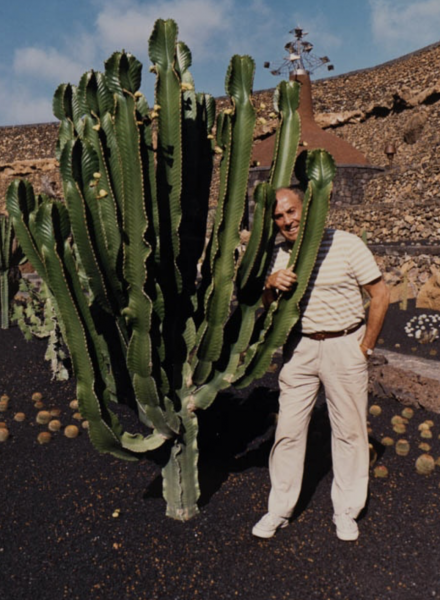
The Professor of Information Sciences highlights that "it is time to recover his message and say, we were already warned, there was someone who already knew it, did it and therefore let's continue to take that reference into account." At the same time, she points out that from the History of Art it is defended that "that which is not remembered and is not there, is lost, although it is difficult for this to be lost in a context like Lanzarote", but she invites to "extend it much further" beyond the Canary Islands.
Currently, the message of César Manrique has been used in the citizen mobilizations held on April 20, 2024 in several islands of the archipelago against mass tourism, to demand economic diversification in the islands and the protection of nature.
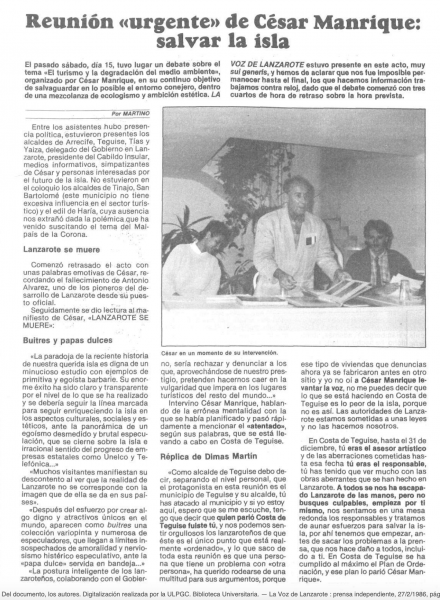
A collective and not imposed model
Izquierdo points out that one of Manrique's great achievements was to "raise awareness among the population", so that the care of the landscape was not imposed but agreed upon among the residents of Lanzarote. "The book of Unpublished Architecture of Lanzarote, was not an imposition, but a model in which he said 'here we have this type of traditional architecture of the island, this is what the houses are like, these are the colors that are used, this type of chimneys, this type of doors, windows'", she recalls. "He was clear about the idea, but he also had to transmit it to the rest of the population so that it would be a collective work," she adds.
For the professor, his closeness to the people was fundamental when it came to conveying the message. "He managed to create a model of architecture or sustainable tourism that is precisely what many places are going for today where it is very difficult to go back," she adds.
A multidisciplinary artist
The researcher describes the figure of Manrique as a "multifaceted" and "multidisciplinary" artist because, unlike most artists, he "touches many creative disciplines." Thus, she highlights that "there are very few cases in Canarian, Spanish or universal art", where creators "have all these qualities".
One of the characteristics transversal to all his work was the value that Manrique gave to contextualization. "All those mobiles that are located in the roundabouts of Arrecife have a meaning, even if you see them isolated in a roundabout, they are connected with the next one and it also has a concept linked to nature, with movement, space, the cosmos, it is a globalizing sense," details the expert.
For Violeta Izquierdo, César Manrique is "a total artist" and "all the elements of his art" are "part of a totalizing work".
Finally, she defends the importance of spreading the legacy of César Manrique beyond the borders of Lanzarote. "He is an artist who has a lot to say for future generations, because he is an artist who must be kept in the collective memory of future generations and because he represents the essence of contemporary art of the 20th century."


Add La Voz de Lanzarote as a preferred Google source.
Stay informed with the latest current news.