Photos: Sergio Betancort
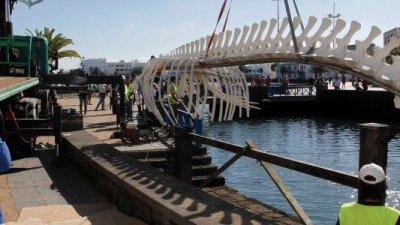
The bone structure of a tropical Bryde's whale specimen, 11 meters long and 8,000 kilograms in weight, has been "adorning" a degraded area of the Charco de San Ginés in Arrecife since this Friday, thanks to a project financed by the Cabildo de Lanzarote and the Government of the Canary Islands, through European funds (PDR-2014), which has had the advice of the Society for the Study of Cetaceans in the Canary Archipelago (SECAC), based in Lanzarote.
The project has been executed by the entity Canarias Conservación-Gabinete Estudios Ambientales, which has experience in the museum preparation of skeletons of large cetaceans with exhibitions carried out in the Royal Botanical Garden of Madrid, the Museum of Natural Sciences of Barcelona, in various locations in Fuerteventura and in the Cetacean Museum of the Canary Islands, in Lanzarote.
The president of the Cabildo of Lanzarote, Pedro San Ginés, who was accompanied by the president of the SECAC, Vidal Martín, the first vice president, Joaquín Caraballo, the councilor of the Biosphere Reserve, Juan Antonio de la Hoz, and the councilor of the Environment of the City Council of Arrecife, Rafael Juan González Robayna, during the assembly of the bone structure, explained that "before the installation, the skeleton of this whale specimen has been subjected to a restoration and articulation process by the technical team of the aforementioned entity".
The scientific name of this migratory tropical species that is protected by international and European Union regulations is 'balaenoptera brydei' and belonging to the family 'balaenoptiradae' (from Latin, 'winged whale').
"Beautify", "raise awareness" and "sensitize"
"The Canary Islands is the only place in Spain where the species is present," said Pedro San Ginés, who also stated that "this sculpture of nature has been recovered not only to beautify this area of the capital of Lanzarote, but to generate a space for awareness and environmental awareness about the importance of conserving our sea, our natural and biological resources and the species that inhabit the marine environment of the archipelago, and that unfortunately are now exposed to a tremendous risk due to the oil explorations that have been imposed on us off our coasts".
"The cost of the restoration and installation project of the bone specimen has been 18,000 euros, financed through the agreement signed between the Cabildo of Lanzarote and the Government of the Canary Islands for the actions included in the Rural Development Plans (PDR-2014)," specified the president last.
Both the Arrecife City Council and the Cabildo of Lanzarote, through the Biosphere Reserve, showed in their day the intention to restore this skeleton and rescue it for exhibition in a degraded area of the Charco de San Ginés. That is why the SECAC has ceded to the city council the use of the skeleton for its exhibition indefinitely, without any economic compensation, and with the only condition that the skeleton is insured during the time that the city council wishes to keep it exposed.
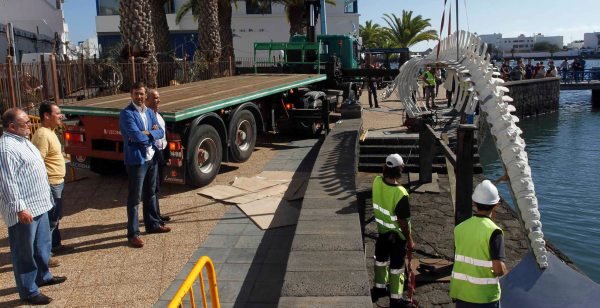
According to the Councilor for the Environment of Arrecife, Rafael Juan González Robayna, "from the city council we are very grateful to the Cabildo of Lanzarote and the SECAC for this transfer of the bone structure." During the assembly, they explained that "given its location in a public exhibition space, the safety of the visiting public has always been a priority, both in the design of the support structure and anchors of the skeleton and in the assembly system".
Stranded in Tenerife in 1995
For his part, the president of the SECAC, Vidal Martín, explained that "the specimen was stranded in 1995 in waters of Tenerife and its bone structure remained deposited in the Faculty of Marine Sciences of the University of Las Palmas de Gran Canaria until 2003, when it was moved to Lanzarote to be exhibited in the Cetacean Museum of the Canary Islands".
The natural skeleton of the specimen belongs to a juvenile female 11 meters long and about 8,000 kilos in weight. It is part of the osteological collections of the Society for the Study of Cetaceans in the Canary Archipelago (SECAC) based in Lanzarote and comes from a stranding case that occurred in 1995 on the island of Tenerife. The necropsy revealed that this young female had died of natural causes.
The tropical Bryde's whale (Balaenoptera brydei) is one of the largest animals on the planet. It is distributed in the warm and tropical waters of the world and is from the group of toothless whales that, like other giants of the sea, feeds by filtering plankton and small fish.
The Canary Islands are within their migratory routes and is a feeding and breeding area. They are frequently sighted in the waters of Lanzarote where they are particularly abundant in spring and summer. Females, somewhat larger than males, can reach up to 13 meters in length and weigh more than 10 tons.

Add La Voz de Lanzarote as a preferred Google source.
Stay informed with the latest current news.