Caleta de Famara, a beloved fishing village belonging to the municipality of Teguise, on the island of Lanzarote, holds within its sands, its whitewashed houses, and the eternal murmur of the Atlantic a history that is lost in the memory of time. Before becoming the peaceful fishing nucleus we know today, these lands were an important aboriginal settlement and an area of water wells, to later transform into a place linked to fishing activity and the storage of catches that arrived from the sea.
Today, Caleta de Famara continues to preserve intact a large part of that seafaring essence that has given it character and personality over the years.
Coinciding with the last Sunday of August, the patron saint festivities in honor of the Sacred Heart of Mary, a revered image of deep devotion and Patroness of the caleteros, came to an end.
At twelve noon, the solemn celebration of the Eucharist began, presided over by Don Leonardo Arellano Ramírez, a formator at the Seminary in Venezuela. The small hermitage proved insufficient to accommodate the large number of faithful who, eager to participate in such a heartfelt celebration, crowded at the entrance and its surroundings.
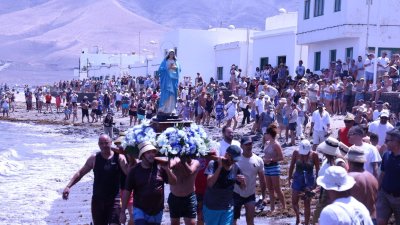
After the Holy Mass, one of the most anticipated moments of the day began; the traditional land and sea procession of the revered image of the Sacred Heart of Mary.
The Patroness of the caleteros was carried on shoulders by men and women of the town, who took turns throughout the entire procession. Everyone wanted, on such a special day, to have the honor of carrying their beloved Patroness on their shoulders and accompanying her through the white sand streets of this unique fishing village.
The procession was led by the "Teguiband" Music Band, from La Villa de Teguise, accompanying the religious procession with their music. Following them marched the celebrating priest, accompanied by a multitude of neighbors, visitors, and faithful who wanted to accompany the revered image on one of the most emotional days of the festivities.
The Sacred Heart of Mary shone radiantly on her throne, elegantly adorned with beautiful floral ornamentation in white and blue tones, colors that seemed to merge with the sea foam and the immense blue of the Atlantic that embraces the coasts of Famara.
Little by little, the procession arrived at the beach, where one of the most unique and exciting moments of the day awaited. There, the revered image, carried on the shoulders of the sailors, was embarked on the small boat "Jesús María".
For its patron, it was a true honor to be in charge of taking the Patroness of the Caleteros by sea. From the shore, a large number of people gathered expectantly to contemplate the maritime procession of the Sacred Image, which sailed through the waters near the beach, accompanied by small boats decorated for the occasion, offering an unforgettable sight.
The sea, an inseparable companion to the life of this town, once again became the setting for faith and devotion. The sailor Patroness sailed the waters, embraced by the affection of her people, while from the mainland, eyes followed the procession of the boat with emotion.
After the maritime procession concluded, the image returned to land and, accompanied by the residents of Caleta de Famara, as well as numerous vacationers and visitors, began its journey back to the small hermitage.
Upon its arrival, it was received with cheers and prolonged applause, a beautiful demonstration of the deep affection and devotion that the Caleteros profess to their Patroness, the Sacred Heart of Mary.
The small hermitage that houses such a revered image is also an inseparable part of the place's history. Built between the late 19th and early 20th centuries, it was constructed using lime produced in the bays of Famara themselves, with the purpose of providing religious services to the fishermen and inhabitants of Caleta de Famara.
A simple temple born from the spiritual need of a people linked to the sea, which over the years has become one of the most beloved and endearing places for the inhabitants of this town.
This last Sunday of August in Caleta de Famara, a day of faith, tradition, and sentiment was experienced, in which the seafaring, simple, and hospitable people celebrated their Patroness, the Sacred Heart of Mary, with pride and devotion.
A festival where history, the sea, and faith met again to keep alive a tradition that is part of the soul of this endearing corner of Lanzarote.
Add La Voz de Lanzarote as a preferred Google source.
Stay informed with the latest current news.