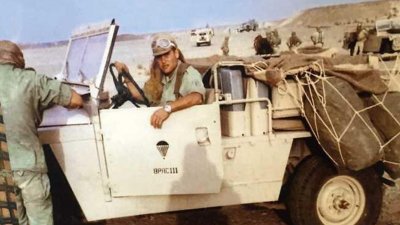
When Spain administered Western Sahara (1884-1975), that land became an opportunity for thousands of Canary Islanders who decided to settle there without ever thinking of returning, something that happened "very quickly and in a rush" the day Spain decided to abandon that territory and evacuate them in Operation Swallow.
This is how Beatriz Andreu, a researcher at the University of Las Palmas de Gran Canaria, explains it to EFE, who dedicated her doctoral thesis, *The Search for El Dorado in the Sahara*, to this topic.
"The different economic crises that occurred in the Canary Islands made the Sahara a nearby place to go, where there was secure work and, in addition, you earned three or four times more, in certain jobs," Andreu details
The historian recounts that it was from the forties and fifties onwards that they began to settle there, in a land rich in phosphates, with oil, and with one of the largest fishing banks in the world.
The Sahara was a colony where "highly stratified" relationships were established, in which, as a general rule, officials and military personnel came from peninsular Spain, and merchants, carpenters, mechanics, and people of other trades were Canarians.
The majority presence of Canary Islanders meant that to the cinema and bar leisure of the sixties Canarian wrestling was added, with the consortium of companies to build the phosphate pier of Bucráa even having its own team and the most important in the Sahara: Unión Temporal.
"Relations in general are good among everyone, but let's say that the greatest closeness seems to be between the Sahrawis and the Canary Islanders," Andreu says."Life there was peaceful. I had a very good time. When I left, I cried, and everyone on the plane did, because I knew I wasn't going back," Josefa, an 80-year-old resident of Las Palmas, tells EFE. She lived in the Sahara for four years while her husband worked as an engineer on the construction of the port of El Aaiún.Canarian migration to the Sahara **was stable and familial:** "They settled there with the idea of living, they built their lives there, and the thought of returning never crossed their minds," the historian points out.
But it is then, at the end of 1975, when Morocco announces a march towards the Sahara, Spain renounces the administration of the territory, and the operation is organized to evacuate all Spaniards residing there to the port of Las Palmas.
An Emotional Gap
For the historian, Operation Swallow was a series of "decisions that were made quickly and incoherently" as well as "an emotional, economic, and vital breach for thousands of people who had to abandon their homes".Between 10,000 and 15,000 civilians arrived in Las Palmas de Gran Canaria with that operation, and although some of those people continued their journey to the Peninsula, many remained in Gran Canaria and other islands, where they were originally from
"A setup was established at the port with tents. Civil Protection, the Red Cross, and Caritas were there, among others, to assist them. But there were neither enough homes nor hotels to accommodate all those people," the city chronicler, Juan José Laforet, explains to EFE.
Around 1,000 vehicles and the personal belongings of all those people accumulated in a large area adjacent to the pierIn addition, **the remains of 703 people were also evacuated**, according to documents from the General Archive of the Administration, of which 408 arrived in Las Palmas on December 14 from the cemetery of El Aaiún, after the remains from Villa Cisneros (today Dajla) and La Güera had been previously evacuated
Lack of Work and Housing
That return was viewed with concern by the citizens of Las Palmas de Gran Canaria, who perceived those Canary Islanders from the Sahara as a threat that could take away their jobs and worsen the housing problem.
"It's the discourse we constantly hear today about immigrants, but the curious thing is that, in this case, it was Canarians returning from abroad," narrates Andréu."They lost their lives, their dreams, their homes, their places, their relationships," he says, highlighting the psychological and emotional consequences that this had, especially for the elderly, who, according to several interviewees for his thesis, fell ill and died shortly after arriving.The uprooting is hard for anyone who emigrates, "but, above all, for all those people who, in an avalanche, had to leave a place and no longer had any reference point for anything," he adds, recalling another recent example: the case of those who lost their homes and even the landscapes of their lives with the La Palma volcano.
To manage the situation, the State established compensation for families, merchants, and industrialists, and prefabricated houses were installed on the slopes of the El Lasso neighborhood, which were demolished in 2000.
The most needy families were housed in Cáritas facilities in Las Palmas de Gran Canaria, and by 1977, social housing began to be allocated, which can still be found today in the neighborhoods of Schamann, Las Remudas (Telde), and Jinámar
The chronicler of Las Palmas de Gran Canaria recalls that not everything was negative about the arrival of these people in the city, as many returned with savings and even fortunes and restarted their businesses in the archipelago, as was the case of the Gran Canarian businessman Juan Padrón.
Laforet recalls that the press at the time reported that some 2,000 Saharawis were also evacuated to Gran Canaria, but the rest were left behind.
"For years they were convinced they were Spanish and, suddenly, they were abandoned," adds historian AndreuAnd so, while Operation Swallow was underway towards the Canary Islands, thousands of Sahrawis took the opposite route, towards Tindouf (Algeria), where many still remain today

Add La Voz de Lanzarote as a preferred Google source.
Stay informed with the latest current news.