
PHOTOS: Courtesy of Oceana
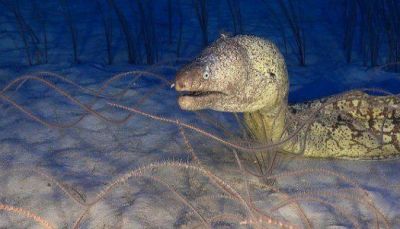
The underwater mountains north of La Graciosa, Dacia and Triton, have been documented for the first time during the expedition that Oceana is carrying out in the area. The images obtained show extensive black coral forests on the summit of Dacia, a great diversity of sponges on the slopes of Triton, including spectacular crystal sponges and carnivorous sponges, and different gorgonians, corals, deep-sea fish or sharks, among other species.
"This has only been a first approach to the unknown depths of the north of the Canary Islands," said Ricardo Aguilar, director of the oceanographic campaign. "It is necessary to obtain more data and carry out detailed studies in order to establish protection systems that allow maintaining the peculiar biodiversity of the Dacia and Triton underwater mountains."
The investigation is being carried out through ROV (Remotely Operated Vehicle) dives, documenting from the summit of Dacia, at about 100 meters deep, to almost 1,000 meters on the slope of Triton. These mountains are located 190 nautical miles and 110 nautical miles north of the island of La Graciosa, respectively.
They are more than 2,000 meters high and rise above a bottom at a depth of about 3,000 meters. Triton consists of two peaks and extends along about 60 kilometers in length, while Dacia has a diameter of just over 20 kilometers.
Banco de la Concepción
Dacia and Triton are part of a group of mountains located between the Canary Islands, Madeira, the Iberian Peninsula and Morocco, serving as connection points for species traveling between these areas. The Spanish Government, through the LIFE+ Indemares Project, has studied another of the marine elevations that belong to this group, the Banco de la Concepción, which will be one of the future marine protected areas of the Atlantic. Portugal, for its part, has presented a plan to protect many of its underwater mountains between the Azores, Madeira and the Iberian Peninsula, such as the Gorringe, Seine and Unicorn Banks.
"These mountains can be considered as the "other" Canary Islands, some of which, although currently submerged, did emerge", says Helena Álvarez, marine scientist at Oceana. "Spain should study and protect these marine mountains so that, together with Portugal, Europe could have an extensive marine protected area where dozens of underwater elevations would house one of the richest and most diverse faunas on the Planet."
Oceana will continue sampling the southernmost underwater mountains of the European Union, the Sahara mountains, about 250 kilometers south of El Hierro, as well as the southern part of this island.


