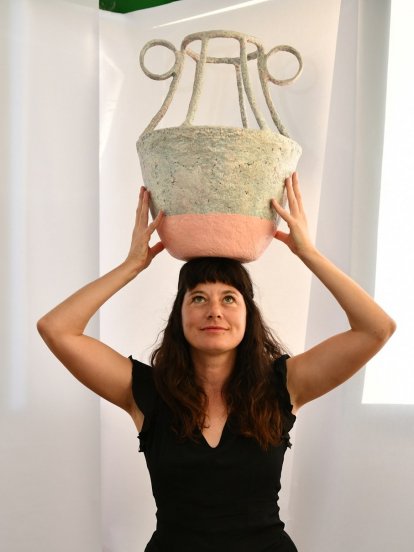
Ever since she was a child, artist Bárbara Turturro, an Italian with a Canarian heart who has lived in Lanzarote for ten years, knew that art was her path in life. At just ten years old, she made an ashtray out of recycled paper for her mother, an object so durable that she still keeps it today and which led her to walk a single path, that of the fusion of art and ecology. A Fine Arts graduate, after the pandemic she decided to found Turba de Papel, a project in which she has dedicated herself body and soul to creating works of art in the form of objects with recycled paper.
From vases and bowls to fruit bowls, sculptures, and furniture made from recycled cardboard and paper, nothing is beyond this artist's reach, who aims to give this material "with soul" a second chance for "the creation of not-so-ordinary objects." In recent years, her talent has led her to participate three times in the Mancha Blanca Craft Fair and in others held in the Canary Islands.
To create his works with utility in everyday life, Turturro makes his own modeling clay, on which he has worked and experimented for over 20 years to achieve the perfect formula. In these objects, imagination and creativity are the protagonists, exploring textures, colors, and shapes. In an interview with La Voz, the artist says that she discovered Lanzarote through José Saramago and César Manrique. From the latter, she drew inspiration on sustainability and art, which led her to visit the island and where "her heart remained".
"From the age of ten, out of necessity, I started recycling materials to make little things to play with, and it has always been something that filled my heart, so I later decided to start a business with it, but with other projects before *Turba de Papel* using as much recycled material as possible, although I realized that **working with a lot of material wasn't very viable** because it's not economically sustainable, so I focused on paper," she says.
Object Creation
The process of creating these objects is long and not at all simple, as the artist does not buy the raw material, although she points out that "that doesn't mean it's free." "I call this participatory art because the neighbors are also part of it," she notes.
During the process, Turturro **makes two distinct pulps and does not mix the paper**. One is white paper that he recovers from Lanzarote's offices, which the companies themselves already shred, and with it, he makes a soak before shredding it with a blender. After draining the excess water, he adds the binder, which is a non-toxic white glue, **always thinking about the sustainability of a finished product**.
After having the dough ready, the process involves shaping the object you want to create. For this, two different techniques are used: one is hand modeling and the other is mold modeling. "In the case of furniture, it is made by hand, under pressure," he details. For furniture, he also uses cardboard and mesh to maintain the structure. "In my works, there is always cardboard or wire, but always biodegradable materials," he says.
After finishing the piece, it is time for drying, which is done in the open air without the need for tools other than wind and sun. The drying time depends on the thickness of the work, from four days for bowls to a month for furniture. Once dry, the last step is to paint them. "I paint with acrylic colors or natural glues that I incorporate into the paper pulp, although it depends on the object," she explains.
In addition, the artist also adds elements of nature to her pieces, such as dates from palm trees or pieces of branches from vines
Lanzarote, a constant inspiration
The landscapes of Lanzarote play a very important role in the objects Bárbara Turturro creates. "There is almost no piece that is born solely from my creativity, they are always an inspiration from nature, mythology, and legends... I really like to read and everything that has been written about Lanzarote, I have read it," she reveals with a laugh.
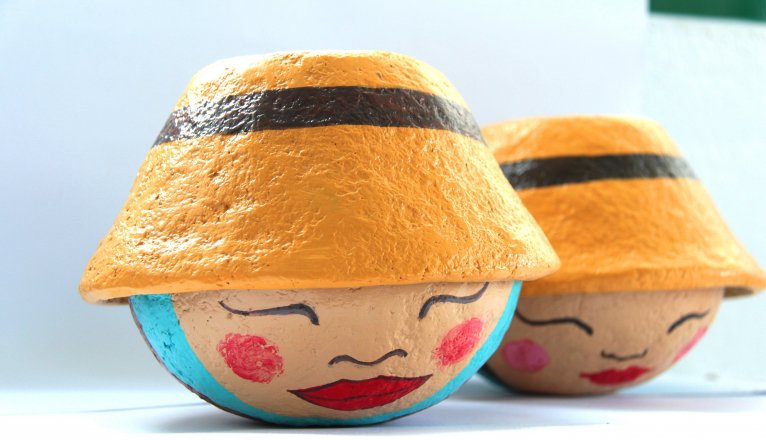
An example of this are the bowls that imitate the heads of jesters, from which the hat that acts as a lid is removed.
On the other hand, the artist emphasizes the **resistance of these objects** despite many people thinking the opposite because they are made primarily of paper. "It's a constant struggle because many people tell you it's a craft or that they used to make them in school... the resistance of the pulp is incredible," she assures.In this regard, she gives the example of the first piece she made as a child, which she still keeps today, more than thirty years later. "It was an ashtray I made for my mother out of paper pulp, and I've used it as an example when presenting my brand," she says. "This piece was telling me two things: one, that it had lasted for over three decades, so **paper is not fragile**, and the other is that it had **fire resistance**," she continues. Likewise, **it can be washed, it doesn't break if dropped, and it's lightweight**The **lapillis**, small figures that imitate volcanic gravel, **are the artist's best-selling item** and were born from the idea of tourists taking a souvenir from Lanzarote and raising awareness at the same time because "if you want to take a stone from Lanzarote, it's better to take this cute lapilli which is light and you're not damaging the environment."To this day, Turturro continues to investigate the use of paper in art and how it can improve technique to create new works. "My dream is to be able to make a paper sailboat and be able to sail, although I also want to try it in architecture and build a habitable space out of recycled paper," he reveals.
Workshops for children and adults
In her project *Turba de Papel*, the artist also offers workshops to learn how to make your own creations with recycled paper pulp. Those interested can contact Bárbara Turturro through the following link, either through a messaging app or her Instagram profile
The artist is waiting to have a space where she can hold these courses and highlights that she would like to be able to offer free workshops.

Add La Voz de Lanzarote as a preferred Google source.
Stay informed with the latest current news.