
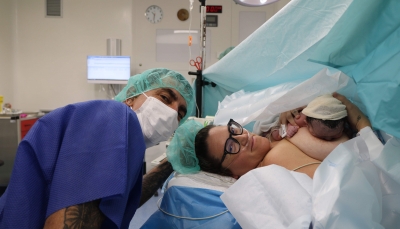
The Doctor José Molina Orosa University Hospital, a center attached to the Ministry of Health of the Government of the Canary Islands, has recently performed the first cesarean section with a companion, launching an accompaniment protocol that aims to strengthen the emotional bond between parents and the newborn and guarantee emotional support for the mother.
Ainhoa, who weighed 2.650 kilos at birth and measured 45 centimeters, is the second daughter of Andrea and Orlando, has become the first baby born at the Molina Orosa Hospital by a cesarean section with the presence of her father, who has been present from the first moments of monitoring until the mother's recovery.
“It has been an incredible and exciting experience,” the parents say, and it has been completely different from the first birth, also by cesarean section. In fact, Andrea Morales does not hesitate to affirm that “it has been a healing process of my first experience”, and that is because on this occasion the parents have experienced it as a joint experience.
The mother has felt accompanied and protected at all times during the intervention and in the resuscitation, and the father, Orlando, has not had to spend the hours of waiting and nervousness that he experienced two years ago, during the birth of his first daughter, Aroa.
A more humanized cesarean section
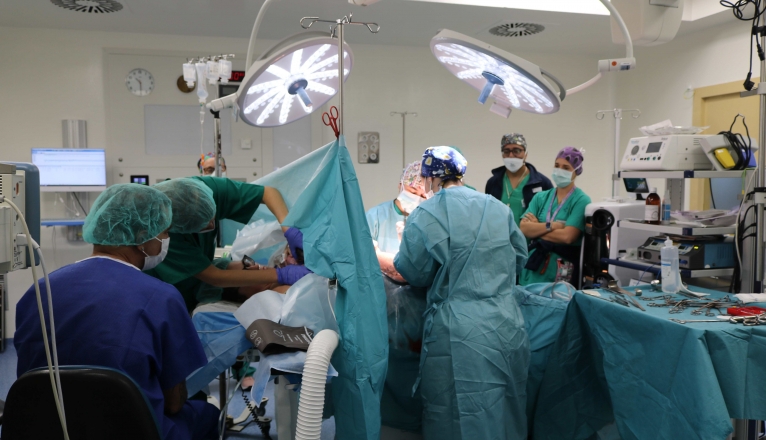
The new protocol, launched by the professionals of Gynecology, delivery room, primary care midwives, Nursing, Anesthesiology and Pediatrics, allows to deepen the practices of humanization and tries to bring, as far as possible, the experience of cesarean section to a natural birth, guaranteeing at all times the clinical safety of the mother and the newborn.
In fact, and despite being a major surgery, this protocol aims for the mother to be fully aware of the birth of her baby with her partner or the person chosen.
In this way, the accompaniment is contemplated for scheduled non-urgent cesarean sections in which risks or complications are not initially assessed. Urgent cesarean sections and those of high obstetric risk are excluded from the protocol, as well as those that present maternal-fetal instability or problems related to anesthesia, in which accompaniment in the operating room is not recommended.
The new protocol offers a more humanized birth and adds to other measures that are already being carried out in the same sense, such as skin-to-skin contact that is guaranteed in natural births and cesarean sections.
The objective of this measure is to generate a positive cesarean section in which the mother feels supported, emotionally supported, and actively participates in the process, despite it being a surgical act. The companion, for his part, plays a fundamental role, and makes the woman feel safer, cared for and emotionally accompanied, which improves the perception of childbirth and helps the cesarean section to be experienced as a more pleasant experience.
More than a thousand births in 2024
The Doctor José Molina Orosa University Hospital registered a total of 1,040 births during the year 2024, which represents a slight decrease of 4.31 percent compared to the previous year, of the total number of births, 774 took place naturally and 248 occurred by cesarean section and epidural anesthesia was administered in 71.2 percent of the total. Of the total number of births, eighteen multiple births were registered, 521 were boys and 519 were girls.
The care for births in the delivery room unit is provided by a staff composed of seventeen midwives, five nurses, five nursing assistants and five orderlies. A team of professionals that develops its work in five delivery rooms, two monitoring rooms and one exploration room. All these spaces guarantee the care and recovery of both mothers and newborns.


