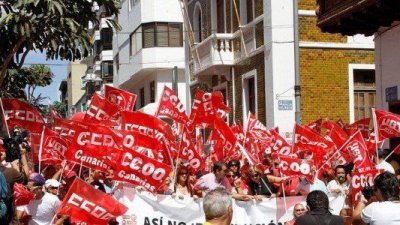
"Psychological damages derived from the organization of work must also be analyzed as a result of a work accident." That is the message that Comisiones Obreras in Lanzarote has launched, which denounces that mental health "continues to be the great forgotten in companies." According to the union, "the tendency to camouflage these damages in Social Security not only affects the affected worker but also Social Security itself, which is assuming an expense that does not correspond to it, and finally the health of the company, since the cause of these is not investigated to prevent it from affecting other colleagues."
In this regard, the union recalls that the General Law of Social Security clearly indicates that "a work accident is understood as any bodily injury that the worker suffers on the occasion or as a consequence of the work they perform on behalf of another," so it considers "evident that it includes injuries of a psychological, behavioral or psychosomatic nature derived from the organization of work." However, it regrets that "workers affected by this type of ailment face a frustrating pilgrimage that usually ends in Social Security."
In the opinion of CCOO, "this situation could be one of the factors behind the waiting list of more than six months to be seen by Mental Health of the Canary Islands Health Service in Lanzarote." In fact, Ico Tabares, occupational health advisor of CCOO in Lanzarote, indicates that "many workers come to the Office who, having suffered episodes of organizational violence in their workplace that has resulted in damage to their health, the Mutual Insurance Company refuses to attend to them because they do not consider its origin to be work-related." And "the most surprising thing," she adds, "is that in most cases, there is even a clear and verifiable event after which the worker goes either to the Emergency Room or to the Mutual Insurance Company in the midst of an anxiety crisis and still they are not considered a work accident."
"Relapse is a matter of time"
CCOO emphasizes that "the legislation on occupational risk prevention establishes the obligation of companies to investigate all work accidents that cause damage to the health of workers, without mentioning the type of factor or the nature of the damage." In addition, "the existence of damage obliges to review the evaluation of occupational risks to determine if the proposed measures are being implemented and if these are the most suitable." However, it questions that "this obligation disappears if these medical leaves are not caused by a work accident, thus perpetuating the toxic organizational situation in the company."
"Unfortunately, when the worker affected by this type of damage returns to their job without the cause having been investigated to put in place corrective measures, they are exposed again to the same situation that led them to medical leave," warns the union, which points out that "in that case, relapse is a matter of time."
In addition, it emphasizes that "it is not about whether we are talking about workplace harassment or not," since "that would simplify a much more complex situation." "Workplace harassment is an extreme situation where the destruction of the victim is pursued and that is currently included in the Penal Code. In order for it to be considered as such, a series of premises must be met in terms of its nature and its existence or permanence in time. However, without reaching workplace harassment, there is a range of intolerable situations in the workplace and that, like any other risk, is not only measurable but must be worked on to eliminate them or minimize their consequences," it points out.
Among these "psychosocial risk factors," CCOO cites some such as "psychological demands," "autonomy," "role clarity," "compensation," and "social support," which have been studied by specialists, but also "bosses who disrespect their employees, who exercise abuse of authority," "constant work overload," "lack of resources to correctly execute tasks," "not having clear functions or responsibilities," "staff divided by unequal treatment," "not having the necessary information to perform the work," "not being able to trust the superiors to solve problems," "exaggeration of errors," "feeling of being undervalued," or "not being proud of the service you provide for not having either the time or the necessary materials."
"A toxic work organization"
"These are brushstrokes of what a toxic work organization potentially harmful to the workers who develop their professional activity in it can mean," says CCOO, which questions that "despite the existing technical-scientific evidence, we find that most companies continue to ignore psychosocial risks and that the Mutual Insurance Companies continue to reject this type of damage to the health of workers as derived from their work."
For this reason, the Insular Union of Lanzarote wanted to "highlight the effects that work organizations that ignore psychosocial risks can have on health" and make "a call for active policies to be bet on in preventive matters and for occupational health to be on the political agenda at all levels." For this and in order to commemorate the international day of safety and health at work, it has organized a training day under the title "Psychosocial risks: beyond workplace harassment," in which José Miguel González Hernández (director of labor of the Government of the Canary Islands), Andrés Fernández Temprano (provincial head of the Labor Inspectorate), Jesús Martínez Perdomo (coordinator of the Mental Health Unit of the Canary Islands Health Service), Heredina Fernández (psychologist of the Canary Islands Health Service), Miguel Ángel Figueroa (coordinator of the training program of ICASEL) and Ico Tabares (occupational health advisor of CCOO) will participate.
The opening of the event, which will begin at 9 a.m. next Friday, April 26 at the Civic Center of Arrecife, will be in charge of the general secretary of the Insular Union of Lanzarote CCOO, Vanesa Frahija, and the closing will be carried out by Francisco Martínez León, secretary of trade union action of the Insular Union of Lanzarote CCOO.


Add La Voz de Lanzarote as a preferred Google source.
Stay informed with the latest current news.