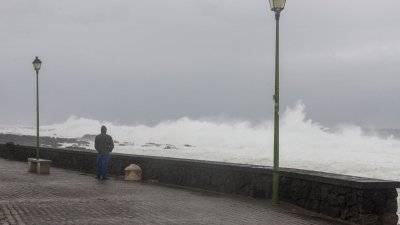
Canary Islands closes a normal and humid climatological winter, in which a slight warm anomaly in February and the passage of three high-impact storms, a record number, which have entered from the north and have not been Atlantic, as is usual, and are associated with climate change.
This was stated this Tuesday at a press conference by the delegate of the State Meteorological Agency (Aemet) in the Canary Islands, David Suárez, who stressed that in recent months "the ceiling has not been reached" in the islands regarding minimum temperatures, since "December was the 21 degrees coldest (of the historical series) and January the 29 degrees", although he admitted that there has been a change in trend compared to the previous winter.
Although this week a cold anomaly of between 1 and 3 degrees less than the historical average is registered, these values below normal will tend to soften slightly in what remains of March, when "a very radical change in trend" is not expected, although he warned that the monthly forecast does not yet reach Easter, which can be consulted shortly on the Aemet website.
At the gates of spring, which in the islands will begin at 2:46 p.m. on next March 20, Suárez has reviewed the climatology recorded in the archipelago between December 1, 2025 and February 28, 2026.
From the point of view of temperature and precipitation, it has been a "slightly warm winter, but from a statistical point of view, it has had a normal and humid character".
Throughout the month of December and, practically all of January, temperatures were below normal values, with the coldest anomaly, of 4.4 degrees down on December 13, associated with the passage of storm Emilia.
However, from February onwards the behavior has been very different and temperatures have been practically above normal, with the peak recorded on the 23rd, when the anomaly reached 5 degrees in the context of a calima episode.
From a regional point of view, the average temperature for the entire winter in the Canary Islands has been 15.4 degrees, which represents a normal character and a slight positive anomaly of 0.2 degrees, he specified.
The described climatological behavior showed 27 low temperature records in December, five in January and 13 in February, but associated with high temperatures.
The Canarian winter has been humid, as shown by the average rainfall recorded, which has been 22% more than expected, although in December it was 33% more and in January it rained "almost twice what was expected", while February was a dry month, as it rained half of what it should have rained, he referred.
David Suárez also highlighted the two important calima episodes recorded in February, with an average concentration of 256 micrograms per cubic meter of air, and recalled that the most frequent period of calima in low areas of the islands is between the months of December and February.
In addition, he reported that the Canarian winter had 641 hours of sunshine, a value slightly above average, while the sea temperature has registered a slight positive anomaly, with an average of 20.36 degrees



Add La Voz de Lanzarote as a preferred Google source.
Stay informed with the latest current news.