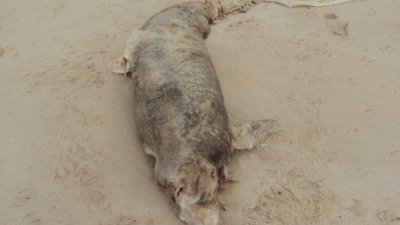
The Environmental Agents Corps of the Cabildo of Fuerteventura removed a new cetacean cadaver from the island's coasts last Monday. Due to its state of decomposition, "it could only be determined" that it was a dolphin. Environmental agents believe that "it could have been dead for between 25 and 30 days." From the Majorera Corporation they have pointed out as a result of this stranding, the seventh in the last three months, that "since the surveys the average is one per week, compared to the average of less than one per month in previous dates."
The cadaver, 1.75 meters long and weighing about 85 kilograms, was located in the cove of El Médano, north of the Grandes Playas de Corralejo, on the morning of Monday, February 2, and was removed with the collaboration of the Local Police of La Oliva.
The Cabildo of Fuerteventura recalls in a note that, "without a direct relationship being verifiable between these events, during the oil explorations the Ministry of the Environment has registered the death of seven cetaceans on the Majorero coast." "In all cases, the strandings took place on the leeward coast, facing the exploration area," they point out.
"Figures higher than usual"
The Councilor for the Environment of Majorera, Natalia Évora, reiterated the position she has already stated on previous occasions. "We are not saying that the explorations were the cause of these deaths, because we do not know. In any case, it should be the scientists who solve it for us, but the reality is that the figures are much higher than usual," she indicated.
The first cadaver appeared on November 20, 2014 in Costa Calma. It was a pygmy sperm whale, as was the specimen found on December 9. On January 11 and 15, two dolphin calves appeared on different beaches on the west coast of Fuerteventura. On January 25, the cadaver of an Atlantic spotted dolphin was found in Punta de Jandía, while the body found on the 27th of that same month was that of a bottlenose dolphin.
From the Majorero Cabildo they point out, according to the dates of the findings, that there has been "exactly one stranding every seven days." "According to the records of the Ministry of the Environment of the Cabildo, in the entire year 2013 there were 12 strandings of cetaceans, and in 2014, between January and mid-November, another 8, which means an average of less than one stranding per month," they point out.


Add La Voz de Lanzarote as a preferred Google source.
Stay informed with the latest current news.