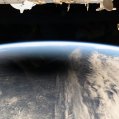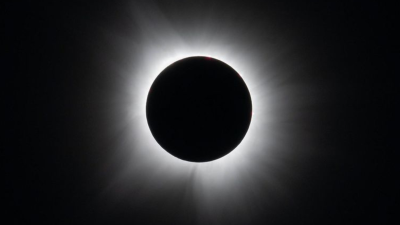
A solar eclipse occurs when the Sun, the Earth, and the Moon align, the latter being in a new moon phase and positioning itself between the two celestial bodies, generating a partial or total light blockage.
This phenomenon occurs on average twice a year in different areas of the Earth and its study is very important for the National Aeronautics and Space Administration (NASA). According to the National Geographic Institute (IGN), there are years when phenomena occur that allow for more than two eclipses a year, reaching five episodes in one year, as happened in 1935 and will not be seen again until 2206.
According to NASA, there are four types of solar eclipses that can occur depending on the alignment of the Moon with the celestial bodies and from where it is observed.
A total solar eclipse is the complete blockage of the sun, generating a shadow on Earth, as if it were dusk at that moment. On the contrary, a partial solar eclipse occurs when the Moon positions itself between the Sun and the Earth, but not perfectly, without generating that complete shadow and only covering a part of the sun. A small portion of the population will be able to see the complete blockage, while the majority will observe the eclipse partially.
An annular eclipse happens when the celestial bodies align but the Moon is at its farthest point from Earth. This causes the Moon to appear smaller than the sun, and a "ring of fire" is observed around it, as it cannot be completely covered. Additionally, low light intensity is observed, but it does not generate any shadow on Earth, meaning it does not darken during those moments.
Finally, a hybrid eclipse, also known as a mixed eclipse, occurs rarely because it has the rarity of experiencing both a total and an annular eclipse due to the Earth's curvature. In parts of the planet, a total eclipse will be seen, while in other locations, it will transition between total and annular as the Moon's shadow moves across the Earth's surface.
During total eclipses, we can exclusively observe a ray of light coming from the Sun's outer atmosphere, known as the solar Corona. This phenomenon is still being studied by scientists, and therefore, the total eclipse is very important. The latest studies conducted by NASA found that the temperature of the Corona remains constant and that a solar cycle occurs with a rotation change over a duration of 11 years.
The next solar eclipses in the Canary Islands will be visible on August 12, 2026, and August 2, 2027, with a partial solar eclipse, and on January 26, 2028, an annular eclipse will take place which will be best seen in the western islands, according to the IGN.
Main differences between a solar eclipse and a lunar eclipse
The solar eclipse aligns in such a way that the Moon is between the Sun and the Earth, whereas in a lunar eclipse, the Earth is in the middle. Furthermore, solar eclipses occur during the new moon phase and exclusively during the day, unlike the lunar eclipse, which occurs during the full moon phase and at night. Likewise, NASA explains that it does not happen every month due to the lunar rotation that causes it to pass above or below the Earth.
Add La Voz de Lanzarote as a preferred Google source.
Stay informed with the latest current news.