
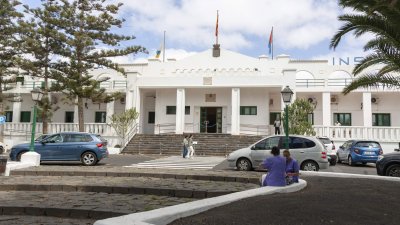
Francisco Franco arrived in Lanzarote during an official visit to the Canary Islands and Western Sahara. In Arrecife, a reception was organized with protocol events and folkloric performances. Among the events of that day was the inauguration of the Insular Hospital, an infrastructure that responded to a long-standing health need expressed by the population.
Behind the official ceremony was a decades-long story: the commitment of doctor José Molina Orosa to provide the island with adequate facilities and the economic difficulties that conditioned the center's early steps.
A hospital the result of decades of demands
The history of the Insular Hospital dates back to the early years of the 20th century. Its main promoter was José Molina Orosa, a doctor born in Arrecife in 1883, who made the improvement of healthcare one of the main objectives of his professional career.
According to biographical documentation from the César Manrique Foundation, Molina Orosa had been working to make the project a reality since approximately 1910. His commitment lasted for decades, in a context marked by a scarcity of resources, communication difficulties with the outside world, and the inadequacy of available facilities to care for the sick.
Until then, Lanzarote had very limited healthcare resources. The creation of its own hospital was essential to improve care and reduce dependence on transfers off the island.
The project began to materialize in 1944, when the Cabildo acquired land in Llanos de Naos from the heirs of Fernando Pereyra Galviaty. The transaction, according to the historical reconstruction consulted, was closed at five pesetas per square meter.
The construction required funding and collaboration from various institutions, as well as new financial contributions. Erecting the building represented a decisive advance, although the lack of budget hindered the hiring of staff, the acquisition of equipment, and the launch of services.
The visit to Arrecife: a political day
On that October 28, Franco arrived on the island aboard the Navy cruiser Canarias, as part of an official tour of the archipelago and Western Sahara. After visiting Fuerteventura, he disembarked in Arrecife, where the streets had been decorated and a reception prepared on the maritime avenue.
The preserved images show a large crowd and various official acts. One of the highlights took place in front of the old headquarters of the Insular Council, now Casa Amarilla, from whose balcony he addressed the attendees.
The day was recorded in the NO-DO newsreel, whose images allow us to know the appearance of the city and some events of the visit. Due to its propagandistic nature, this material should be interpreted with caution: the presence of a crowd does not in itself allow us to determine the degree of political adherence of the population to the regime.
The entourage also traveled to the Montañas del Fuego, where the use of volcanic heat was one of the development possibilities studied for Lanzarote. Manuel Chamorro developed this line of work in the Plan for irrigation and industrialization of the islands of Lanzarote and Fuerteventura, published in 1951, which proposed combining the energy resources of Timanfaya with wind energy and water desalination to boost agriculture and industry.
The idea had technical precedents, including a 1949 study on the possibilities of harnessing the heat of Montaña de Fuego. However, the documentation consulted does not allow us to specify what explanations the visitor received during that tour or what concrete decisions were made regarding the project.
The historical reconstruction places the entourage's departure that same night, aboard the cruiser Canarias. However, a complete and verified chronology of all their movements is not available.
An inauguration that did not end shortages
The official inauguration of the Insular Hospital is dated October 28, 1950, although there are chronological references that mention 1951. The specific documentation linked to the October event supports the date used in this article, although the discrepancy should not be considered definitively resolved until additional primary documentation is consulted.
The ceremony did not mean that all departments and services were available from the outset. The incorporation of services was progressive and was conditioned by economic and personnel limitations.
The investigation by Gregorio Cabrera, included in the book José Molina Orosa. Light in darkness, indicates that the center began its trajectory with a general medicine ward of ten beds, in addition to facilities related to the asylum and the Children's Home. The pavilion for tuberculosis patients was still pending.
The ten beds corresponded exclusively to that general medicine ward, not to the total capacity of the establishment. Nor has sufficient documentation been found to establish when each facility began to operate.
In mid-October 1951, almost a year after the inauguration, the hospital still faced significant economic and healthcare limitations. The distance between the official ceremony and the effective availability of services reflects the difficulties of the early years of an essential infrastructure for the Lanzarote population.
José Molina Orosa, the doctor who made the project possible
The main promoter of the Insular Hospital did not attend the official inauguration, according to the biographical information disseminated by the César Manrique Foundation based on Gregorio Cabrera's study.
His absence contrasts with the public relevance of a ceremony that culminated, at least formally, an aspiration to which he had dedicated a good part of his life. No documentation has been found to establish why he did not attend, so it is not possible to attribute personal or political reasons without further evidence.
Molina Orosa remained linked to the center and directed it until his retirement in 1953. His career received subsequent recognition when the hospital adopted the name Hospital Doctor José Molina Orosa, by order of the Ministry of Health published in the Official Gazette of the Canary Islands on March 3, 2008.
His legacy transcends the construction of the building and represents the effort to improve patient care on an island that for decades had very limited healthcare resources.
César Manrique and the transformation of Las Palmas square
The official visit coincided with a transformation of the urban space of Arrecife. In 1950, the City Council commissioned the young César Manrique to beautify Las Palmas square, in front of the church of San Ginés.
The remodeling coincided with the construction of the Cross of the Fallen, a monument linked to Francoist symbology that was not part of Manrique's original design. The historical study on the remodeling indicates that the cross was commissioned separately and was to be completed before the arrival of the entourage.
The monument was finished on October 28, 1950, although its formal blessing and inauguration did not take place until 1956. Distinguishing between these two moments allows for the reconstruction of the square's evolution without attributing authorship of an element not present in his plans to the artist.
The space constitutes another setting for Arrecife's historical memory, where urban transformation intertwines with the political symbols of the dictatorship.
From the historical hospital to the collective memory of Lanzarote
During the following decades, the Insular Hospital evolved and assumed various healthcare functions, including geriatric care. Its trajectory reflects the changes experienced by public healthcare and the social transformations of Lanzarote.
In 2019, the center came under the responsibility of the Canary Islands Health Service and maintained its historical identity as a specialized space for the care of the elderly. Its evolution has also raised questions related to the conservation of the building and its adaptation to healthcare needs.
Reducing that day to the official visit would mean sidelining those who made the project possible and sustained its activity under difficult conditions.
The history of the Insular Hospital is, above all, that of a healthcare demand driven by José Molina Orosa and shared by a society that needed better medical services. Between the political representation of the regime and the shortcomings of the early years, the center became a fundamental piece of Lanzarote's collective memory.
Documentary sources
• César Manrique Foundation. Gregorio Cabrera, José Molina Orosa. Luz en tiniebla, Islas de Memoria collection.
• Antonio J. Montelongo Franquiz and Marcial A. Falero Lemes, El Puerto del Arrecife, Cabildo de Lanzarote and Ayuntamiento de Arrecife (2000).
• Manuel Chamorro, Plan de riegos e industrialización de las islas de Lanzarote y Fuerteventura (1951). • Government of the Canary Islands. Technical document on geothermal energy that includes the 1949 study on the exploitation of heat from Montaña de Fuego.
• Historical study Historical memory: remodeling of Plaza de Las Palmas (2018), on the intervention of César Manrique and the chronology of the Cross of the Fallen.
• Government of the Canary Islands. Order of February 20, 2008 on the naming of the Doctor José Molina Orosa Hospital, Official Gazette of the Canary Islands, no. 45, of March 3, 2008.


Add La Voz de Lanzarote as a preferred Google source.
Stay informed with the latest current news.