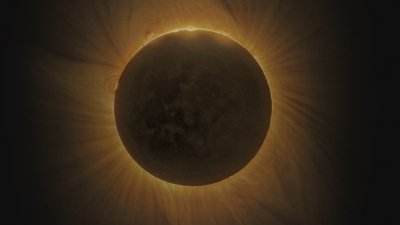
The next August 12, a solar eclipse will take place in Spain. The Canary Islands will not have a totality strip as occurs in some areas of the peninsula but it will be visible in Lanzarote from 72.64% in the south of the island, to 73.78% in the north, according to the IGN (National Geographic Institute).
The 100% visibility is a historical phenomenon that has not occurred since 1959 in the Canary Islands and that we will not have the chance to see for more than a hundred years. However, in the Iberian Peninsula, where such a phenomenon has not occurred since 1912, they will again see a total solar eclipse in 2027.
The duration of the eclipse is approximately two hours, it will begin around 6:30 PM and there will be no culmination moment as there is no total visibility strip of the phenomenon.
Where to watch the eclipse
When choosing the perfect place to observe the solar eclipse, the scientific communicator and staff member of the Elder Museum of Science and Technology, explains that we should look towards the sunset, that is, the west horizon and have clear skies. Some of these areas, according to Viajes National Geographic, would be Famara, Mirador del Río, Punta del Papagayo, Los Hervideros and La Santa.
According to what we have learned, the Elder Museum of Science and Technology will be at a point on each island to observe this phenomenon. In Lanzarote, the chosen site is Tinajo, pending the exact location to be provided by the city council.
Damage and where to get approved glasses
The observation of eclipses cannot be done directly without any protection; approved glasses must be used, otherwise there would be serious consequences for the retina.
“Neither X-rays, nor plates, nor welding glasses, nor old photo negatives, nor six pairs of sunglasses” are by any chance a safe protection for the scientific communicator, only approved glasses are useful.
He also assures that without adequate protection, the damage caused by the solar eclipse is not instantaneous and there are many serious consequences, among which he highlights retinal burning. Gregorio de la Fuente compares it, saving the distances, to a skin burn “you get burned and while you are burning you don't feel it, until the next day when it bothers you and you notice the skin is reddish” he assures that “that burn on the retina does not hurt, nor does it have to be years later and can appear with retinal detachment, blindness…”
Approved glasses can be obtained at opticians, pharmacies, and supermarkets at prices ranging from 1.49 to 5 euros. Likewise, whoever goes to the Tinajo meeting point, the Elder Museum will distribute approved glasses for free.
Activities
Elder Museum staff will be at the point chosen by the Tinajo City Council with material to facilitate the visibility of the eclipse such as the telescope, adapted to the solar phenomenon. It will also feature explanations and workshops for children as well as the distribution of free approved glasses.

Add La Voz de Lanzarote as a preferred Google source.
Stay informed with the latest current news.