
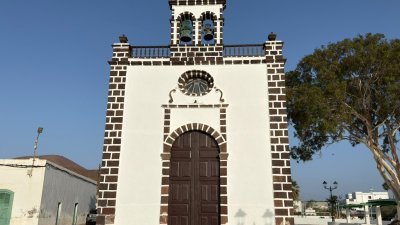
There are stories that are born in archives and others that survive in the memory of peoples. That of the Christ of the Waters of Guatiza belongs to both dimensions, although not with the same intensity. We know that a devotion existed and exists, we know that a church was built under that invocation, and we can document much of its evolution. What we do not have is the document that certifies the exact moment when that image of Christ would have appeared floating off the coast. And yet, the story has survived.
It survived because it speaks of something that for centuries determined life in Lanzarote: water. On an island where rain was never a sure element and where a succession of dry years could turn a bad harvest into hunger, emigration, and poverty, the arrival of a crucifix from the sea, and that shortly after it began to rain, could not be an indifferent episode for those who lived it or for those who received the story from their elders.
Tradition places the episode in the Caleta del Riadero, on the coast of Guatiza, next to the area of Los Cocoteros. There, after a prolonged drought of three years, a shepherd who was near the coast saw an object in the water that, due to its shape and dimensions, made him think it could be a human body. Upon approaching, he discovered it was an image of a crucified Christ. He took it out of the sea and brought it to the village. Shortly after, the rains arrived, and with them, a time of better harvests. Thus, according to transmitted memory, the Christ of the Waters was born.
This is not a story that appeared recently to feed the tourist attraction of Guatiza. The tradition is part of local historiography and was collected by Agustín de la Hoz in his work Lanzarote, published in 1962. Subsequent academic research has reproduced the episode and expressly cites De la Hoz when explaining the origin of the invocation. The academic source preserved by the University of Las Palmas de Gran Canaria indicates that the Christ received its name after appearing floating in the Caleta del Riadero and that the event became related to the rains after three years of drought.
But precisely because the story is attractive, it is advisable to tell it carefully. One thing is to affirm that the tradition exists and another is to turn each of its details into a proven fact. The document that allows establishing the exact day or year of the apparition has not been located. In various current publications it is repeated that it occurred "in the mid-19th century", but this dating does not appear to be supported, in the primary documentation located, by an act or file that allows it to be fixed with certainty.
To understand why the story could acquire so much strength, one must place oneself in the Lanzarote of those centuries. The island depended extraordinarily on scarce and irregular rainfall. Agriculture and livestock were subjected to permanent uncertainty, and prolonged periods without rain could cause devastating consequences. Historical documentation confirms that droughts were one of Lanzarote's great calamities. In the 19th century, episodes of hunger and poor harvests even stimulated migratory movements and aggravated the fragility of communities that lived dependent on water.
That context helps to understand the deep meaning of the tradition of Christ. Rain was not simply a meteorological change. It could represent the difference between staying on the island or leaving, between harvesting or losing everything, between feeding the livestock or seeing it disappear. That is why the story of a Christ who arrives from the sea and announces the rain acquires a dimension that goes far beyond popular religiosity. It is also a story about survival.
The story of Christ is also related to the transformation of the settlement itself. Agustín de la Hoz spoke of "the two Guatizas": the old Guatiza of Santa Margarita and the new Guatiza associated with Christ of the Waters. The population of the old Santa Margarita area was moving to other spaces, and the new Guatiza grew in a more sheltered place. The change also had a defensive dimension: the exposure of certain settlements to the coast and to pirate and corsair landings was part of the island's historical experience.
The new population needed its own religious services. And here the legend begins to meet the documents. One of the most solid pieces of data from the entire investigation is 1832. A study by José Concepción Rodríguez, published in the II Conference on Studies on Lanzarote and Fuerteventura, documents that in that year the construction of the temple of the Santo Cristo de las Aguas in Guatiza began. The research is supported by a file preserved in the Diocesan Archive of Las Palmas, related to the request of the neighbors to have a closer temple, given the distance to the old hermitage of Santa Margarita.
The file is especially interesting because it reflects a specific need of the inhabitants. The neighbors claimed a religious solution for the community that had been consolidating in the new nucleus. We are not, therefore, facing a church built solely for artistic or architectural reasons. Its construction also responds to population growth and a social and religious need. The chronology of Memoria de Lanzarote also records 1832 as the year in which the construction of the Church of the Santo Cristo de las Aguas began.
The date of 1832 forces us to look cautiously at the assertion, repeated today in some publications, that the Christ appeared "in the mid-19th century." If in 1832 a temple dedicated to the Santo Cristo de las Aguas was already being built, the invocation and the presence of the image must have had, at a minimum, a prior context that we still need to document better. The issue is not resolved: there may be different construction phases, there may be an earlier tradition linked to a previous place of worship, and it is also possible that the publicized dating of the finding is too late.
A specialized source on Lanzarote's architecture maintains precisely that the current building was erected starting in 1869, while before there would have been another church, chronologically located between the late 17th and early 18th centuries. That interpretation relates the primitive church to the tradition of the Christ found in El Riadero after three years without rain. This is a clue of great interest, but it must remain in the realm of hypothesis until the documentation allows for a definitive reconstruction of the different phases of the temple.
What we can document is the consolidation of the devotion. In 1890, several residents of Guatiza approached the Teguise City Council to request a space for a cemetery. In the document, they explained that the inhabitants of Guatiza and Mala had obtained a Parish Aid, established in "the other hermitage" existing in Guatiza, under the invocation of the Santo Cristo de las Aguas. That administrative reference demonstrates that at the end of the 19th century, the Christ was already fully part of the religious organization and daily life of the community.
The 1890 document also has social value. The residents needed a cemetery to avoid transporting the deceased to another space, located, according to the file, about ten kilometers away. The history of the Christ thus ceases to be solely that of an image and a supposed miracle: it appears linked to the construction of a community, to its material needs, and to the consolidation of a population center with its own identity.
The evolution culminated, decades later, with the creation of the parish. On May 10, 1915, the parish of the Santo Cristo de las Aguas was formally created to serve Guatiza and Mala. The date allows us to complete a trajectory that began much earlier: a tradition born in the memory of a maritime discovery, a community that claims a temple, a construction documented since 1832, a parish aid at the end of the 19th century, and, finally, a parish formally constituted in the 20th century.
The image itself also retains questions. Various sources indicate that it presents characteristics of the Sevillian school, although its author has not been identified. It has even been suggested that it could have been an image whose original destination was America and that, due to unknown circumstances, it ended up arriving in Lanzarote. But we have not located documentation that allows us to affirm this hypothesis as a fact. It must continue to be treated as an open possibility, just as there is no primary proof that explains exactly how the sculpture reached the coast of Guatiza.
There is, however, something profoundly symbolic in the story. The Christ would not have arrived by land, nor by a known route, nor at the hands of an identified sculptor. Tradition says he arrived from the sea. And the sea, in the history of Lanzarote, has been at the same time a path, a threat, and a border. Conquerors, merchants, pirates, emigrants, and goods arrived by it; by it also departed the people of Lanzarote who had to leave the island in times of hunger and drought. That a religious image appeared precisely in that space turns the story into a profoundly Lanzarotian story.
The feast of the Santo Cristo de las Aguas is celebrated on September 14, but this date also needs clarification. We cannot claim that the image appeared in the sea on September 14. The date corresponds to the religious celebration, not to a day of discovery that has been documentarily proven. That difference may seem small, but it is essential when one intends to transform a tradition into a historical commemoration without losing rigor.
Perhaps that is why the story still retains some mystery. We know where tradition places the discovery: the Caleta del Riadero. We know what appeared: a crucified Christ. We know what happened next according to the memory transmitted over generations: the rains arrived after three years of drought. We know that the devotion was consolidated in the 19th century and that in 1832 a temple dedicated to the Santo Cristo de las Aguas was already being built. We know that the tradition was collected by Agustín de la Hoz and that it has subsequently been studied from the perspective of art history, architecture, and heritage.
What we still do not know is equally important: the exact day of the discovery, the precise year, the identity of the neighbor who would have recovered the image, and the documentary relationship between the traditional episode and the different construction phases of the temple. Nor can we assume that the image was originally destined for America. The absence of such proof does not invalidate the tradition; it simply marks the boundary between what we can document and what belongs to collective memory.
Perhaps that border is precisely what makes the story so attractive. Communities do not always preserve what appears in a document. They also preserve what explains who they are. For Guatiza, the Christ of the Waters seems to have fulfilled that function for generations. His story unites landscape and faith, sea and land, drought and rain, the old Guatiza of Santa Margarita and the new population that grew around his devotion.
It is a story of fear and hope. First there is the drought. Then an image appears in the sea. Then the rain comes. We do not know if it happened exactly like that. Documentary history cannot prove the miracle. But it can prove something perhaps more important: that this story became an essential part of the memory and religious identity of Guatiza. And on an island where water has always been a matter of survival, it is not difficult to understand why a Christ who arrived from the ocean after three years of drought ended up being called, simply, the Christ of the Waters.
Every September 14, Guatiza celebrates its Christ again. It does not celebrate a religious image alone. It also celebrates a story born between the thirsty land and the sea: the story of a Christ who, according to tradition, arrived floating and who, shortly after, brought the rain.
Sources and contrasted documentation
Agustín de la Hoz, Lanzarote (1962), p. 154, cited by later research on the Christ of the Waters.
José Concepción Rodríguez, "Sculptures by the image maker Fernando Estévez in Lanzarote," in II Conference on Studies on Lanzarote and Fuerteventura, with reference to the file from the Diocesan Archive of Las Palmas and the start of the construction of the temple in 1832.
Memoria de Lanzarote, historical record from 1832 on the beginning of the construction of the Church of the Holy Christ of the Waters.
Historical and municipal documentation reproduced by Guatiza, yesterday and today, especially the 1890 file relating to the cemetery and the Parish Aid of the Holy Christ of the Waters.
Documentation from the Diocese of the Canary Islands on the creation of the parish of the Holy Christ of the Waters for Guatiza and Mala on May 10, 1915.
Research and local sources on the old Guatiza of Santa Margarita, the displacement of the population, and the tradition of the Christ who appeared in Caleta del Riadero.
Sources on the temple's architecture that propose different construction phases and place the current building in the second half of the 19th century; this issue remains a historiographical hypothesis when definitive documentary proof is lacking.
References to a possible American destination for the image and its Sevillian craftsmanship remain hypotheses until primary documentation appears that allows their confirmation.


Add La Voz de Lanzarote as a preferred Google source.
Stay informed with the latest current news.