
The **AMPLÍA project**, led by the University of Las Palmas de Gran Canaria and funded by the European Union's Next Generation Funds, has concluded with the proposal to extend the Biosphere Reserves of the eastern islands to **their surrounding waters**. This would contribute to a zoning more appropriate to the preservation objectives of these UNESCO territories and to the protection of the rich Canarian marine biodiversity.
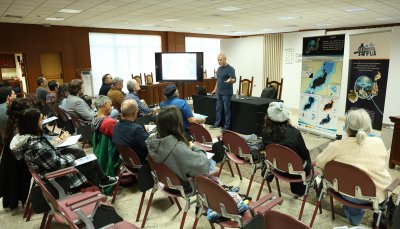
The Doctor of Marine Sciences and director of the project, José Juan Castro, presented the balance and conclusions of the research this Tuesday to maritime professionals, ecologists, and other interested parties, including the counselor of the Lanzarote Biosphere Reserve and the Fisheries department, Samuel Martín, and the Director General of Fisheries of the Canary Islands Government, Esteban Reyes.
The diagnosis, achieved thanks to the collaboration of various scientific and administrative institutions, highlights the importance of effectively including the marine strip within the boundaries of Biosphere Reserves, as a key tool for curbing the deterioration of marine ecosystems and moving towards their recovery.
Exhaustive Review of the Seabed
The AMPLÍA project has allowed for an exhaustive review and update of available biological, ecological, socioeconomic, and fisheries information, in addition to proposing short, medium, and long-term management strategies, in a context marked by climate change. The ultimate goal is to move towards a participatory co-management model of marine ecosystems and resources under the umbrella of the Biosphere Reserves of Gran Canaria, Fuerteventura, and Lanzarote.
According to José Juan Castro, although the Canary Islands constitute one of the national territories with the largest marine protected area, scientific data show that this protection has not translated into a good state of conservation of ecosystems. "Most fish species are overexploited or at their maximum exploitation levels, and there is clear evidence of a significant loss of fishing productivity," he pointed out.
He also highlighted that, in the last fifty years, fish biomass has decreased by approximately 90 percent, while the average size of specimens has diminished by around 30 percent. Added to this is the alarming decline in macroalgae, which have lost nearly eighty percent of their numbers in the last two decades.
During the workshops, held throughout 2025, the scientific conclusions coincided with citizen contributions in identifying areas of disturbance, affected by spills, maritime traffic, noise, etc. "This circumstance makes us optimistic about social awareness of marine impacts and the possibility of continued collaboration between both parties to improve the state of our waters," added the director of AMPLÍA.
The marine strip, key
As pointed out by councilor Samuel Martín, Biosphere Reserves, designated by UNESCO, aim to demonstrate that it is possible to reconcile biodiversity conservation with the sustainable development of local communities: "In the Reserves of the eastern province of the Canary Islands, terrestrial and marine areas coexist, harboring highly productive ecosystems, from sedimentary bottoms that sustain the food chain to large areas where cetaceans, loggerhead turtles, and other marine species of high ecological value are present," explains Martín.In this context, the AMPLÍA project has analyzed the state of the marine biological resources of the eastern Canary Islands to study the advisability of expanding the marine area of the Biosphere Reserves and reorganizing their spatial structuring, so that the protection of the most vulnerable ecosystems and species is truly effective
The work has integrated not only updated scientific information but also the knowledge of key groups, such as professional and recreational fishermen, divers, scientists, and technical staff from public administrations. Through numerous participatory workshops, the indicators obtained have been shared, and progress has been made towards a consensus proposal for marine spatial planning, identifying areas and ecosystems that require greater attention and protection to promote the recovery of biodiversity and ocean abundance in the eastern Canary Islands


