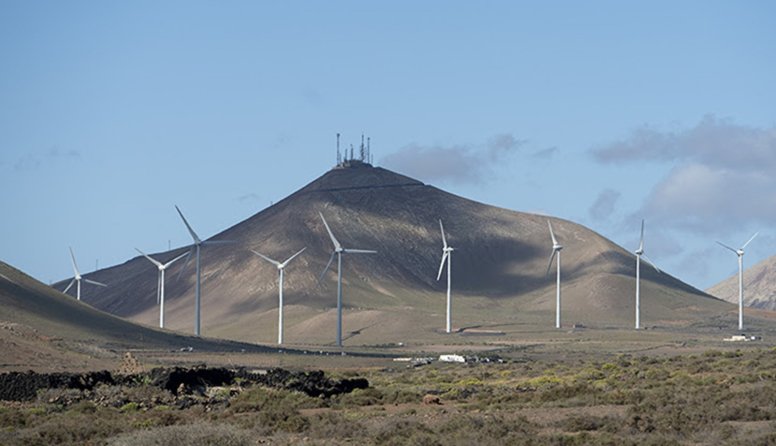
The blades of a wind turbine over seventy meters long rotate to the rhythm of the wind. The structure can be seen from several villages away and stands out against a volcanic landscape unique in the world. Projects to install solar panel fields or wind turbines in Lanzarote are stirring up a debate that has been simmering on the island for decades: renewables yes, but not at any price. Meanwhile, the boom in renewable energy and its role in the fight against climate change make the Canary Island a focus for the interests of energy companies.
"No type of energy advancement can jeopardize Lanzarote's environment because Lanzarote is heritage," defends Rosa María Regueiro Ferreira, professor of Applied Economics and doctor from the University of Santiago de Compostela, during an interview with La Voz. "A one-size-fits-all approach doesn't work here; it has to be done according to the reality of each territory," she adds.
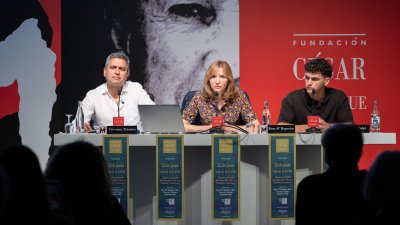
Regueiro is a member of the Bioeconomy and Natural Resources Group at the Galician university and was responsible for coordinating an extensive and exhaustive research commissioned by the César Manrique Foundation. This work also involved lawyer and Fishery Economics specialist Torcuato Teixeira and environmental technician Damiano Volpi.
The study, which has lasted a year and a half, provides a snapshot of the current renewable energy scenario in Lanzarote, based on current regulations, planned projects, the stance of different experts, the perception of the local population, and the impact on stakeholders.
Lanzarote, what island does it want to be?
Currently, Lanzarote has several open energy fronts: potential areas for installing offshore wind energy, acceleration zones for renewables on land for solar panels and wind turbines, and projects processed under the urgent procedure to install photovoltaic fields on rural land.
In wind energy, the island has five (or six) parks in operation (with a total of 23 megawatts of power), depending on whether the San Bartolomé park is counted as a single park or an extension of the previous one. This is far from figures like those of Gran Canaria, which has 51 wind farms (161 megawatts of power in total) or Tenerife, with eighteen (187 megawatts of power). It is also more lagging than these islands in photovoltaic energy.
In Lanzarote, 91% of energy comes from fossil fuels and only 9% from renewables. This reality occurs in a context where the high demand for energy comes from the tourism sector: shops and services (34%) and hospitality (29.9%), above household consumption (28.7%). The consumption of energy and water driven by this model occurs "in proportions that the territory can barely sustain," the report states.
The penetration of renewables in the archipelago is affected by several reasons, including the isolated geographical situation, the difficulty in integrating renewables, and the variation in demand. Also by the landscape, environmental, and social impact of these types of infrastructures.
Losing agricultural rural land is "mortgaging the future"
Lanzarote is the fourth Canary Island with the most protected areas and has a territory "conditioned by its limited land availability and high environmental sensitivity." Despite this, wind farms are located on "agricultural and landscape rural land," and the areas planned for installing more wind farms are also categorized as agricultural rural land.
The research warns of Lanzarote's "worrying" dependence on external food supply and states that "ceding rural land to private energy installations is equivalent to mortgaging the island's future as a minimally self-sufficient territory." Thus, it indicates that even fallow land is "a strategic reserve for the day when need presses."
"It is very dangerous to make everything depend on the ship that has to bring us," adds Rosa María Regueiro during a telephone interview, recalling that the coronavirus crisis or the power outage on the peninsula last year highlighted the dependence on the outside.
To avoid the exaggerated consumption of agricultural land and the impact on Lanzarote's landscape, which is a "cultural heritage" and a "hallmark" in a globalized world, they propose upgrading the existing wind farms on the island, as well as installing photovoltaic panels on rooftops and degraded land, and incentivizing local energy communities so that the benefits do not fall into the hands of large multinationals.
In fact, one of the wind farms built in Lanzarote, Los Valles, dates back to 2006 and is currently the oldest on the island, with outdated technology that could be updated.
Citizen consensus, crucial for defining renewables
The work, which included the perspective of the agricultural and fishing sector, with the Chamber of Commerce of Lanzarote, representatives of nautical recreational and sports activities, spokespersons for institutions, environmental groups, and experts in Law and Environment, concludes that there is no rejection of the ecological transition on the island, but there is a rejection of the "extractivist" model that burdens the island with costs and takes away the benefits.
Thus, for example, it points out that the declaration of Renewable Acceleration Zones (ZAR), signed between the Government of the Canary Islands and the Cabildo of Lanzarote, "has not incorporated" elements such as landscape or public participation. "There is not necessarily deep or deliberative participation," states the Executive Report of the project.
"We do not believe that renewables can be promoted by leaving society aside," insists Rosa María Regueiro, who indicates that the Canary Islands law that allowed the approval of Renewable Acceleration Zones has "a dangerous addendum." "It says that they are zones that do not have special environmental significance, and that if they do, it is easily correctable. That is an ambiguity, which from a scientific point of view is very dangerous," maintains the research coordinator.
Meanwhile, environmental technician Damiano Volpi explains that the choice of the agreed-upon zones to install wind and solar farms "have a clear predisposition" towards certain municipalities. The most affected municipality by far is Tías, where 6.5 square kilometers are contemplated for installing wind power; followed by Teguise, with 3.5 square kilometers for the same purpose. To this is added the choice of land in Tinajo very close to Timanfaya National Park.
The ZAR remain in force
Volpi has warned about the validity of the renewable energy maps that occupy 31 square kilometers of Lanzarote: "Right now they have removed them from the Grafcan viewer, which was where they could be seen exactly," adding that "it means they are still valid and can still be applied because there has been no legal suspension."
The publication in the Official Gazette of the Canary Islands of these acceleration zones has not yet been rectified by the same means. These maps contemplate that 1,477 hectares (14.7 square kilometers) will be allocated to wind farms, occupying 1.75% of the territory, although only 0.1% would be needed to achieve decarbonization objectives.
"The fact that you make something disappear from a place on the internet does not mean that it ceases to be in force as a normative application," added lawyer Torcuato Teixeira. The specialist in Fisheries Law recalls that there is "very little transparency" in the implementation of renewables, despite the fact that international regulations require transparency.
"There is a fairly clear disappearance of environmental rule of law," continues Teixeira, who points out that the precautionary principle "cannot be set aside for justifications that are more than questionable."
The precautionary principle
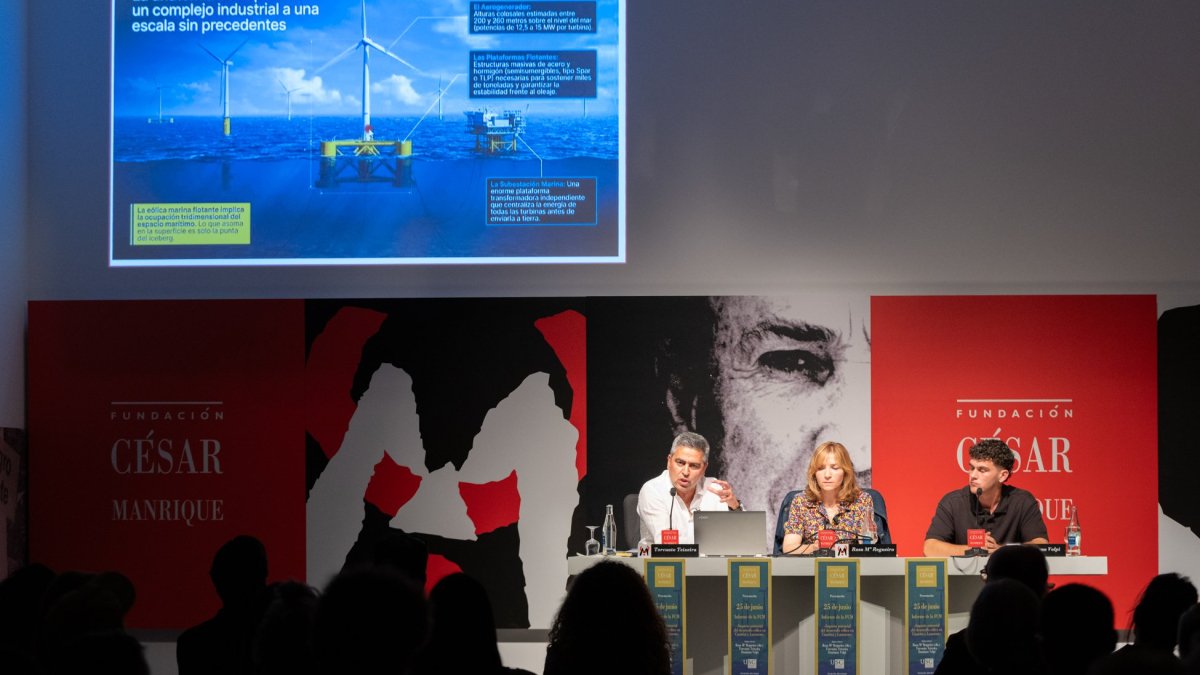
Regarding the installation of renewables in the marine environment, the report delves into the precautionary principle, "a binding legal standard that prevents projects from being authorized when there is reasonable scientific uncertainty about possible serious damage to the marine environment or the fishing sector." This principle makes it possible to ensure that "if there is not enough certainty, it cannot be authorized."
Thus, the research recalls that there are "necessary instruments" in the legal system to protect the environment and society. At the same time, they state that fishing grounds, food security, the cohesion of coastal communities, and the marine landscape are "assets of general interest" and that they must be "weighed" in the same way as decarbonization objectives.
Finally, the study states that Lanzarote should move towards "a model of integral development," where there is active social participation and where local property is protected "to avoid any type of speculative action." Even, that it should move towards the economic participation of local communities and citizens to equitably distribute the benefits.
Add La Voz de Lanzarote as a preferred Google source.
Stay informed with the latest current news.