The dependence on fossil fuels is one of the handicaps that prevent achieving the decarbonization of the planet and therefore combating climate change. To end the dependence on fuel, renewable energies (onshore wind, offshore wind, and photovoltaic) become a fundamental tool. However, their installation in territories as sensitive as Lanzarote gives rise to an intense debate: achieving a balance between preserving its landscape and environment, while achieving energy independence.
In this intense debate, Lanzarote maintains several open fronts. Among them, the island contemplates the construction of two offshore wind farms off its east coast. An exhaustive study commissioned by the César Manrique Foundation to the Bioeconomy and Natural Resources Group of the University of Santiago de Compostela and presented last Thursday reveals that, for the moment, there are two offshore wind farm initiatives on the table out of the 23 planned in the Canary Islands. One of them, promoted by the multinational Ocean Winds (composed of two European energy giants), and the other by Capital Energy, an energy company based in Madrid.
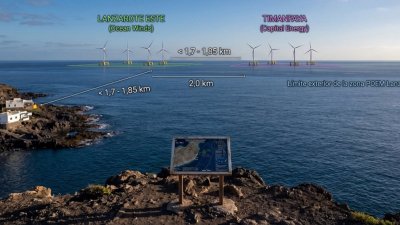
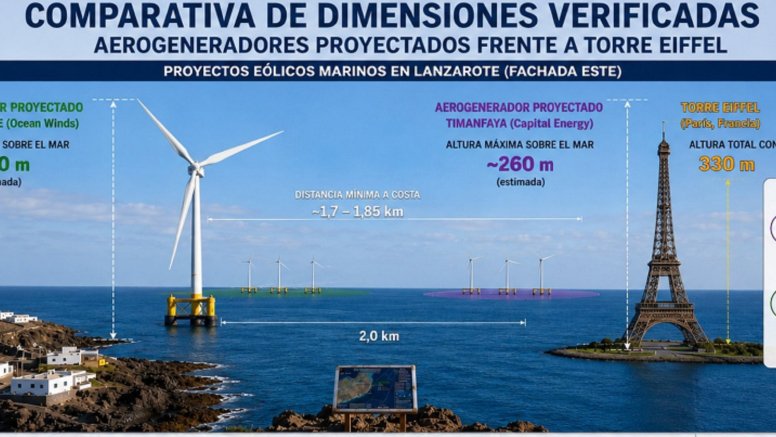
These projects, with an approximate height of 260 meters per turbine, would involve installing wind turbines off the coast of Las Caletas that represent 79% of the height of the Eiffel Tower, only 70 meters shorter than one of the most famous buildings in the world.
Two offshore wind farms with eight wind turbines
The wind farm promoted by Ocean Winds is named Lanzarote Este. This project, planned in Las Caletas (Teguise), would be composed of four wind turbines of 12.5 megawatts with semi-submersible floating platforms. The installation would protrude at least 247 meters above sea level and would consist of a 66-kilovolt submarine cable, at a distance of between 1.7 and 1.85 kilometers from the coast.
Meanwhile, Capital Energy's project, called Timanfaya, would be near the previous wind farm, and would be composed of another four wind turbines, with an approximate height of 260 meters, depending on the turbines contemplated. In this case, it would be located two kilometers from the coast.
The sum of both projects would not only affect Las Caletas equally, but would also harm the coastal towns of Costa Teguise, Arrecife, and Playa Honda.
Unlike onshore wind and photovoltaic energy, which have already caused controversy in Lanzarote for dedicating 3.75% of the island's territory to the installation of renewables and whose competence is regional, the installation of offshore wind depends directly on the Government of Spain.
To date, these two projects for Lanzarote have been registered with the Ministry for Ecological Transition and the Demographic Challenge, with a capacity of 50 megawatts for each offshore wind farm, based on the high potential zones for marine energy (ZAPER) of the Maritime Spatial Planning (POEM) approved in 2023.
A relationship between distance and height "unprecedented" in Europe
The research warns that the short distance between the offshore wind farms and the Lanzarote coastline "has no precedent in any other Spanish marine demarcation" and that there is "no artificial structure" on the island that resembles these dimensions.
The study indicates that the minimum distance from the coastline of the zone classified as "high potential" is between 1.7 and 1.85 kilometers, making it "the shortest of all Spanish marine demarcations." In other words, there is no offshore wind project in Spain that is as close to the coastline as those planned for Lanzarote.
Furthermore, the combination of this great height with its short distance to the coast is "unprecedented" in the Spanish and European maritime planning context.
Thus, the researchers highlight that these projects would represent "an alteration of high intensity" on the landscape of Lanzarote, a territory declared a Biosphere Reserve by UNESCO and directly linked to the legacy of César Manrique.
To date, the research commissioned by the César Manrique Foundation shows that the potential zones for installing offshore wind farms do not coincide between the proposals of the PTCan, dependent on the Canary Islands Government, and the POEM, promoted by MITECO in 2023. In the Ministry, the coast between Haría and Arrecife is considered, while in the Government of the Canary Islands, they are also projected on the west of the island.
In total, the high potential zone for offshore wind energy in Lanzarote covers 97.39 square kilometers. This complex research indicates that state planning "admits" the installation of windmills over the sea between Haría and Arrecife, but that it "does not authorize it without further ado."
At the same time, they warn that in these two projects, the requirements derived from the European Landscape Convention have not been met to date, which include a perceptual impact assessment, public participation, and an examination of the proportionality between energy objectives and landscape alteration.
Impact on the fishing fleet
Although the Spanish initiative included areas where offshore wind farms cannot be projected, "there is no explicit mention" of fishing activity or other activities.
Thus, the researchers warn that the installation of offshore wind power is "the last link in a chain of decisions that systematically ignore the primary sectors of Lanzarote".
Lanzarote and La Graciosa have a fleet of 114 vessels, of which 70% to 80% are dedicated to selective artisanal fishing. Currently, the Canary Islands fishing fleet is experiencing a decline (7.4% since 2014) and a "structural" loss of vessels.
According to the data collected by this research, the installation of offshore wind energy would represent "a new restriction" in a declining sector and would generate a "cumulative" effect on the La Graciosa Marine Fishing Reserve, which is already at its maximum capacity. 48 vessels operate in this protected area, with a maximum capacity of 50 boats.
In contrast, the research indicates that job creation linked to offshore wind power may be limited by the lack of reliable data, the required specialization, and the "non-existence" of industrial wind centers on the islands.
This study does not delve into the terrestrial and marine environmental impact of wind energy, but it warns of the importance of conducting a "detailed environmental impact analysis". Furthermore, it states that the European Parliament approved last May to defend the fishing sector against wind promotion and the need to conduct studies that delve into the impact generated on the seabed.
Add La Voz de Lanzarote as a preferred Google source.
Stay informed with the latest current news.