
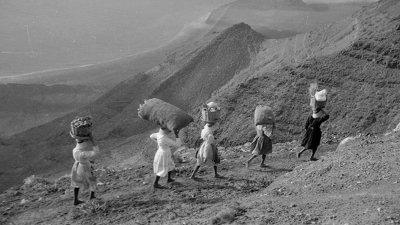
For generations, the gracioseras women crossed the sea and went up the Risco to exchange fish for food. Along the same route, the deceased were also transported to Haría, before the island had its own cemetery.
The history of the Camino de los Gracioseros allows us to reconstruct a scene that summarizes a good part of the traditional life of La Graciosa: women who crossed the sea, disembarked on the coast of Famara, and faced the climb up the Risco with the hope of returning with food and necessary products for their homes. The traditional hats, baskets, and loads that accompanied those walkers are part of a memory documented in historical photographs and anthropological studies, but also preserved in stories passed down through generations.
Beyond the image we might form of those journeys, the important thing is to understand what that route represented. It was not an excursion or a picturesque custom, but an essential economic activity for a community that depended on the sea for survival and on Lanzarote to obtain a good part of what it could not produce on its own island.
On October 14, 2023, the second Bajada del Camino de las Gracioseras publicly revived that memory. The initiative paid homage to the women who turned that route into a supply and communication line, but also recalled a lesser-known story: along the same path that served to bring fish to the towns in the north of Lanzarote, funeral processions had to pass, in much more painful circumstances, accompanying their dead.
A trail prior to the commercial tradition
The Camino de los Gracioseros has a history prior to the women who ended up making it a symbol of Graciosa identity. Its use was linked to the exploitation of the territory, grazing, the collection of orchil, and communications between the coast of Famara and the settlements in the north of Lanzarote.
With the development of the La Graciosa community, the route acquired a daily function. Fishing was an essential activity, but it was not enough to cover all the population's needs. Vegetables, potatoes, cereals, fabrics, and other products had to arrive from Lanzarote through purchase or exchange.
The route brought together three inseparable spaces: the sea that had to be crossed, the coast where they disembarked, and the path that ascended the Risco to the vicinity of Yé and the villages of Haría. Reaching dry land did not mean the journey was over. The climb and the journey through the rural settlements where the fish was traded still lay ahead.
The informative documentation allows us to recognize the importance of this activity during the decades prior to the generalization of regular transport, although it does not establish a single date for the beginning of trade along the path. Its history, therefore, cannot be reduced to a specific era: it was a communication route used and transformed according to the needs of those who depended on it.
The women who turned fish into food
Fishing and trade were part of the same economic chain. While the men were mainly engaged in fishing, the women played a decisive role in the preservation, marketing, and transport of the product. At a time when boats lacked engines, they also took on the task of transporting the fish to Lanzarote, climbing the Risco, and returning with necessary goods for their homes.
The anthropological study by Manuel del Río Suárez on La Graciosa describes this economic organization and records the exchanges maintained with towns such as Haría, Teguise, and Arrecife. The fish could be sold or exchanged for fruits, vegetables, fabrics, and other products. It was not a marginal activity, but an essential contribution to the sustenance of families.
Traditional descriptions speak of heavy loads and women who, on certain stretches, preferred to walk barefoot to protect their espadrilles. These are testimonies that help to understand the harshness of the journey, although they should not be presented as an identical practice on all trips or for all walkers.
The Risco thus became an economic infrastructure with no other means than knowledge of the terrain, physical resistance, and necessity. On one side lay the fish; on the other, the food and products that allowed the domestic economy to be completed.
The bonfires that announced the return
Among the most unique aspects of this tradition is the signaling system that allowed the women's return to be communicated to their families.
Manuel del Río Suárez describes how, upon reaching the upper part of the Risco, they would light bonfires to announce their return. The signals could then be repeated in stone enclosures known as "tegalas," located on the coast. The location of the fire allowed for the identification of the corresponding family and for the husband to be notified to come and pick up his wife in the small boat.
In a community separated from Lanzarote by the El Río strait, these signals served a practical function. They allowed for the coordination of the final leg of the journey and communicated that the crossing had concluded.
The "tegalas" also reveal that the path did not end at the summit. Their operation depended on a family network waiting on the coast, recognizing the signals, and collaborating to complete the return. Survival did not rely solely on individual effort but also on community organization adapted to the territory's conditions.
When the last journey also crossed El Río
The history of the Camino de los Gracioseros contains an episode of particular hardship. Before La Graciosa had its own cemetery, the deceased had to be transported to Lanzarote for burial.
Del Río Suárez's study records that the bodies were transported in small boats to the coast, and from there, the funeral procession would begin the ascent up the Risco to Haría. The route that women traveled to sell fish and return with products for their homes then transformed into a funeral route.
The lack of a cemetery forced families to face the sea crossing and the climb up a steep path under the most painful circumstances. The route connected markets and homes, but also the community with the place where their dead rested.
The situation began to change during the 1940s when the Economic Command of the Canary Islands promoted the construction of basic infrastructure in La Graciosa. Photographic documentation preserved in the FEDAC/Casa de Colón collection records an investment of 12,000 pesetas for the cemetery in 1943. In the following years, other actions were carried out, including the construction of the church, the pier, and a cistern.
These works were part of a transformation process that allowed the island to be equipped with services that were previously non-existent or insufficient. The cemetery meant more than just having a space for burials: it ended the need to systematically transport the deceased to Haría for burial.
The path that remains in memory
The evolution of maritime and land transport progressively reduced the daily commercial function of the path. However, its importance did not disappear immediately. In 1987, Jesús Manuel Páez published an article in Lancelot about the transport and communications of La Graciosa, recalling the difficulties of maritime connections and the usefulness of the path when sea conditions prevented navigation.
The memory of that route has been recorded in photographs, anthropological studies, and stories passed down through generations. The commemorative Bajada publicly revived that tradition to recognize the effort of those who sustained the island's economy, without intending to exactly reproduce living conditions that belonged to another time.
The path allows us to understand a history that goes beyond the hardship of a climb. It speaks of women who took on a decisive part of the family economy, of a community that learned to make use of available resources, and of ties with Lanzarote that were indispensable for daily life.
The Risco de Famara was a physical barrier, but never an absolute separation. For generations, the inhabitants of La Graciosa found a way to cross the sea, travel the path, and maintain economic and family ties with Lanzarote. They also had to use that same route to accompany their dead.
The Bajada of October 14, 2023, recalled a tradition that did not originate that day. Its value lay in bringing back to the present a part of the island's history associated with the silent work of several generations, especially of women whose activity was decisive for the survival of their homes.
Because there was a time when the life of La Graciosa depended on a crossing, a climb, and a signal fire. And in that journey, repeated over and over, an entire community was sustained.
Documentary sources
1. Memoria de Lanzarote. Preparing to descend El Risco. Photograph by Jan Blaauboer, General Archive of the
Cabildo de La Palma, reference CLP_72.
2. Del Río Suárez, Manuel. Anthropological approach to the Island of La Graciosa. Originally published in the
Boletín Informativo Aguayro, no. 162, 1985.
3. Memoria de Lanzarote / FEDAC-Casa de Colón. Photographic documentation on the investments of the Economic Command
of the Canary Islands in La Graciosa, including the construction of the cemetery in 1943.
4. History of La Graciosa. Information on the second Bajada del Camino de las Gracioseras, held on October 14
of 2023.


Add La Voz de Lanzarote as a preferred Google source.
Stay informed with the latest current news.