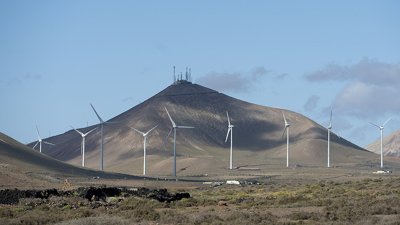
Lanzarote has been facing the crossroads for years of leaving behind fossil fuels and becoming an island powered by renewables. This imperative need to achieve decarbonization clashes with a territory where the landscape culture is an inseparable part of its identity.
A study commissioned by the Biosphere Reserve points out that Renewable Acceleration Zones (ZAR), a legal mechanism to incentivize the installation of solar panels and wind turbines that has been accumulating months of controversy, must avoid "atomizing" the landscape, "spotting" it with turbines and panels. It also concludes that it must refrain from massively occupying rural land.
Following the controversy generated by the publication of maps that occupied more than 3,100 hectares of territory as potential renewable energy zones, the Lanzarote Island Council Government has retracted its agreement with the Canary Islands Executive and has requested that the maps that opened the door to solar panel fields and wind turbines be rectified. Currently, the island's proposal is for these Renewable Acceleration Zones to occupy less than 200 hectares, 0.25% of the island.
This report, prepared in mid-July by two Doctors of Architecture, Vicente Mirallave and Flora Pescador, concludes that the ZAR maps published in the Official Gazette of the Canary Islands did not take into account the geographical and social impact that wind turbines and photovoltaic plants would generate. In fact, another investigation carried out by the César Manrique Foundation warned that no energy advancement could "put Lanzarote in check."
Furthermore, this recent report, now disseminated by the Lanzarote Island Council, indicates that to plan the transition towards renewables, their installation on rooftops should be prioritized, in the case of photovoltaics, as well as in "obsolete, incomplete, and other degraded areas" for all types of renewable energy. The research also states that these alternative energies should be installed near already created consumption networks.
Thus, it warns that ZARs must "minimize their visual impact," taking into account parameters such as landscape integration, adaptation to the island's topography, and the reduction of wind turbine height. At the same time, it must preserve the population's quality of life, care for the collective perception of the landscape, and social acceptance.
This proposal, which is not yet definitive, will indeed go through the town councils of Lanzarote this time, after the maps agreed upon last summer did not receive the approval of the councils. In it, it is contemplated that photovoltaic energy should be the main one in Lanzarote on roofs and degraded soils, while advocating for the repowering of existing wind farms, just as the César Manrique Foundation also pointed out in its study released last June.
Among the proposed measures, the report opens the way to generating a joint space for the implementation of renewables with Fuerteventura and "saving efforts and land consumption", given that the electrical system of both islands is connected.
More than 910 hectares on roofs
Based on data from the Canary Islands Technological Institute (ITC) in 2021, this document states that the island has 910 hectares of roofs available for installing photovoltaic energy, which would allow for achieving 906 megawatts installed by 2040. In this scenario, the residential sector would occupy 55% of the total and the hospitality sector 15%.
This data is based on the latest document on the photovoltaic energy capacity of roofs in Lanzarote, which is outdated. Therefore, given the new constructions carried out to date, the figure could be higher.
The research states that electrical self-sufficiency is technically achievable, but it must be accompanied by an increase in storage and the electrification of other sectors. To achieve the objectives set by the Canary Islands Energy Transition Plan (PTECAN) for 2040, the total decarbonization needed would be 1,301 megawatts, considering photovoltaic, offshore and onshore wind, thermal, and wave energy (generated by waves). However, the research indicates that the high occupation of the territory forces choices of spaces.
Anthropized spaces
In addition to prioritizing industrial roofs and housing rooftops, the research highlights that they should be planned around areas of electricity consumption and high energy demand. Among them, in the municipality of Teguise, in the vicinity of Las Caletas on rural land for territorial protection and public ownership. It also proposes another space in the Maneje area on rural land for territorial protection and infrastructure protection. In total, 29.22 hectares in Arrecife and Teguise. The ownership of the second group of lands is not specified.
A total of 61 hectares on public land
The project proposes the implementation of renewable energies on publicly owned land to "avoid speculative processes and guarantee management oriented towards the general interest".
At this point, they also propose a plot of land west of the Tahíche prison, owned by the Cabildo de Lanzarote and categorized as rural land for infrastructure and equipment protection, intended to be educational land for university teaching.
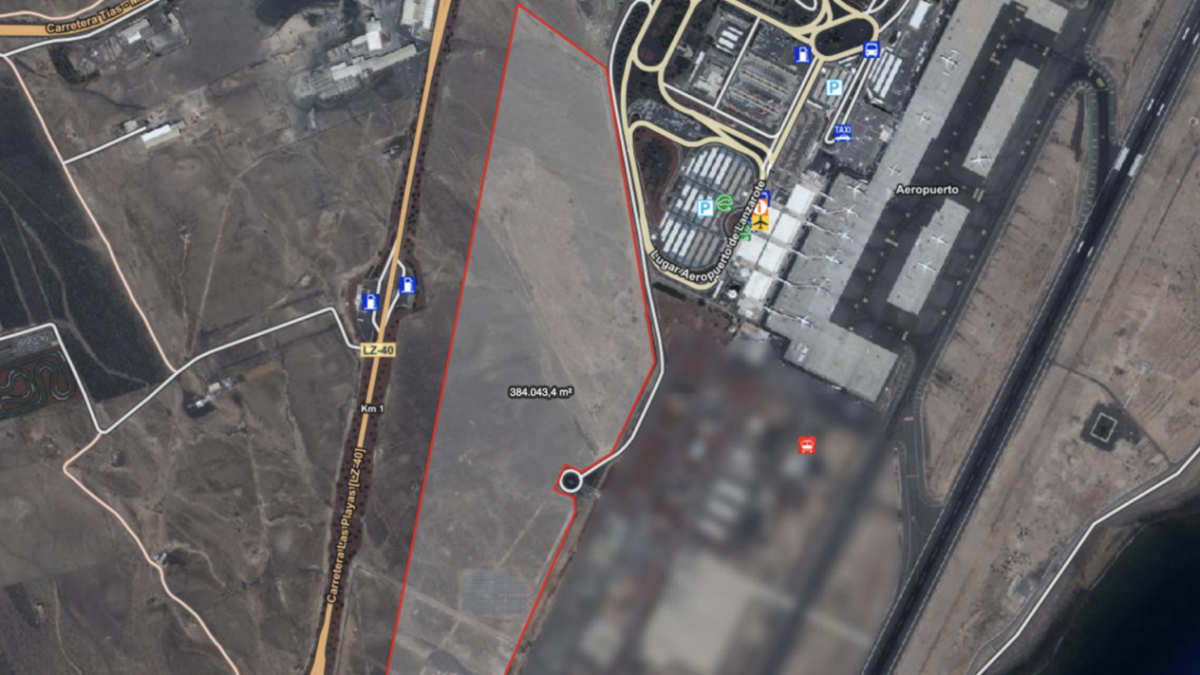
To this is added another plot of land, owned by the public company Aena, next to the César Manrique Airport of Lanzarote, classified as rural land for economic protection of infrastructure. In total, another 61.1 hectares.
In addition to public lands, the research adds the possibility of using quarries to install photovoltaic panels and thus reuse degraded mining extraction land. At this point, it highlights the possibility of installing 16.85 hectares of solar panels in the Lanzagrava quarry. In addition to 8.8 hectares for installing photovoltaic panels on the land of the Hermanos Tavío quarry between Montaña Blanca and Playa Blanca; as well as another 28.28 hectares in the Horinsa quarry in Tías for photovoltaics. In total, 70 hectares planned on quarry land.
Furthermore, the research opens the way to create 3D landscape impact studies for each area, which should be part of the mandatory procedure in the Ordinary Environmental Impact Assessment of the project.
Given this reality, it is also important to consider that Lanzarote does not have the operational capacity to recycle wind turbine blades.
Add La Voz de Lanzarote as a preferred Google source.
Stay informed with the latest current news.