
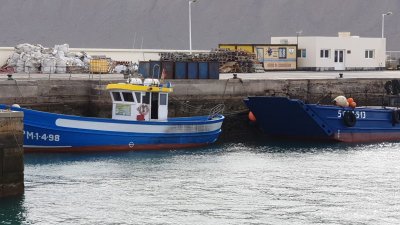
The communication between Lanzarote and La Graciosa has been, for generations, an essential necessity for the life of the smallest island in the Canary archipelago. The movement of people, the supply of shops, and the arrival of mail depended on a connection that, for a good part of its history, was maintained thanks to small boats and the experience of sailors.
The short distance between Órzola and Caleta de Sebo could give a misleading impression of ease. The wind, the waves, and the characteristics of the coast made maneuvers difficult and, on occasion, forced the suspension of trips. For the people of La Graciosa, having a boat did not mean guaranteed communication: when the sea conditions made navigation impossible, supplies and essential travel also became complicated.
Before regular maritime transport acquired greater continuity, crossing by the Guinate cliff constituted an alternative to overcome isolation. Historical reconstructions of La Graciosa's communications describe the difficulties of this route and the dependence of its inhabitants on meteorological conditions.
The feluccas of the Toledo family and the regular service
The organization of a stable maritime connection represented a decisive advance for the population of La Graciosa. According to the historical reconstruction published on the portal Historia de la Graciosa, during the fifties, a regular service began to operate with a felucca from the Toledo family, which covered the route between Caleta de Sebo and Órzola twice a day. The boat transported passengers and supplies for the island's shops. During the sixties, other feluccas were incorporated, which contributed to the continuity of the service.
Those boats fulfilled a function that went far beyond transporting travelers. They allowed basic products to be brought to Caleta de Sebo and facilitated trips to Lanzarote for commercial, administrative, family, or health reasons. In a community closely linked to fishing and dependent on the outside for part of its supplies, each crossing had a direct importance in daily life.
The continuity of the trips rested largely on the initiative of families linked to the sea and on the knowledge their captains had of the coast. Their experience was fundamental for assessing navigation conditions and deciding when it was possible to make the crossing safely.
The consulted sources place the development of these services in the fifties and sixties, although they do not allow attributing the definitive birth of the line to a single date. The first trips, the organization of schedules, and the progressive incorporation of vessels were part of a gradual process.
From mail to passenger ships
Before passenger transport was consolidated as an organized commercial activity, mail was one of the essential functions of maritime communication. The academic work of José Ferrer Villalba, "Operativa y maniobra en buques de pasaje de pequeño porte: «Graciosero Uno»", presented in 2016 at the University of La Laguna, reconstructs part of this evolution through the trajectory of the vessels used on the route.
The study states that Jorge Toledo Betancor transported correspondence to La Graciosa in a small boat called Chipirripe. Later, Juan Romero Morales took over the transport of passengers between Órzola and Caleta de Sebo with boats such as Jorge Luis, La María del Pino, Guarazoca, and Safari II. The continuity of this activity contributed to consolidating the connection between both towns.
The university work also addresses the evolution towards an organized line around 1970. This reference should be understood within the process of consolidating the service, as other sources place regular trips in the fifties. Family backgrounds, mail transport, and the subsequent organization of a passenger line were stages of the same transformation.
The evolution of the vessels responded to specific needs: to facilitate travel, transport goods, and ensure more stable communication between the two islands. The service evolved from small initiatives linked to mail and supply to becoming a connection of growing importance for the population.
Órzola and Caleta de Sebo, two ports united by necessity
The supply of La Graciosa depended to a large extent on products from Lanzarote. Historical reconstructions of the route describe the difficulties of accessing the port of Órzola, exposed to the northern swell and conditioned by shallow areas.
These characteristics complicated maneuvers, especially when the groundswell increased. The arrival of boats and the unloading of goods required experience and prudence, while storms could force the suspension of operations.
The port infrastructure also needed improvements. It was not enough to have boats and regular schedules: it was necessary to have adequate spaces for embarking and disembarking passengers, handling goods, and facilitating operations on the coast.
In February 1959, an investment of 30,000 pesetas was allocated to expand the Caleta de Sebo landing stage and carry out landfill works. The news appeared in the weekly Antena, number 299, of February 24, 1959, page 5, and is included in the chronology of Memoria de Lanzarote.
The action demonstrates that the improvement of the facilities was already a necessity in the fifties. The continuity of transport depended as much on the boats as on the conditions of the places where port operations took place.
The Órzola landing stage, inaugurated in 1957
Another documented milestone occurred on July 23, 1957, when the civil governor Martín Cobos visited Lanzarote and inaugurated a landing stage in Órzola. The information was published by Antena, number 219, on July 30 of that year, on page 2, and appears in the historical chronology of Memoria de Lanzarote.
The facility constituted a relevant precedent for the development of the connection with La Graciosa, although it did not eliminate the difficulties arising from the swell, storms, and approach conditions to the coast. The improvement of infrastructures was a progressive process, linked to the needs of a fundamental route for the population.
The inauguration of 1957 and the subsequent works carried out in Caleta de Sebo allow us to reconstruct part of that development. Along with the evolution of the boats, the port facilities played an essential role in consolidating maritime communications.
When the storm interrupted communication
The reliance on navigation had direct consequences on the lives of the inhabitants. North storms and heavy surf could interrupt the connection, delay the arrival of goods, and hinder urgent travel. In these circumstances, the safety of passengers and crews had to prevail over any transportation need.
The difficulties of entering Órzola, the exposure to the north, and the shallow depth of certain areas complicated maneuvers. These conditions reflect the risks faced by sailors and the concern of the gracioseros when the weather prevented the service from operating.
Crossing the Guinate cliff offered a historical alternative for leaving La Graciosa when navigation was not possible. However, the journey over rugged terrain required effort and could not easily replace maritime transport, especially for those who needed to move goods or make urgent trips.
Isolation translated into concrete difficulties: supply delays, postponed trips, and obstacles in accessing services located in Lanzarote. The regularity of the route improved communication possibilities, although sea conditions continued to be a determining factor.
The evolution of transport and basic services
The history of the maritime connection is part of a broader transformation of living conditions in La Graciosa. The island progressively incorporated services and infrastructure that modified the daily activity of its inhabitants, although improvements arrived in different stages.
Consulted historical reconstructions place the installation of a small desalination plant in 1977, with an estimated production of between 75 and 80 tons of water per day, along with autonomous electrical generators that supplied electricity to Caleta de Sebo for twelve hours a day. Other references place the arrival of a broader electricity supply in 1985 and running water in 1990 via an underwater pipeline from Lanzarote.
These advances help to understand the importance of maritime transport for decades. La Graciosa depended on the connection with the neighboring island to obtain some of the goods and services it could not produce locally. The improvement of communications accompanied economic and social changes and contributed to reducing some of the difficulties arising from isolation.
The line also evolved to meet new mobility needs. Small boats linked to mail and supplies gave way to a more organized passenger service, with boats adapted to the demands of the route. Ferrer Villalba's study allows us to follow this transformation through the vessels used and the maneuvers necessary to operate in both ports.
Currently, the route between Órzola and Caleta de Sebo continues to be the usual maritime connection with La Graciosa, both for its residents and for those who visit the island. Its importance remains linked to mobility, supply, and the historical relationship between the two communities.
A route that is part of the island's memory
The connection between Órzola and Caleta de Sebo is much more than a few miles' journey. It is part of the social and economic history of La Graciosa and the efforts of its inhabitants to maintain contact with Lanzarote despite the difficulties imposed by the ocean.
For decades, mail, passengers, and supplies traveled in small boats whose work was indispensable. Port improvements facilitated operations, while the experience of the sailors and the adaptation of the boats made it possible to consolidate a service that transformed the island's daily life.
The history of this route was built through generations of work, navigation, and adaptation. Each crossing contributed to keeping open an essential link between two communities separated by the sea, but united by a historical relationship of exchange, dependence, and shared life.
Documentary and bibliographic sources
• Memoria de Lanzarote. Chronology of July 23, 1957: inauguration of the Órzola landing stage. Original reference: Antena, no. 219, July 30, 1957, p. 2.
• Memoria de Lanzarote. Expansion of the Caleta de Sebo landing stage esplanade, February 1959. Original reference: Antena, no. 299, February 24, 1959, p. 5.
• Historia de la Graciosa. "Transport and communications." Reproduction of a historical text on the maritime connection between Órzola and Caleta de Sebo, navigation difficulties, and alternatives used by the Graciosa inhabitants.
• González Viera, F. Javier; Morín Pérez, Pilar; Acosta Rodríguez, J. Ezequiel. La Graciosa: historical and geographical study. References to services, infrastructure, and transport, reproduced in Historia de la Graciosa.
• Ferrer Villalba, José. Operation and maneuvering on small passenger ships: "Graciosero Uno". Final Degree Project, University of La Laguna, 2016.
• Hola Islas Canarias. "This is how the eighth island was born". Historical context on early maritime transport and the evolution of the line. • History of La Graciosa. Consultation articles on transport, communications, and infrastructure of the island.

Add La Voz de Lanzarote as a preferred Google source.
Stay informed with the latest current news.