
Felipe Ravina's relationship with the sea began when he was very young. His father and he spent hours in the tide pools of southern Tenerife. Since he was a child, he found it hard to get out of the water and gave up other plans if he could choose to stay in the sea. Over time he discovered the ocean, using goggles and a snorkel, and eventually became a diver. He graduated in Marine Sciences and became one of the youngest marine documentary filmmakers in the Canary Islands.
For a decade, his love for nature has led him to fight tirelessly to show the marine treasures of this archipelago of Macaronesia and to raise awareness about the risks faced by the islands' biodiversity, driven by mass tourism. Now, this environmental struggle travels the world through a documentary that has been awarded on multiple occasions in several countries: Nika, the tropical pilot whale.
This project, directed by José Hernández and co-directed by Felipe Ravina, will arrive in Lanzarote as the main promotional image for the eleventh edition of the Ocean Film Tour, the international film festival about the oceans, which will land in Jameos del Agua on November 7 and 8. Among other awards, this work has been awarded the Golden Railing at SIMAC, the most important Spanish award for marine documentaries.
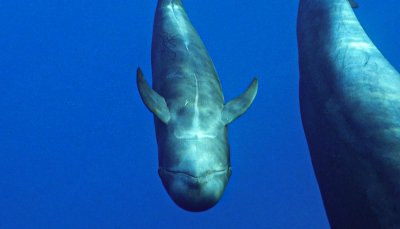
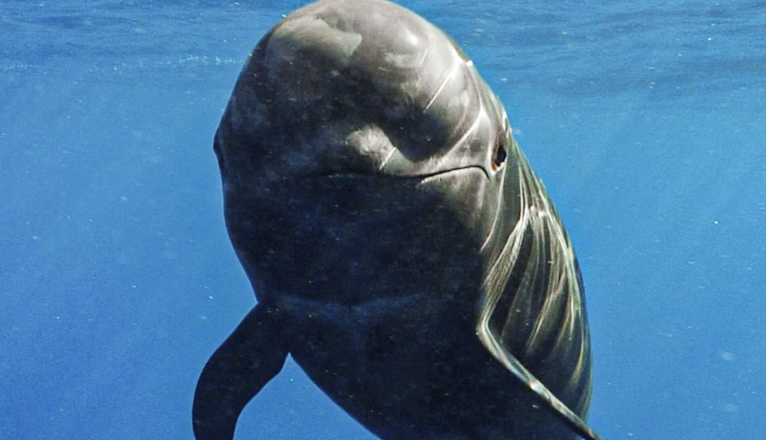
The documentary filmmaker explains the consequences of tourist pressure in the Canary Islands through Nika, a young tropical pilot whale (globicephala macrorhynchus), also known as short-finned pilot whale, who resides with her family on the coast of southern Tenerife, an area with several environmental protections and the only whale sanctuary in Europe. It is also a space plagued by mass tourism and the constant coming and going of high-speed boats and ships that cause constant collisions with cetaceans and high levels of stress among the animals.
The risk of losing paradise
"The most special memories I have are of some places that are no longer there and others, like Puertito de Adeje (Tenerife), that are in the process of being destroyed," Ravina narrates during an interview with La Voz. "Growing up in a place that you appreciate so much and seeing how everything you love so much is destroyed is very sad," he continues.
Although this documentary filmmaker is aware of the "fortune" of having grown up in the Canary Islands, he expresses his regret at seeing that what the islanders enjoyed growing up is "being destroyed everywhere."
Among his conservation work, Ravina annually records the populations of tropical pilot whales that live in the south of the island, with a permit from the Government of Spain, since swimming with cetaceans is prohibited in the country. "We saw a behavior that was quite more curious than usual, I recorded everything I could that day and then we went back other days and we saw that this behavior was repeated," he highlights.
Felipe Ravina and José Hernández capture in the documentary the unusual behavior of this young tropical pilot whale. "We started looking to see if it was an animal we knew, what was behind all this because we were very curious about what was happening," he explains. "It is a story full of inexplicable coincidences, with a whale that shows a behavior that had never been recorded among tropical pilot whales," he adds.
In addition to his work with marine documentaries, Felipe Ravina has 141,000 followers on social media, where he shows marine species of the archipelago, but also denounces the dumping of sewage into the coast or the destruction of the coastline to build tourist projects. The Tenerife native is one of the visible faces of the Canarian environmental movement Canarias tiene un límite (Canary Islands has a limit).
"I have always made documentaries with the intention of showing everything we have, but also the great threats they are suffering and that if we continue down this path, they will disappear," Ravina adds. "If you don't show it, people don't mobilize and it seems that the problem is not so serious when in reality it is," he concludes.
Add La Voz de Lanzarote as a preferred Google source.
Stay informed with the latest current news.


