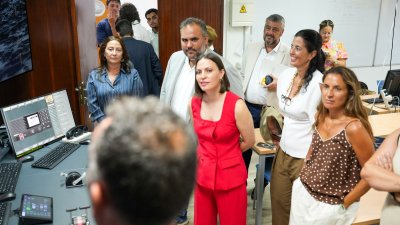
The Maritime-Fisheries Vocational Training Institute of the Canary Islands, known as the Lanzarote Fishing School, has begun the 2026-2027 academic year today, Wednesday, September 16, in which it will debut two new simulators that will allow for the expansion and improvement of the center's training offerings. For the acquisition of this equipment, one for firefighting and the other for radiocommunications, the Ministry of Agriculture, Livestock, Fisheries, and Food Sovereignty of the Government of the Canary Islands allocated 905,000 euros, in line with the actions for the constant improvement of the facilities and resources of the regional Executive's agricultural and fishing training centers.
On one hand, a firefighting simulator has been acquired for 770,000 euros, which will be installed at the end of October and will allow students to practice in conditions close to those that may occur in a real emergency, a transversal training for maritime professionals. To this investment, another 135,000 euros are added for a GMDSS radio simulator, which is already operational and will reinforce the practical training in maritime radiocommunications necessary for certain qualifications and professional certificates.
The presentation ceremony of the new academic period was attended by the Minister of Universities, Science, Innovation and Culture, Migdalia Machín, the Director General of Fisheries of the Government of the Canary Islands, Esteban Reyes; and the Director of the Canary Institute of Agri-food Quality, Luis Arráez Guadalupe, along with the Minister of Education of the Cabildo of Lanzarote, María Ascensión Toledo Hernández; the Minister of Biosphere Reserve, Environment and Climate Change of the Cabildo of Lanzarote, Samuel Carmelo Martín Morera; and the director of the center, Víctor Manuel Álvarez Armas.
Machín indicated that the Lanzarote Fishing School “is a source of pride for the Island and a benchmark in maritime training” and highlighted that “professionals prepared to join a sector that increasingly needs knowledge, innovation, and specialization to face challenges such as sustainability or the responsible management of our resources are trained here”. “A new course begins today and I want to encourage students to make the most of this stage, because the training they receive here not only opens doors to their professional future, but also contributes to the future of a sector essential for the Canary Islands and closely linked to our identity as islands,” he added.
For his part, the Director General of Fisheries, Esteban Reyes, pointed out that the agricultural and fishing training centers attached to the Ministry of Agriculture, Livestock, Fisheries and Food Sovereignty offer training “essential to guarantee the generational renewal of the Canarian primary sector”. He also highlighted the school's work in promoting the blue economy and valued the quality of the training offered by this educational center, which was recognized last June by the Atlantic Society of Oceanographers with the Oceans 2026 Award. “That recognition of the center's trajectory and commitment highlights the importance of promoting specialized, practical training adapted to the needs of the sector, capable of facing the present and future challenges of the maritime and fishing sectors through knowledge, innovation, and sustainability,” he concluded.
To date, 240 students have enrolled in the center, which expects to exceed 700 registrations in specialty maritime and update courses. It should be noted that these are provisional figures, as Vocational Training in the Canary Islands has an extraordinary enrollment period in September and non-regulated specialty courses will continue to be taught throughout the rest of the year.
During this academic year, the center's training offer includes Higher Level Vocational Training Cycles in Maritime Transport and High Seas Fishing; and in Ship Machinery Maintenance Organization. In addition, it also offers Intermediate Level Vocational Training Cycles in Underwater and Hyperbaric Operations, Coastal Navigation and Fishing, Ship and Vessel Machinery Maintenance and Control, and Aquaculture.
Likewise, this center offers its students a wide variety of training courses for Fishing Captain or Basic Professional Diver, among others. Regarding maritime specialty courses, the offer includes training such as Fast Rescue Boats, Advanced Certificate in Firefighting, Restricted Operator of the Global Maritime Distress and Safety System, etc..
In addition to the Polytechnic Institute of Maritime-Fishing Vocational Training of the Canary Islands, the course opening was held simultaneously throughout the day in the rest of the training centers attached to the Ministry. The following attended these inauguration ceremonies, representing the Government of the Canary Islands: the deputy minister of the Primary Sector, Eduardo García Cabello, who was present at the ECA of Los Llanos de Aridane; the director general of Agriculture, Juan Ramón Rodríguez Marín, at the ECA of Tacoronte; and the director general of Livestock, Andrés Díaz Matoso, at the ECA of Arucas.
--
Add La Voz de Lanzarote as a preferred Google source.
Stay informed with the latest current news.