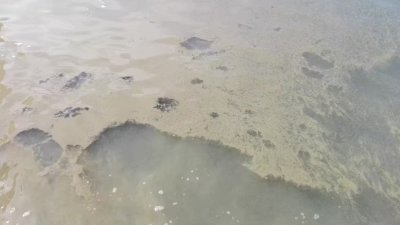
Surely at some point we have seen a series of brown spots in the sea when we have gone for a dip. Most likely, the first thought that comes to mind is that it is waste, dirt, or some kind of spill. However, nothing could be further from the truth. These spots are a type of cyanobacteria called Trichodesmium erythraeum, also known as marine sawdust.
According to the Network of Marine Environment Observers in the Canary Islands (REDPROMAR), it is very common in the waters of the Canary Islands, even though we cannot always see it. The waters of the Canary Islands are the ideal setting for the proliferation of this cyanobacteria, as it reproduces in waters with a temperature above 23 degrees.
Several conditions make it abundant in the archipelago. One of them is the calima, which feeds Trichodesmium erythraeum with iron, a mineral it needs to develop. Temperatures are also crucial for its growth, as they require water values of more than 22 or 23 degrees. For this reason, there is a greater presence of this cyanobacteria in the summer months.
Another reason that explains its presence is little wind, as this causes them to float if the sea is calm and large quantities accumulate, making them visible.
According to REDPROMAR, the last reported presence of this bacteria in Lanzarote took place on April 5, 2024, in the area of Los Pocillos beach, in Puerto del Carmen.
As explained by the Network of Marine Environment Observers in the Canary Islands, when a large concentration of this marine sawdust occurs, its own growth can harm it, as intense sunlight causes a "very high photosynthesis rate" and excess oxygen can be toxic to them.
This is why most of the spots we see of this cyanobacteria are formed by dead or dying colonies. "In doing so, they release nitrogen and phosphorus into the water, fertilizing the environment and promoting the growth of other organisms," they point out.
With their presence, should we swim in the sea or not?
It is logical that, after seeing a brown spot in the water, we hesitate whether we can swim or not. Experts recommend that, if a proliferation of Trichodesmium is spotted in a bathing area, it is better to avoid getting into the water.
Furthermore, direct contact with the spots that can be seen in the water should be avoided, as it can cause irritation, especially to the skin.
According to Professor Antonio González Ramos, researcher of the Institute for Sustainable Aquaculture and Marine Ecosystems (ECOAQUA), of the Institute of Mathematical Sciences of the CSIC, "when the blooms reach the coast degraded, they form whitish 'creams' (scum) that release ammonia which, in addition to generating bad odors, can cause hives in case of direct contact. Swimming would only have to be prohibited on beaches (or sections) where they appear, just as would be done in the case of jellyfish blooms appearing in coastal waters".
Add La Voz de Lanzarote as a preferred Google source.
Stay informed with the latest current news.