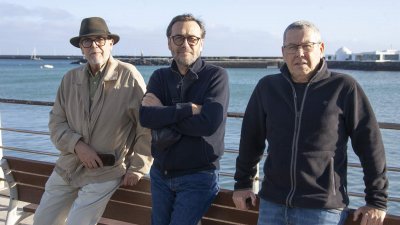
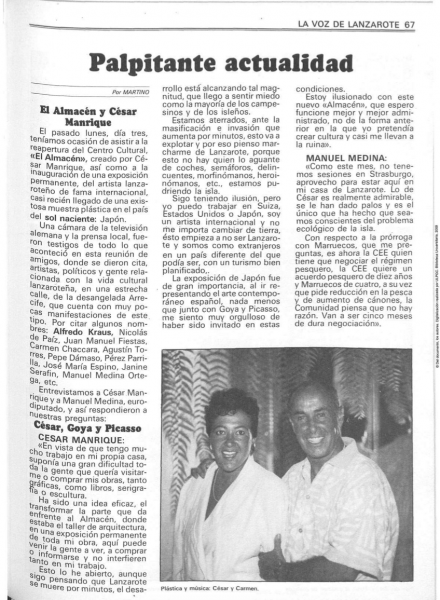
The opening of El Almacén de César Manrique was an "unprecedented event" in a Lanzarote still besieged by the last gasps of the Franco dictatorship. It was the year 1974, when the island's most international artist opened this multidimensional space together with Luis Ibáñez, Pepe Dámaso and Gerardo Fontes.
From its opening until 1988, this place, located in Arrecife, was managed by Manrique himself and was a space "of freedom and encounter" for the people "most open, curious and desirous of culture", says the co-author of the work El Almacén de Manrique: 50 años, 50 voces, Fernando Ruíz in an interview with La Voz.
Its creation in a society still in "black and white" due to the consequences of Francoism "catapulted and accelerated the process of integration of the island in the field of modern culture and, not only of modern culture, but in the anthropological sense", a Lanzarote, "more open and universal".
Inside, debates were opened as important as the awareness of Lanzarote's identity as an island and the defense of its territory and its landscape. "El Guincho was generated there, it was born there, it grew there," he explains.
The milestones around its opening are many: it takes place in the middle of the dictatorship, with a modern, multidimensional and avant-garde character and where a place of conversation was created to tackle pioneering debates on the island.
Ruiz defines El Almacén as "a space of freedom and openness to the world". One of those responsible for this work coming to light, together with José M. Parrilla and Mario Alberto Perdomo, defends that "the creation of El Almacén was an unprecedented experience. Its importance is even greater because it is generated in a space far from the centralities, both of the Canary Islands and of the State", he continues. Something that also helped him go more unnoticed before the harshness of the regime.
A space for sexual freedom
In an era of repression and where people from the LGTBIQ+ community were persecuted by the Franco regime, El Almacén was a space open to sexual diversity, an "oasis" in the middle of an intolerant Spain.
So much so that it was not until three years after its opening on the island when the first demonstration of the group was held in Barcelona, in 1977. The following year, in 1978, homosexuality was "decriminalized" in Spain. Meanwhile, it was not until 2007 when a state law was approved that allowed trans people to change their sex in official documents such as the ID or passport.
"When I talk about sexual freedom, it is not that any sexual activity was practiced there, simply that people who had sexual diversity or trans people expressed themselves freely," says Ruiz, who explains that "there was no space in Lanzarote where they could feel more protected and, therefore, with more capacity to express themselves freely".
In a Lanzarote much less plural than now, part of the local population had reservations about their children enjoying this cultural space. "I had friends who said that their parents told them: "Don't even think about going to El Almacén, it's a bad place." I imagine they thought it was a bad place because of that kind of possibility. Of course, it's enough for them to tell you no, for them to run," he jokes.
However, Ruiz claims the "value and pride" that "at such early dates" on the island "it was clear" the acceptance and "the right that each person has to express themselves affectively as they see fit".
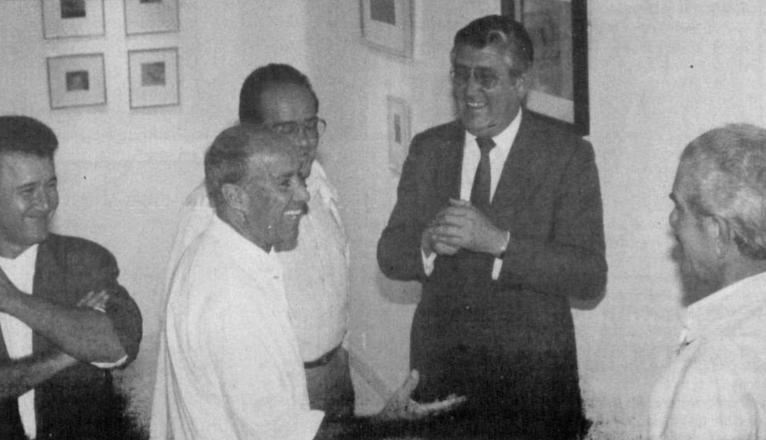
A book, fifty stories
The work collects fifty testimonies, from 25 women and 25 men, of different ages and sensitivities to show "the plurality of experiences" lived in El Almacén from its opening until in 1989 it ceased to be owned by Manrique and became public property. "There were as many Almacén as people who enjoyed it, because each each individual is the expression of their subjectivity", Ruíz highlights.
"Each one resonated in some way and was more interested in some issues and we were interested in showing how different El Almacén was for the lives of many people and, at the same time, the common elements for everyone", adds the co-editor.
In addition, this multidisciplinary space was a place where to enjoy and share any artistic branch. Among them, people interested in cinema, plastic arts, photography or simply the possibility of "talking and meeting" were combined.
However, the passage of time has not maintained the essence of this place so significant for the cultural history of Lanzarote. Ruíz highlights "a very significant fact" and that is that the old entrance to the gallery of El Aljibe de El Almacén, which was in the restaurant, is now closed to the public and covered by boxes of small bottles of beers and now you enter from behind. "What used to be entered and indicated that it was culture, today indicates that you are entering a tourist restaurant, but not a cultural and artistic one".
In Manrique's time, this space had walls full of artistic posters of "extraordinary value", brought by the artist from the MoMa in New York or the Reina Sofía. In addition, works by the artist such as the Jameos del Agua, the Cueva de los Verdes or his own house were exhibited.
The work El Almacén de Manrique: 50 años, 50 voces can only be purchased in the bookstore El Puente and if benefits are obtained from its sale they will be destined to the Association of Oncohematological Families of Lanzarote (AFOL). Its publication is "to recognize so many people who participated and witnessed an extraordinarily creative situation on this island and who contributed their grain of sand".


Add La Voz de Lanzarote as a preferred Google source.
Stay informed with the latest current news.