
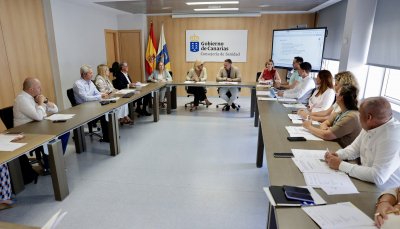
The Minister of Health, Esther Monzón, chaired this Tuesday, August 5, in Las Palmas de Gran Canaria, a meeting of the Management Council of her department in which a balance of the first two years of management of this legislature was made and the projects and actions to be developed in the coming months were analyzed.
Of the indicators analyzed, those corresponding to surgical activity have been highlighted, which registers a total of 76,832 interventions between January and June of this year, which represents an increase of 3% compared to the same semester of 2024, a figure linked to the management plans put in place to increase hospital activity.
The meeting was also attended by the director of the Canary Islands Health Service (SCS), Adasat Goya, the general directors of the SCS and the directors of the Health Areas of all the islands.
In this meeting, special emphasis was placed on the measures developed to reduce waiting lists and on the new services, protocols and equipment put in place to continue increasing the quality of care that is made available to the citizens of the Canary Islands. Thus, it was reported that the implementation of the Activa Plan has improved surgical activity.
The Plan includes programs to continue intensifying activity with periodic evaluations of activity by hospitals. In addition, Esther Monzón recalled that the two budgets of this legislature included increases in funds allocated to Health: 15.2% in 2024, and 5% in 2025, reaching a total of 4,598 million euros, which represents a specific weight of 39.3% of the overall accounts of the Autonomous Community.
Twenty improvements implemented
During the first quarter of this year, the Unified Clinical History Viewer was launched, an unprecedented advance in the archipelago that allows SCS health professionals to access the complete clinical history of patients, regardless of the center or island to which they belong.
In the healthcare field, the Action Plan for Chronically Ill Patients of High Complexity in the Canary Islands 2024 (Plan 5C) has been implemented, which offers comprehensive, personalized and multidisciplinary care to the most vulnerable patients, improving their quality of life and promoting the sustainability of the healthcare system, and the AP_Cuida2 program, which aims to enhance the continuity of patient care after hospital discharge.
On chronicity, the Neurodegenerative Diseases Strategy has been launched for the comprehensive care of people with Alzheimer's, Parkinson's, ALS or multiple sclerosis, and progress continues to be made in the Rare Diseases Strategy, with the creation of the Autonomous Registry, the consolidation of the two Provincial Reference Units and the expansion of neonatal screening, which has gone from eight to 31 rare diseases detected, with a forecast of reaching 43 during 2025.
The meeting also highlighted the expansion and improvements made in home hospitalization resources, with the new service of the Hospital del Norte de Tenerife, the reforms carried out in the infrastructures and care circuits of the HUC Emergency Department.
In palliative care, the historical lack of these resources at home in the islands of Fuerteventura and Tenerife is being resolved, the latter island in which the project is being developed in collaboration with Primary Care and specific units have also been created in the Hospital del Sur and in the HUC.
In addition, in the area of Public Health, it was highlighted that the General Directorate continues to work on the creation of the Canary Islands Public Health Agency and has implemented the Plan for the prevention of childhood obesity (POICAN), in addition to didactic guides and workshops on nutrition and campaigns to prevent sexually transmitted infections, among other measures. The Strategy for prescribing physical and sports activity has also been created, and training for Primary Care professionals is already underway.
In Mental Health, more than a dozen new resources have been created, including a new hospitalization unit and a day hospital for Eating Disorders in Gran Canaria, with the aim of covering a historical deficit of these resources on the island and avoiding transfers to the peninsula. In addition, it was recalled that new mental health devices have been launched in municipalities such as Telde, Las Palmas de Gran Canaria, La Laguna or San Andrés y Sauces, and, in collaboration with the Ministry of Education, the Program for the prevention of suicidal behavior in schools was implemented, among other new protocols.
In Early Care, the Lanzarote Unit began operating in 2024, and last July, the third unit in Tenerife at the Hospital del Sur. These two resources complete the eleven Early Care Units (UAT) initially planned within the regional plan.
In the non-capital islands, among the more than a dozen new actions, the launch of Hemodynamics services in Lanzarote and Fuerteventura, Radiation Oncology in Lanzarote, the renovation of the pediatrics ward and the pain unit in La Palma, or the launch of the magnetic resonance equipment in La Gomera were highlighted. In El Hierro, its endowment in electromedical equipment has been improved and the expansion of the Hospital Nuestra Señora de los Reyes has been resumed for the installation of the magnetic resonance, among other services.
In Hospital Care, new CT scanners have been provided to the Specialty Care Center of Gáldar, the University Hospital of Gran Canaria Negrín and the University Hospital Nuestra Señora de Candelaria, the Oncology Day Hospital of the Hospital del Sur de Tenerife, and new Psychiatric Emergencies in the HUC have been launched.
Consolidation of the staff
During the Management Council of the Ministry, the integration of the extinct ICHH into the SCS, the progress of the stabilization process of the SCS professional staff, the call for a new public employment offer, with 8,296 places, the approval of the fifth degree of professional career and a talent retention plan with more than three hundred places for residents who complete their training period were discussed.
The SCS also carried out an expansion of the number of places in the organic staff of the public health centers of the Canary Islands, which allows to provide stability to the staff. In total, more than 9,000 places were created in these processes.
In addition, the Government of the Canary Islands approved the implementation of a fifth level of professional career for the SCS staff, making the archipelago the second autonomous community to have five degrees of professional career for its workers.
Commitment to infrastructure
Regarding health infrastructure, the meeting served to review the actions carried out during the first two years of the legislature, such as, for example, the expansion or new construction in the health centers of Playa de Arinaga and Guanarteme, in Gran Canaria, El Sauzal, Las Chafiras and Buenavista, in Tenerife, and Alajeró, in La Gomera, among others.
In addition, the current actions in the Pediatric Tower of the Maternal Hospital and the contracting of the cyclotron and associated laboratories of the HUC, for 11.2 million, which will make the archipelago self-sufficient in the production of radiopharmaceuticals necessary to perform PET-CT diagnostic studies, were highlighted.
Future measures
Regarding the forecasts for the remainder of the legislature, it was agreed to continue working to continue reducing waiting lists and waiting times for surgical intervention as much as possible; the selective processes underway will be completed, which will reduce the temporary nature of the SCS to the eight percent established in State Law 20/2021, of December 28, and construction projects will be initiated whose need and demand date back to previous legislatures, such as those of the local clinics of Puntallana, in La Palma, of Arrecife, in Lanzarote, of El Castillo and El Matorral, in Fuerteventura.
The cyclotron of the Hospital Doctor Negrín will also be put out to tender, among other projects, and the Canary Islands will be equipped with Proton Therapy as committed. Likewise, the opening of the Day Hospital for Eating Disorders in the CAE of La Orotava and the incorporation of a CT scanner in the HUC, both actions in Tenerife, were announced.
Finally, the implementation of Digital Health projects such as the 5C Responde service, a telephone line to answer questions and reinforce accessibility from home, was addressed. Primary Care will continue to be strengthened, with the development of the +AP Strategy, and the lines of action of the plans, programs and strategies in progress will continue to be developed.


