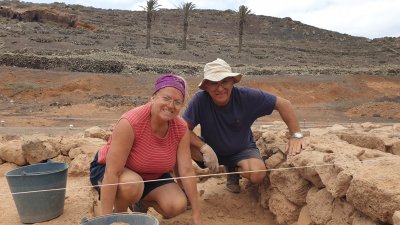
When the owner of the El Paso farm decided to remove part of the sand cover to transport the rubble to a nearby plot, he did not imagine that beneath those layers of gravel and volcanic sand there was an archaeological treasure.
Forty years of research after those maneuvers that demolished part of this historical construction, science has revealed that El Bebedero, an indigenous settlement near the town of Tiagua, has the largest hydraulic construction in the archipelago made by the indigenous Canary Islanders.
"El Bebedero has changed the way we see the oldest history of the Canary Islands," says Pablo Atoche, a professor of Prehistory at the University of Las Palmas de Gran Canaria (ULPGC) and director of the research carried out at this archaeological site in Teguise. This site, along with the nearby Buenavista site, is the oldest in Lanzarote.
A Cistern Unprecedented in Indigenous Canary Islands
The findings made after decades of work show that the indigenous population was "very technologically advanced" and "capable of exploiting the island's resources with their own technology," Atoche continues. This aboriginal cistern not only captured water but also decanted it in a paved area so that it came out clean.
Its use dates from the 1st century BC to after the 4th century AD. This construction, made by the Mahos, captured rainwater from all the hills north of El Bebedero and directed it towards the collection and decanting area, so that after being filtered, it ended up stored in the cistern.
"It was a kind of highly developed complex to take advantage of this probably scarce resource, not as scarce as now, but scarce," Atoche points out. The captured water was also directed to other areas of the site, such as the areas for treating animal skins with which the aborigines traded with merchants and Romans.
Atoche explains that the type of hydraulic construction at El Bebedero has nothing to do with the San Marcial well in Rubicón, which was a Roman-made vaulted cistern, and that there is nothing similar in the Canary Islands.
An Archaeological Depth of Almost Two Meters
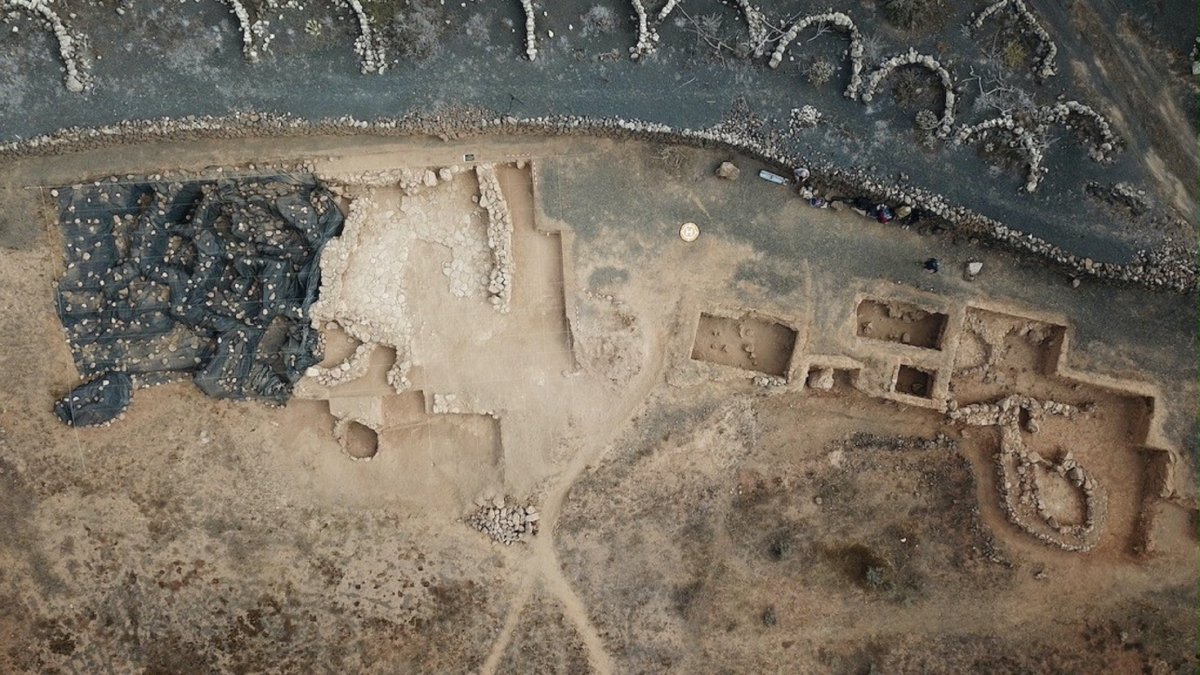
Already in 1985, with the approval of the family that owned the land, excavation work began in El Bebedero. Then, Atoche and the team of professionals who moved to the area discovered a "totally novel" element, and that is that this site had an archaeological depth of almost two meters. That finding gave them "the possibility of making a diachronic, temporal vision, from the present to the first moments of occupation," he recalls during a telephone interview.
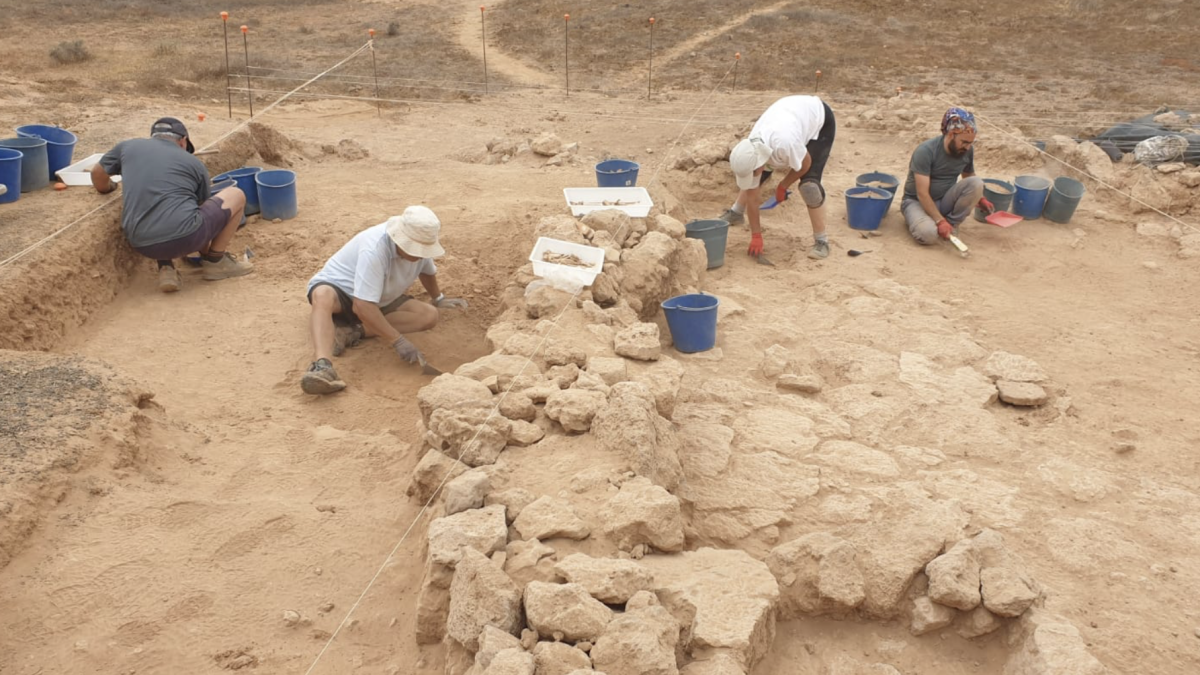
Furthermore, the sanding that was carried out on the land for the cultivation of tobacco and cereals during the forties of the last century managed to "fossilize" everything that was underneath and preserve it. As every summer, the excavation campaign carried out by the research group G9 History, Economy and Society of the University of Las Palmas, made up of historians, archaeologists, sociologists, economists and geographers, has lasted for four weeks of fieldwork to continue unraveling the secrets hidden under the rofe.
The investigations carried out to date have revealed that in El Bebedero about twenty to twenty-five people lived, who also engaged in the sacrifice of goats and sheep, and then traded the meat and skins. "They treated the skins at that site because typical tools have appeared," explains Pablo Atoche.
At the end of the 20th century, Pablo Atoche and the team of researchers he worked with discovered that the Mahos of Lanzarote traded with merchants and Romans. "They exchanged things that remained in El Bebedero such as amphorae, metals, bronze, iron, glass beads, etc.," he adds.
"Probably the population was dedicated to transforming products derived from domestic livestock to exchange them for products brought by those sailors, such as wine, oil, and that type of thing that did not exist on the island and which would probably be luxury items, highly appreciated by the local population," explains the person in charge of the research.
To date, researchers have dated using carbon-14, a compound that allows knowing the age of organic remains, that this space was occupied from the 1st century BC (also known as Before Christ) until at least the 13th century. However, this year they have taken samples from greater depths, among ceramics and bones, so they suspect that the dating may be even older than what has been proven so far. Even so, it will be the laboratory results that reveal the real situation.
In other areas of El Bebedero there were also "hearths, combustion structures, areas where people ate, lived and probably carried out more daily activities," he continues.
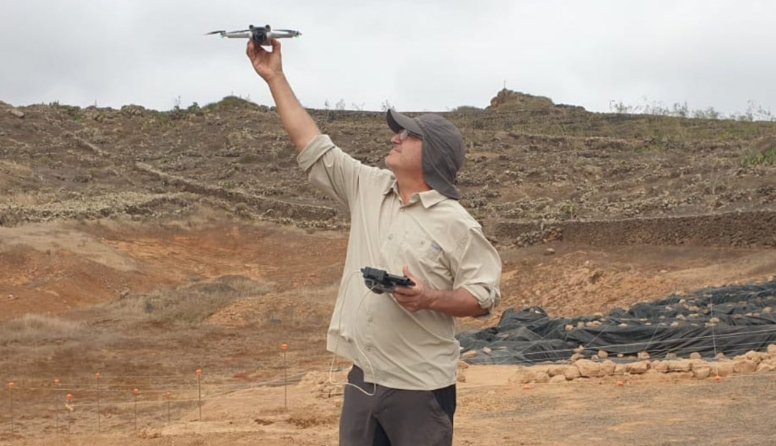
Although the researchers' initial forecasts indicated that the housing area was a small space, they have already found a structure with eight rooms and, using a ground-penetrating radar, they have discovered that there are more. "There is a large-scale and also very important site," states Atoche.
What an interpretation center could contribute to Lanzarote
Near El Bebedero is also the Cueva de Los Majos, and there are indications that there are more sites to explore. The Barreto family, owners of the land, has allowed researchers to delve into the site "without any restrictions" since 1985.
Although the El Bebedero archaeological site is a fundamental point of Canary aboriginal history, only the Teguise City Council finances the research work. On other occasions, they have also had state funding through R&D projects. However, they do not have financial support from the Cabildo de Lanzarote or the Government of the Canary Islands.
Furthermore, several cultural initiatives have been proposed for the El Bebedero site. For example, building an interpretation center dedicated to the archaeology and agrarian culture of Lanzarote on the farm itself. The acquisition of the land by public administrations to preserve this space has also been proposed.
"The infrastructure is practically created because there was already an important museum center," says Atocha, who is committed to turning this space into "one of the great museum centers" of Lanzarote.



Add La Voz de Lanzarote as a preferred Google source.
Stay informed with the latest current news.