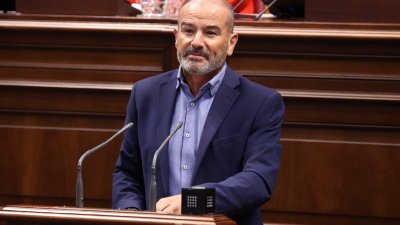
The spokesperson for Education of the Socialist Parliamentary Group, Marcos Hernández, defended this Wednesday 21 in the Plenary Session of the regional Chamber the Government of the Canary Islands, a Non-Binding Proposal (PNL), rejected by the political groups, to promote an integral plan for climate adaptation of the educational centers of the archipelago, with the objective of guaranteeing that students and teaching professionals can carry out their activity in adequate conditions of safety, health, and well-being.
Hernández warned that "heat can no longer be considered an exceptional circumstance and must be incorporated into the ordinary planning of educational infrastructures, and recalled that the summer of 2026 was the hottest recorded in Spain since at least 1869, and that high temperatures forced the suspension of in-person teaching activity on September 15 in all centers in Fuerteventura and in those of nine municipalities in Gran Canaria".
For the socialist deputy, "these episodes demonstrate the need to anticipate the effects of climate change and prevent the educational response from depending exclusively on meteorological alerts".
In this regard, he defended that, "although the suspension of classes may be necessary in extreme situations, a responsible public policy must also improve the structural conditions of the centers to reduce their vulnerability".
Only 120 out of 925 educational centers have environmental sensors
The spokesperson for Education acknowledged the actions undertaken by the Government of the Canary Islands, such as the Plan for the adaptation of educational centers to high temperatures, presented in 2024, and the Canary School Climate project, launched in 2026. However, he questioned the scope of these initiatives, since the 240 sensors installed in 120 centers are still far from covering a public network that has 925 educational centers.
Hernández called for the regional Executive to "take the leap" from pilot projects to a strategy for all of the Canary Islands, and pointed out that, although shade spaces have been created in numerous centers and actions for the naturalization of patios have been announced, these measures are "insufficient" if they are not part of an integral planning, with objective priorities and guaranteed funding.
The socialist initiative proposes to approve, within a maximum period of six months, a Canary Plan for Climate Adaptation, Thermal Comfort and Energy Efficiency of Educational Centers, of a pluriannual nature. The document must integrate existing actions and establish an individualized diagnosis of each center, a climate risk map, and a public intervention calendar detailing priorities, budgets, responsible parties, and execution deadlines.
The plan must consider, in addition to the installation of shade, improvements in insulation, solar protection, ventilation, air quality, efficient air conditioning systems when necessary, renewable energies, self-consumption, and the renaturalization of courtyards.
The PSOE also proposes a specific and pluriannual budgetary line that allows financing these actions and guarantees that the needs of the centers do not depend on the economic capacity of each municipality.
Hernández has paid special attention to nursery schools, special education centers, and those that enroll students with disabilities or special educational needs, as well as to buildings with the greatest deficiencies and thermal exposure. Likewise, he has called for the progressive replacement of provisional modular classrooms that remain for years with permanent educational facilities.
The proposal includes the participation of families, management teams, school councils, unions, and municipalities in the monitoring of the plan, in addition to annual reports to Parliament with data on investments, actions carried out, thermal incidents, and energy consumption evolution.
The socialist deputy has argued that climate adaptation constitutes a public responsibility linked to the right to education and health protection. "The quality of a public school cannot depend on the orientation of its classroom, the shade of its courtyard, or the capacity of its municipality to undertake construction work."
With this PNL, the Socialist Group calls on the Government of the Canary Islands to turn specific actions into a "structural, transparent, and evaluable policy, so that all children in the Archipelago can learn in adequate conditions and all educational professionals can carry out their work in dignified and healthy spaces."

Add La Voz de Lanzarote as a preferred Google source.
Stay informed with the latest current news.