The young Moroccan Abarrafía H., 20 years old, has spent 57 days in prison because his status as a newly arrived immigrant in a small boat made him a suspect of fleeing, while the story of an atrocious crime he did not commit was being built around him: that of having tried to burn a Canary Island minor alive after spraying her with flammable liquid.
The judge himself who sent him to prison on July 21 already had his doubts as to whether he had committed such acts -as he acknowledged in the pre-trial detention order-, but the reality is that only the recovery of the victim, hospitalized in Seville since then, has freed him from that accusation. Her testimony supports that both were trapped in an accidental fire and that he helped her escape.
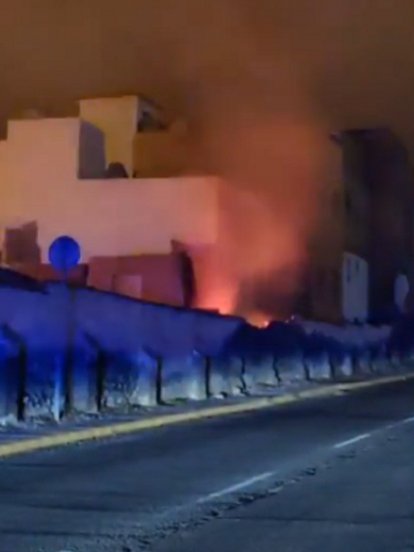
The case of the 17-year-old girl who suffered serious burns to 50 percent of her body in the early morning of July 16 in an occupied substandard housing in the La Isleta neighborhood, in Las Palmas de Gran Canaria, very close to one of the main first reception centers for migrants in the Canary Islands, has been one of the most shocking events of this summer in Spain. That is why its outcome has been so surprising once it has been possible to listen to its main protagonist: the minor.
This is a story in three acts of how it was possible for a fire that has been revealed to be fortuitous to be presented as an attempt by an irregular immigrant to murder a vulnerable Spanish teenager in an especially cruel way, who had run away from a juvenile center. All this, in a Spain shocked those days by the serious racist incidents that occurred in Torres Pacheco.
The substantial data on the fire and its background are collected in detail in the two orders issued to date by the Court of Violence against Children of Las Palmas de Gran Canaria: the prison order (July 21) and the release order (September 16).
First act: The context
At 3:53 in the morning of July 16, cameras record a man, first, and a woman, later, trying to leave a building from which smoke is coming out.
Eight minutes later, 112 receives the first alert call, but its author does not do it to ask for help: he wants to report that "that Moor" -Abarrafía H.- is in that house and that he is going to "burst" him. "Only at the end of the call, he mentions, dubiously, that 'there is a girl burned whole', explains the judge in his first order.
Second act: Was it him?
The minor was taken seriously to the ICU of the Doctor Negrín Hospital, from where days later she was referred to Seville, to the Virgen del Rocío Hospital, specialized in major burns.
Abarrafía H. was also hospitalized, but he had no burns, not even smoke poisoning. The Police arrested him as soon as he was discharged. Already then he claimed that everything had been an accident, that they were smoking and that they threw cigarette butts on the floor, which caused the garbage around them to burn, and with it, their mattress.
At that time, the burned minor has barely been able to articulate a few words, which turned against the young Moroccan. The judge refers to them in his first order when he asks to listen "to the ambulance personnel to whom the victim stated that it had been the investigated who had caused the burns by lighting, it is understood, the mattress with a paper."
Judge Tomás Martín records his doubts from the very prison order. First, he is wary of the witness who called 112, after verifying that he is involved in the persecution to which a group of young Spaniards subjected several Maghreb migrants five days earlier in La Isleta, who had to take refuge in the Police Station.
From the images of the videos he comes to the preliminary conclusion that it is "unlikely" that the minor left the burning building without help, closed with a wall and without practicable doors. "If she received assistance to leave, the only person who could have provided it was Abarrafía H.", he reasons.
He also appreciates that in the same recording of 112 Abarrafía H. is heard in the background saying "doctor, help."
But another doubt enters him: the hospital medical reports maintain that the minor has been burned with a flammable liquid, something that the Police rules out from the beginning.
In these circumstances, he decides to send the detainee to prison until the burned minor can testify. The legal reason on which he bases it is the risk of flight, something that he justifies in the condition of irregular immigrant without address or roots of Abarrafía H., who had arrived in Lanzarote in a small boat only a month and a half before.
Third act: the victim speaks, it was fortuitous
This Tuesday, Abarrafía H. has been released, after the judge received on video the testimony of the minor, interrogated by the Police in the hospital once she has recovered enough to testify about what happened that night.
The judge not only withdraws the prison measure against him, but also recognizes that there is no basis to accuse him of homicide or intentional injury (caused on purpose). He only prohibits him from leaving Gran Canaria, pending determination of whether or not he committed recklessness.
And all this, because the testimony of the minor shows that the fire broke out accidentally, in the same way that the detainee had related to the Police, and confirms that the young Moroccan had helped her out of the place where she had been trapped.
In addition, the instructor has received reports from the National Police and the Fire Department of Las Palmas de Gran Canaria that refute what the doctors who attended the minor had initially conjectured: the injuries may be serious and extensive, but there is no evidence that the affected person was sprayed with flammable liquids.
Abarrafía H. is free, but there is no shortage of those who continue to point him out these days as a "monster" and even as a murderer, despite the reasons expressed by the Court. In many cases, through the same accounts and profiles on social networks that tried to make La Isleta follow in the wake of Torre Pacheco.


Add La Voz de Lanzarote as a preferred Google source.
Stay informed with the latest current news.