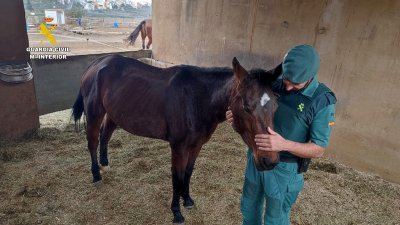
The Civil Guard of Gran Canaria investigated two people on October 22 for the alleged authorship of a crime against animals, after locating in some stables of the Lomo de La Herradura in the Tamaraceite neighborhood a horse whose life was in danger, as well as the remains of another deceased equine.
The investigation began as a result of the contribution of a series of data by citizen collaboration, in which the SEPRONA of the Las Palmas Command participated, regarding the existence of a horse that was in poor condition and the possible death of a second in a room located near the Hoya Andrea neighborhood of the municipality of Las Palmas de Gran Canaria.
SEPRONA agents went to the place, where the poor condition of a horse and the possible death of another were verified. Upon arrival, the agents confirmed the veracity of the facts and requested the intervention of a veterinary technician from the General Directorate of Livestock of the Government of the Canary Islands.
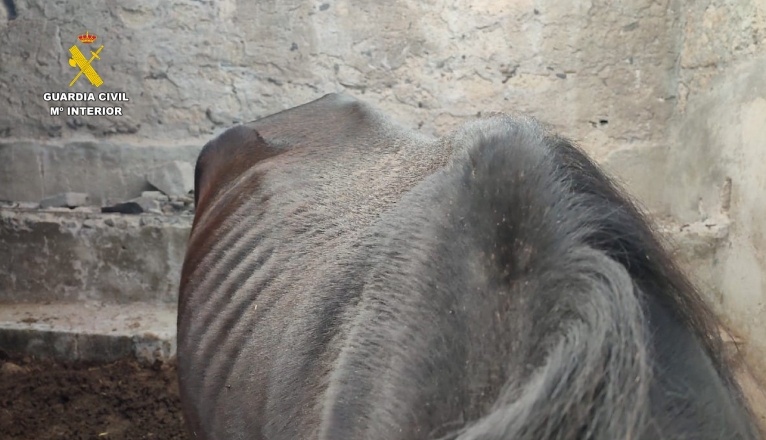
During the inspection, a brown mare was found in a state of extreme thinness, surrounded by excrement, without food and with only a little dirty water. In the course of the efforts to locate the owners, the mare was observed eating its own excrement, generating great concern among the acting agents.
The animal's managers were contacted, and one of them appeared at the scene, stating that a second white-haired mare had been given to an unknown person. In addition, they claimed that the mare in poor condition was recovering from an illness, although without veterinary supervision.
The lack of coherence in the statements of those responsible raised suspicions among the SEPRONA agents, so when insisting on the situation of the missing mare, it was revealed that she had died some time ago and that her remains had been buried in a nearby dunghill. The Civil Guard excavated in the indicated place where they found large bones and white hair, which were identified as compatible with those of an adult equine.
Given the seriousness of the situation, the decision was made to take precautionary action on the mare that was still alive, ensuring that she received treatment in a veterinary clinic. Veterinary reports and subsequent investigation led to the conclusion that the owners and caretakers of the horses could have committed a crime against animals, carrying out the corresponding police proceedings.
The current Penal Code, in its article 340 bis, establishes prison sentences of twelve to twenty-four months, as well as special disqualification of two to four years for the exercise of professions related to animals, for those who cause a domestic animal injury that requires veterinary treatment for the restoration of their health. In turn, when the death of the animal is caused on the occasion of the events, the penalties provided will be aggravated.



Add La Voz de Lanzarote as a preferred Google source.
Stay informed with the latest current news.