
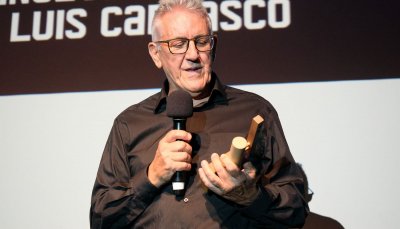
The Veintinueve Trece Photography and Visual Arts Encounter kicked off its tenth edition this Monday with an event held in the Buñuel hall at El Almacén, where the career of photojournalist José Luis Carraco was recognized.
This new edition of this event, which has obtained the highest score from the Ministry of Culture for photography competitions throughout Spain, is dedicated, as every year, to a counter-trend, in this case to the collective, as opposed to individualism.
Carrasco accepted the award from his grandchildren, Roque and Kalea, and explained "how your life can change depending on where you are or who you meet." He arrived on the island in the eighties, but when he lived in Madrid and worked as a waiter, he used to go to the EFE Agency headquarters, where another waiter friend worked. "I liked going there, to keep him company and see the comings and goings of photographers, journalists, people entering the cafeteria with their cameras, and that atmosphere," he explained
He never imagined that years later, in Lanzarote, where he began collaborating with the magazine Pronósticos because he knew how to develop black and white film, he would end up collaborating for that agency, in addition to working for Lancelot, Canarias 7, and La Voz de Lanzarote for forty years. He dedicated the award "to all his press colleagues." "It has undoubtedly been the best job in the world," said Carrasco, who is now retired.
The event continued with the screening of an audiovisual piece, created expressly for this edition, titled ‘Cosecha’ (Harvest), by filmmaker Nayra Sanz Fuentes, which deals with collectives dedicated to accessing data farms to make them available to the public. “We have a very big responsibility to ensure this is a tool that helps us and doesn't become a kind of new tormenting deity,” she stated.
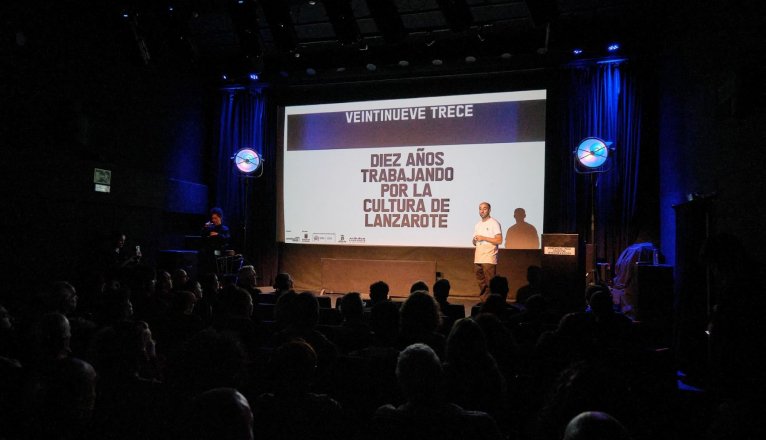
Ten years for culture in Lanzarote
The director of the event, Nico Melián, recalled that the first edition started with only five collaborators and in these ten years more than two hundred people have already collaborated. He said that culture "is not a subsidized good" but rather "an essential need and it also generates employment".
"Our idea was that Lanzarote deserved a space to think about its image and talk about its people, its territory, and the way we live and tell the story of the island," he pointed out. "We are reaching people who are genuinely interested in the island for its context, its importance, its culture, its roots."He highlighted that the culture of everyday life "allows us to recognize and protect our heritage, defend the territory, and look at each other with great empathy" and pointed out that culture should serve as a refuge and as a space for encounter, consciousness, and collective imagination. "Culture does not have to engage in partisan politics, but it does have to engage in social politics," he added.
This edition thus becomes a small tribute to the people who work collectively, "those who care for, accompany, create, and sustain Lanzarote every day," who belong to some type of association and perform that intermediary role between the administration and civil society. "This edition is an invitation to continue thinking together, to continue building community, creating and constructing a collective vision of who we are and where we want to go," he concluded.
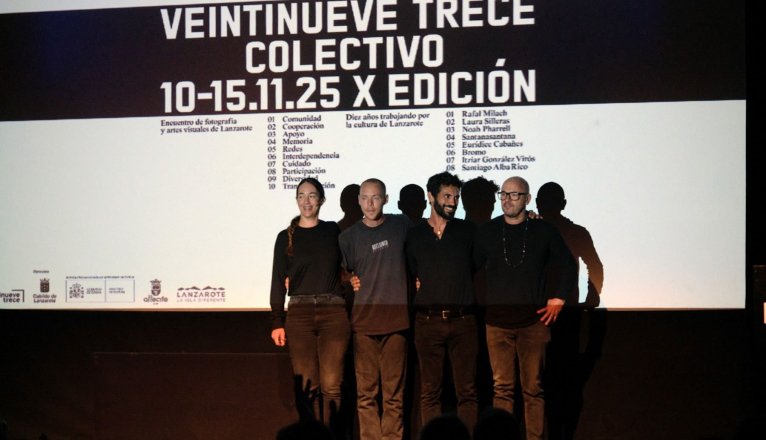
Collective manifesto
The event concluded with the reading of a 'Collective Manifesto' by Tharais Armas, within an artistic piece directed by Esteban Cedrés, with Alexis Lemes on the timple and the dance of Javier Ferrer. The manifesto claims collective organization as the basis for public policies, the "right to meet, to disagree and imagine, to build," and plurality as a form of common intelligence.


