
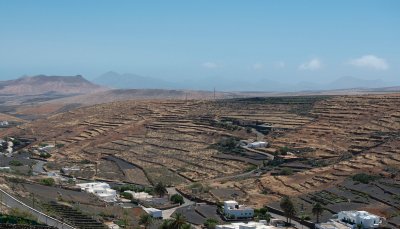
The César Manrique Foundation (FCM) will host **this Thursday, October 9, at 7:30 p.m.**, the conference entitled *Terraced Landscapes: Living Heritage and Future Challenges*, given by Lidia Romero, a geographer specialized in cultural landscapes. The event will take place in the José Saramago room (La Plazuela, Arrecife) and will be broadcast live through the FCM website and YouTube channel. Romero's conference will be about some **unique landscapes** that, although they are part of our history and culture, often go unnoticed: **agricultural cultural landscapes on terraces**. These are stepped terraces located in mountainous areas, especially on islands such as those of the Macaronesian archipelagos, and which, for centuries, were essential for cultivating in difficult terrain.
However, today they have lost the value they once had and, in many cases, have fallen into oblivion. An illustrative example is the name of a Ribeira Sacra wine made with Mencía grapes—typical of the northwest of the Iberian Peninsula—called Bancales Olvidados (Forgotten Terraces).
In the speaker's opinion, recovering this type of landscape is not only a matter of memory, but also of the future. To understand them well, we must look at them from different angles: as spaces with history, as agricultural systems, and as part of our natural and social environment. They are complex and diverse landscapes that can play a key role in land management and in the fight against current challenges such as climate change or the loss of territorial identity.
Lidia Romero's speech is included in the FCM's Archipiélago Forum. This forum is intended to reflect on the culture, science, and environment of the Canary Islands through researchers, intellectuals, and creators who carry out their work on the islands, and has already included the presence of Juan José Falcón Sanabria, Telesforo Bravo, Francisco Sánchez, Joaquín Sabaté Bel, Juan José Armas Marcelo, Nilo Palenzuela, Roque Calero, Alfredo Herrera Piqué, Alexis Ravelo, and Selena Millares, among others.
Lidia Esther Romero Martín is a geographer and professor in the Degree in Geography and Land Management, in the Master's Degree in Historical, Cultural, and Natural Heritage, and in the Special Training Program of Diploma in Canarian Studies; degrees from the University of Las Palmas de Gran Canaria (ULPGC). She is also part of the research team of Geography, Environment, and Geographic Information Technologies of the ULPGC, where she is responsible for the line of research dedicated to cultural landscapes—especially those configured by terraces on islands—and their role in the current scenario of global change. She is also a member of the International Terrace Landscapes Alliance and has participated in several international conferences on the subject.
She has been the principal investigator (PI) in European projects related to the recovery of terraced landscapes and on the role of agricultural terraces in relation to natural hazards. She is currently working as a researcher in a national project on adaptation to crises in inland tourist destinations (La Gomera and inland Gran Canaria). She has published several scientific articles on cultural landscapes on terraces, their multifunctionality and ecosystem services, as well as their quality for conservation, priority, and viability for restoration. In 2018, she received the Viera y Clavijo Prize for Humanities with the research work entitled Analysis of agricultural abandonment and its application to the conservation of the terraced heritage: Guiniguada Basin.


